

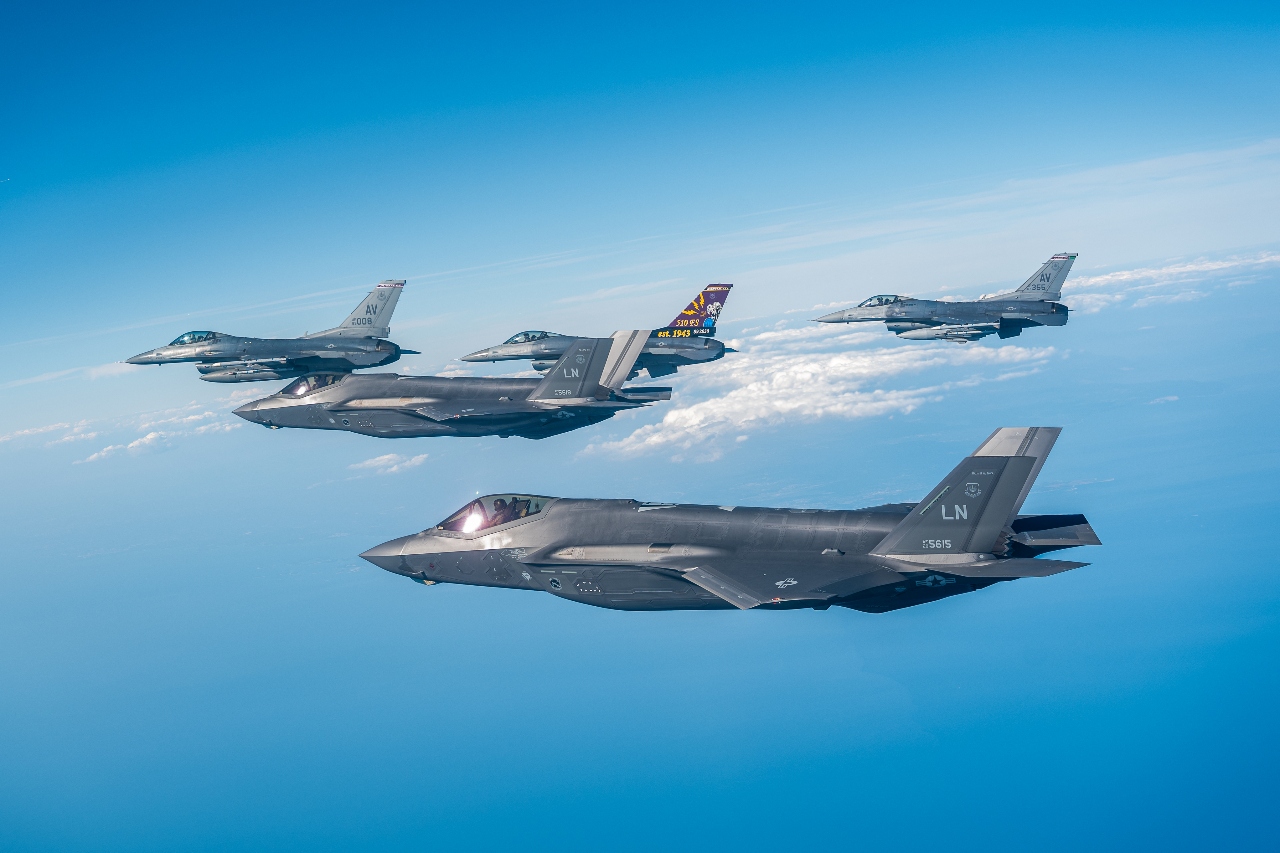
Key Points and Summary – A decade after entering service, the controversial F-35 Lightning II is undergoing a massive modernization effort known as the Block 4 upgrade.
-This is all made possible by Technology Refresh 3 (TR-3), which installs a new core processor with a staggering 25 times more computing power, essential for advanced AI capabilities.
-The Block 4 program includes 75 enhancements that will dramatically improve the F-35’s sensors, allow it to carry more and different weapons, and boost its network interoperability, turning it into what one official calls the “ultimate game-changer” on the battlefield.
The Big F-35 Upgrade Has Begun
The F-35 Lightning II first attained initial operational capability (IOC) just over 10 years ago; more specifically, it was the US Marine Corps’ F-35B variant that did so in July 2015. In the process the F-35 became the second-ever 5th-generation stealth fighter jet to achieve operational status, following in the footsteps of the F-22 Raptor, thus giving a double dose of bragging rights not only to the country of original, i.e., the United States of America, but to the two warbirds’ manufacturer, Lockheed Martin’s legendary Skunk Works division.
In that past decade, the Lightning II has generated quite a bit of controversy, thanks in no small part to its hefty price tag. These expenses naturally generate the question of what sort of bang the US taxpayers are getting for their bucks. Well, as it turns out (and as is also true of the F-22), the oh-so-controversial F-35 is undergoing continuous improvements and upgrades.
F-35 BLOCK 4 MODERNIZATION PROGRAM
There are no fewer than 75 new programs being incorporated into the F-35 modernization effort, which is collectively being designated as Block 4. In turn, those 75 programs are being divided into three main areas of consideration.
In a 16 June 2025 article for National Defense Magazine, Allyson Park quotes some statements from J.R. McDonald, Lockheed Martin’s vice president of business development for the F-35 program, delivered during a media briefing at the Paris Air Show: “Number one, all of the sensors [are] being improved dramatically. Number two, the ability to carry more and different types of weapons. And number three, and I think this will become the ultimate game-changer, is the additional interoperability features that will allow us to communicate across the domains and be that central node in the battlespace,”
TECHNOLOGY REFRESH 3
In turn, Block 4 is being facilitated by Technology Refresh 3 (TR-3), which includes open mission systems architecture, a new integrated core processor with greater computing power, an enhanced panoramic cockpit display, a larger memory unit, and other classified capabilities. Regarding the integrated core processor in particular, it will have a whopping 25 times the computing power of the Technology Refresh 2 model, mainly due to the fact that the previous core processor was insufficient for advanced AI capabilities.
ONE SENIOR US AIR FORCE OFFICER’S PERSPECTIVES
During testimony before the Tactical Air and Land Forces Subcommittee of the House Armed Services Committee, Lt. Gen. Michael J. Schmidt, Program Executive Officer of the USAF’s F-35 program, posited that “Block 4 upgrades add new and enhanced capabilities to ensure our platform remains relevant against rapidly evolving threats. Much like a new mobile cell phone or personal computer, TR-3 will host new Block 4 capabilities and applications with significantly more computing power and memory than the legacy infrastructure.”
THE WAY FORWARD FOR THE F-35
Despite these improvements—and in spite of the proven effectiveness of the plane in real-world combat—the F-35 continues to attract detractors and naysayers like moths to a flame. Among these detractors has been no less than Elon Musk. Mr. Musk has derided the jet as a “jack of all trades, master of none” because it was “required to be too many things to too many people,” the result of a “broken” requirements system, and the “worst military value for money in history.”
Luckily for Lockheed Martin and the advocates of the F-35 program, Mr. Musk no longer heads the Department of Government Efficiency (DOGE). What’s more, the 6th Generation B-47 Next Generation Air Dominance (NGAD) program still in its infancy, and with the very real possibility of a war with the People’s Republic of China breaking out before NGAD goes operational, the F-35 is still going to be needed by the US and its allies in the Indo-Pacific region to counter the PRC’s stealth fighters, namely the Chengdu J-20 and the Shenyang J-35.
Not to mention the ability of America’s NATO allies to be on equal footing with Russia’s Sukhoi Su-57 “Felon” stealth fighters in case Vladimir Putin were to initiate World War III on the European continent. Indeed, this past March and May, respectively, the Skunk Works division personnel conducted successful interoperability exercises with Dutch and Danish F-35s.
Ergo, love it or hate it, the F-35 ain’t going away anytime soon.
About the Author: Christian D. Orr, Defense Expert
Christian D. Orr is a Senior Defense Editor. He is a former Air Force Security Forces officer, Federal law enforcement officer, and private military contractor (with assignments worked in Iraq, the United Arab Emirates, Kosovo, Japan, Germany, and the Pentagon). Chris holds a B.A. in International Relations from the University of Southern California (USC) and an M.A. in Intelligence Studies (concentration in Terrorism Studies) from American Military University (AMU).
Military Affairs
China’s Stealth Air Force Has 1 Mission


