

Key Points and Summary – With Russia’s imperial ambitions checked by a resurgent U.S.-led alliance, the West must now implement a new “Containment 2.0” strategy to ensure long-term peace in Europe.
-This comprehensive plan extends from Finland to the Black Sea, leveraging new NATO members to turn the Baltic into a “NATO Lake,” hardening Poland’s “Eastern Shield” with Abrams tanks, and crucially, providing Ukraine with dominant airpower to deter future invasions.
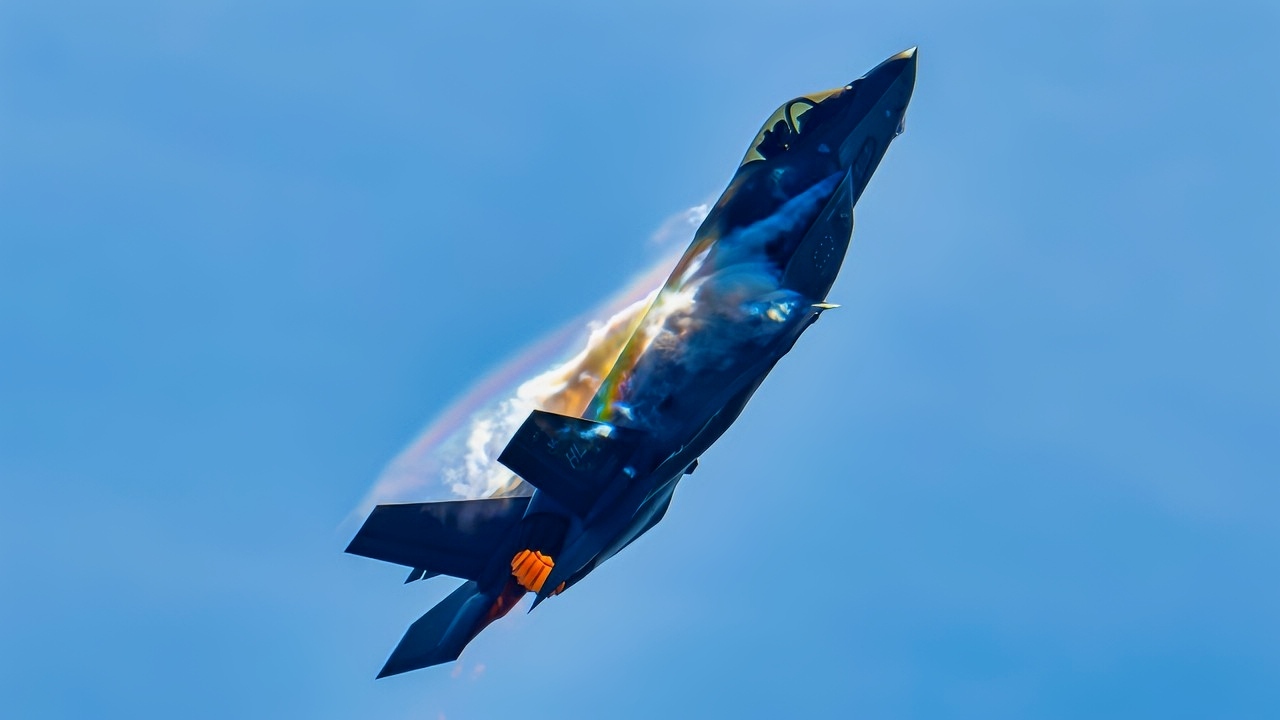
-The strategy is ultimately backstopped by U.S. naval power and extended nuclear deterrence, with the F-35 now certified to carry tactical nuclear weapons.
Containment Against Russia: An Old Idea Makes a Comeback
Vladimir Putin’s ambitions to restore Imperial Russia are over. In Alaska, Putin had to walk a cordon of F-22s at Joint Base Elmendorf-Richardson, a vivid reminder that his team lost the Cold War.
Then Monday’s meeting at the White House witnessed the embrace of Ukraine’s future security by Europe’s top power players and by the USA. As Putin knows, other key nations like Poland are already fully committed to containing Russia. G7 members Japan and Canada are also ready to provide support.
This support is the 100% restoration of American global leadership.
Of course, the big concern is that Russia is rearming and remains a serious threat to Europe. The idea of giving up territory like the fortified city of Kramatorsk—which never fell to Russia—is heartbreaking. It’s also a significant tactical problem. If it happens as part of a peace deal, relinquishing the city could increase the risk of a future breakout invasion by Russia.
This time, security guarantees must look nothing like the hollow Budapest Accords. Ukraine’s defense will be based on a mutual security guarantee akin to NATO’s Article 5, and coordinated as part of the overall long-term containment of Russia. “What is totally clear is that all of Europe should be involved. This isn’t just about Ukraine’s territory, it’s about the political order of Europe and there, Germany has a major interest and a major responsibility,” German Chancellor Friedrich Merz told DW on August 19.
Yes, containment. Air defenses and airpower, in the form of F-35s and other air sovereignty fighters, can play a bigger role. If Putin tries to roll tanks out from the Donbass in 2027, airpower must be ready to help Ukraine’s armies stop them.
What Containment Could Look Like
Here’s how to apply containment, from Finland to the Black Sea.
Finland:
President Alexander Stubb of Finland pointed out that his country has an 800-mile border with Russia. In May, the Finnish Defense Forces told AFP that Russia was “building more infrastructure to be able to bring in more troops after the war” in Ukraine ended.
Fortunately, the dense forests, deep ammunition reserves, and constant training of Finnish military forces would make an invasion exceedingly difficult. NATO membership significantly increased deterrence, and Finland has a first-rate air force to control terrain as well as airspace.
The Baltic Sea:
When Sweden and Finland joined NATO, the Baltic Sea became “NATO’s Lake,” says the alliance. This defence includes protecting cable and other Critical Undersea Infrastructure, as well as the potential to track and bottle up Russia’s shadow fleet of off-the-books oil tankers.
On August 17, the aircraft carrier USS Gerald R. Ford transited the Strait of Dover en route to the North Sea, a fitting reminder that naval airpower is part of containment, too. =
Poland’s Eastern Shield:
Neutralizing the Russian enclave of Kaliningrad and defending the Baltics depends on Poland, which has replaced Germany as the eastern battle front. “Right here, in Lithuania, where we are taking the defense of NATO’s eastern flank into our own hands,” Merz said on a May 30 visit to embed German troops with the 45th Armored Brigade in Lithuania.
Defense of the region hinges on thwarting any Russian lightning drives with US Abrams tanks, both American and Polish. Poland is preparing for war with Russia and fortifying about 435 miles of its border with Belarus under the East Shield initiative. Last year, Poland opened a tank repair facility in Poznań to provide support for both Poland’s upcoming Abrams main battle tanks and the US tank fleets in the region.
Containment in the Donbass:
Airpower is the answer to support Ukraine’s battle-hardened army for the long haul. Western political restrictions kept offensive airpower off the table, resulting in a ground war lock by late 2022.
For lasting deterrence in Ukraine, airpower must resume its dominating role in combined arms, and not just with drones. Drones can be effective against tanks. Attack fighters, however, are devastating to maneuver forces.
The US Army Air Forces’ P-47s and other fighters chewed up vehicles from Rommel’s panzer divisions behind the Normandy beachheads in 1944. NATO’s Cold War strategy was based on air attacks behind the Iron Curtain and battlefield echelons.
The 1991 Gulf War took precision “tank plinking” by F-111s to new heights. Coalition airpower in Syria proved out a whole new array of weaponry against moving vehicles. No matter how the lines are drawn, Ukraine must have airpower on tap to counter any future Russian invasion—and thereby deter it.
Crimea:
Unjust as it is for Russia to keep the land taken in 2014, Crimea does not play the strategic role it once did. Ukraine’s naval activity—with help from the US and NATO—has given Ukraine effective control of the Black Sea. Ukraine’s Neptune missiles sank the Russian Navy’s cruiser Moskva on April 14, 2022. The Moskva was the flagship of the Black Sea Fleet; continued attacks on shipping in the port of Sebastopol compelled Russia to move its Black Sea fleet to Novorossiysk.
Since then, uncrewed surface vessels operated by Ukraine, along with Storm Shadow and even ATACMs missiles, have given Ukraine the upper hand. A Ukrainian Magura 5 sea drone used a US-modified “FrankenSAM” air defense system to shoot down a Russian Mi-8 helicopter in December 2024. Crimea is scenic and has tourist beaches, but it’s not the naval asset it was in 2014.
Extended Nuclear Deterrence:
It’s best if Putin is reminded, officially or unofficially, that the ultimate backstop for deterrence in Europe consists of US tactical nuclear weapons. The F-35 gained formal certification to carry the B61-12 nuclear bomb on October 12, 2023.
The US Air Force is believed to store about 100 nuclear bombs at locations which may include Belgium, Germany, Italy, the Netherlands, and Turkey, which have in the past shared the mission with an array of nuclear-certified aircraft.
Plenty of European partners fly the F-35, and its formidable sensor and strike roles should nail down containment.
About the Author: Dr. Rebecca Grant, Lexington Institute
Dr. Rebecca Grant, a Vice President at the Lexington Institute, is a national security analyst based in Washington, DC specializing in defense and aerospace research and national security consulting. She has over 20 years experience working with the United States Air Force, United States Navy, and top aerospace clients. In addition, Dr. Grant has often appeared on television as an expert on national security for Fox News, Fox Business, CNN, and MSNBC and as a series regular on The Smithsonian’s Air Warriors. Dr. Grant also writes on China, Russia and other technology and national security topics for Fox News Opinion. Her military books include 75 Great Airmen (with Lt. Gen. Chris Miller), The B-2 Goes to War, and Battle-Tested: Aircraft Carriers in Afghanistan and Iraq. Dr. Grant graduated from Wellesley College and earned a PhD in International Relations from the London School of Economics, University of London. You can follow her on X: @Rebeccagrantdc.
Military Affairs
China’s Stealth Air Force Has 1 Mission


bish-bish
August 20, 2025 at 12:41 pm
Writers shouldn’t be armchair warriors who completely fail to acknowledge admiral rob bauer’s frank admission that russia isn’t viewed within deep circles as your average taliban (sandal-wearing goat herder).
Russia is a full-fledged nuke power, with possession of status-6 which is also known as poseidon.
And currently about to test the burevestnik, a nuke with a flying range of 20,000 km.
It is a weapin that destroys you if it hits you, and If you hit it, it destroys you all the same.
So, What’s with the post midday lunchtime-dream of coralling russia with f-35s, aircraft known to have various maintenance issues.
Better to employ unmanned drones.