

The Yakovlev Yak-141 was the world’s first supersonic VTOL aircraft. The Soviet Union built four prototypes between 1987 and 1991. It was designed to replace the Yak-38 as a carrier-based fleet defense fighter. Top speed: Mach 1.7. In October 1991, after a hard landing fire and the collapse of Soviet funding, the program was cancelled. Within weeks, Lockheed Martin signed a partnership agreement with Yakovlev to fund continued Yak-141 prototype flights and acquire design data. Lockheed only publicly revealed the agreement in 1994. The F-35B’s three-bearing swivel nozzle — the engineering core of its vertical takeoff and landing capability — uses an approach derived directly from Yak-141 research. Thus, the F-35B has some real Russian ‘DNA’.
The F-35B Has Soviet YAK-141 Tech

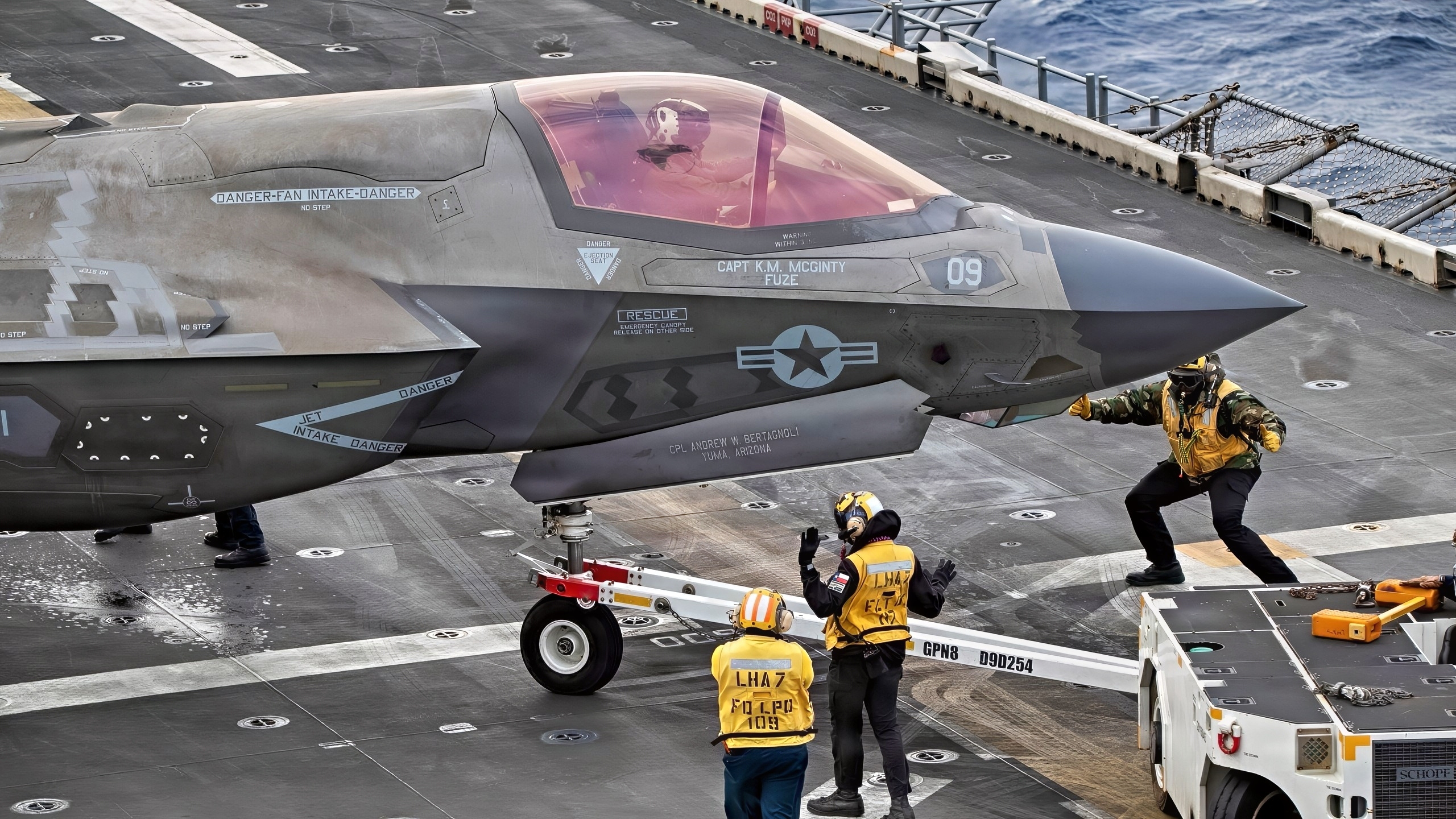
An F-35B Lightning II with Marine Fighter Attack Squadron 121, 3rd Marine Aircraft Wing out of Marine Corps Air Station Yuma, Ariz., stopped at Joint Base Elmendorf-Richardson, Alaska, en route to Marine Corps Air Station Iwakuni, Japan, Jan. 12, 2017.

NAS PATUXENT RIVER, Md. — An F-35 Lightning II test pilot conducts flight test Sept. 10 to certify the carrier variant of the fighter aircraft for carrying the AGM-158C Long-Range Anti-Ship Missile (LRASM). As part of ongoing integration efforts, the Pax River F-35 Integrated Test Force (Pax ITF) team flew two days of test flights to evaluate flutter, loads, and flying qualities with two AGM-158 loaded on external stations. LRASM is a defined near-term solution for the Offensive Anti-Surface Warfare (OASuW) air-launch capability gap that will provide flexible, long-range, advanced, anti-surface capability against high-threat maritime targets. The Pax River ITF’s mission is to effectively plan, coordinate, and conduct safe, secure, and efficient flight test for F-35B and C variants, and provide necessary and timely data to support program verification / certification and fleet operational requirements.
The Yakovlev Yak-141 supersonic VTOL program was officially canceled in 1991–1992 following the collapse of the Soviet Union, economic crises, funding shortages, and a serious accident involving a prototype.
Though promising, the program never entered mass production, resulting in only four test aircraft.
In an interesting footnote to the story, it was revealed that the Yak-141 and the F-35B Lightning II share a distinct silhouette due to a shared approach to supersonic Vertical Take-Off and Landing (VTOL) technology, with Lockheed Martin having studied Yak-141 technical data in the 1990s.
While the Yak-141 pioneered this technology in the 1980s, the F-35 is not a direct copy, but rather benefits from research into the Soviet-era Three-bearing swivel nozzle.
Background On The Yak-141
The Soviets developed the Yak-141, sometimes known as the Yak-41, during the 1980s. The aircraft was originally intended as a replacement for the Yak-38; it was designed as a supersonic fleet defense fighter capable of STOVL/VTOL operating from Soviet aircraft carriers.
It had three engines: one lift-cruise R-79V-300 Tumansky with a thrust of 1,500kg and two small RD-41s with a thrust of 4,100kg each.
The powerplant enabled the plane to lift off vertically, carrying up to 15,800kg. Alternatively, the Yak-141 could perform short take-offs (60-120m) with a weight of up to 19,500kg.
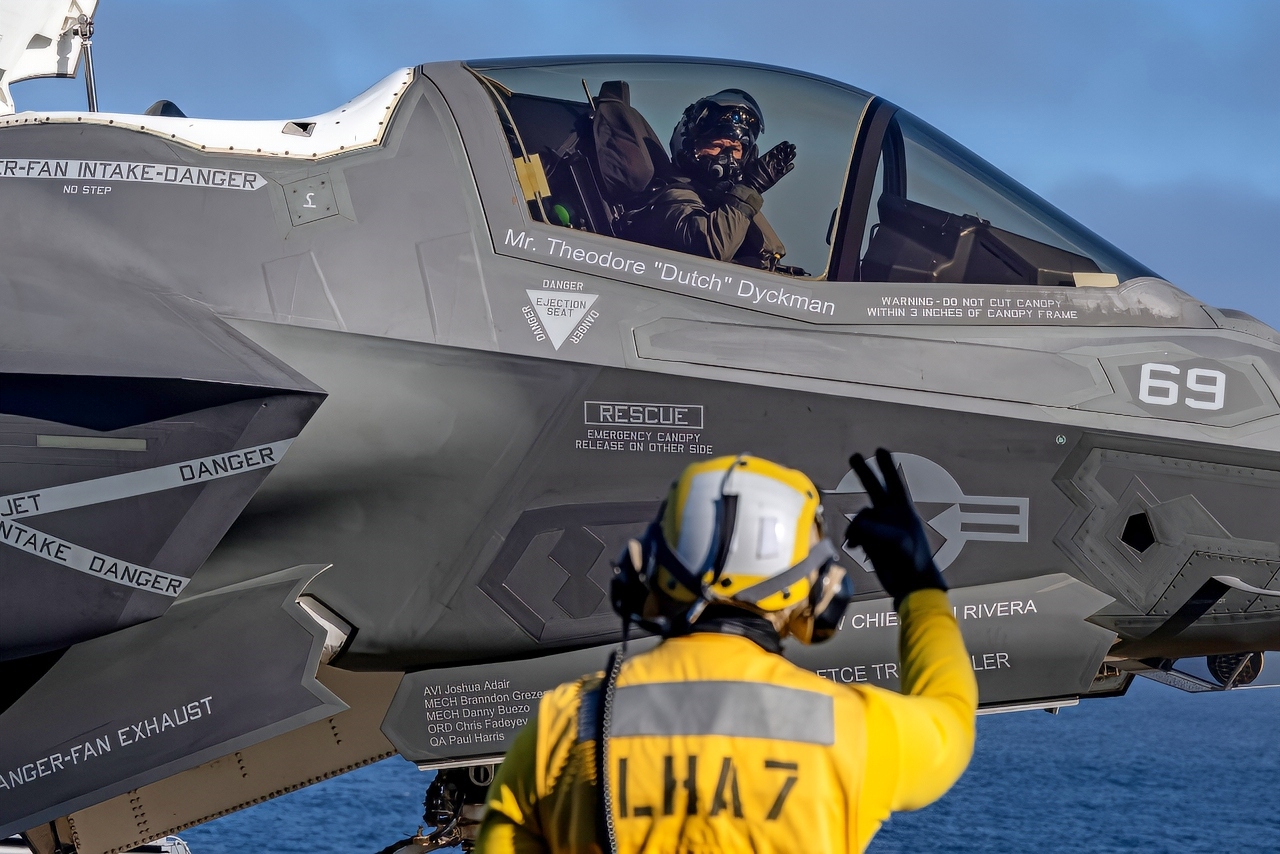
A joint team consisting of F-35 Patuxent River Integrated Test Force flight test members, U.S. Sailors and Marines, and the crew of the Japan Maritime Self-Defense Force Izumo-class multi-functional destroyer JS Kaga (DDH-184) are executing developmental sea trials in the eastern Pacific Ocean to gather the necessary data to certify F-35B Lightning II short takeoff and vertical landing aircraft operations. While aboard the MSDF’s largest ship, the Pax ITF flight test team has been gathering compatibility data for analysis in order to make recommendations for future F-35B operational envelopes, further enhancing the Japanese navy’s capabilities. The results of the testing will contribute to improved interoperability between Japan and the United States, strengthening the deterrence and response capabilities of the Japan-U.S. alliance and contributing to peace and stability in the Indo-Pacific region. Japan is an F-35 Joint Program Office foreign military sales customer planning to purchase 42 F-35Bs. The F-35 Joint Program Office continues to develop, produce, and sustain the F-35 Air System to fulfill its mandate to deliver a capable, available, and affordable air system with fifth-generation capabilities.
The aircraft first flew in March 1987, then had its first hovering flight in late December 1989, and its first transition flight from hovering to horizontal in June 1990. It had a top speed of Mach 1.7, making it the first supersonic VTOL aircraft.
In 1991, eight flights were conducted from a Russian aircraft carrier before a hard landing in October, which resulted in a fuel tank rupture and a fire. In late October, the project was canceled due to insufficient funding.
The Yak-38, from which the aircraft was based, burned an inordinate amount of fuel during vertical takeoff, resulting in a range of only about 200 miles.
Partnership With Lockheed Martin
Later in 1991, after the fall of the Soviet Union and the subsequent cancellation of the Yak-141, Lockheed Martin entered into a partnership with Yakolev.
Task and Purpose posted an article stating, “The two companies allegedly signed an agreement in 1991; however, Lockheed Martin didn’t reveal it until 1994, which outlined funding for additional Yak-141 prototypes, including a plan to fly the remaining operational prototype at the Farnborough Airshow in September 1992.”
In 1993, NASA published an article on Yakolev’s VSTOL technology, which stated, “Military hardware that had once been highly classified and the basis for our own defense planning was now openly marketed at airshows around the world…This environment permitted a visit to the Yakovlev Design Bureau (YAK) for a vertical/short takeoff and landing (VSTOL) technology assessment. Yakovlev is the FSU’s sole Design Bureau with experience in VSTOL aircraft and has developed two flying examples, the YAK-38 ‘FORGER’ and YAK-141 ‘FREESTYLE’.”
Did the US and Lockheed Martin benefit from the Soviets’ efforts with the Yak-141? No doubt. When the finished engine for the Joint Strike Fighter Program, which became the F-35B, was quite different from the original design.
T&P added, “Indeed, the VTOL design was changed to ‘ASTOVL Configuration 141’; while it is possible that this name was a coincidence, it’s worth noting for the possible reference to the Yak-141.”
The F-35B Design Was Different From The Yak-141
The Yak-141 and F-35B share a similar three-bearing swivel-nozzle propulsion concept for vertical takeoff and landing (VTOL), partly because Lockheed Martin partnered with Yakovlev in the 1990s to gain test data.
However, the F-35B’s design was fundamentally different. The Yak-141 uses a single rear-vectoring engine, combined with two dedicated lift jets located behind the cockpit, which are dead weight during horizontal flight.
In contrast, the F-35B uses a single engine with a shaft-driven LiftFan behind the cockpit, providing superior efficiency and lift.
The F-35B was designed for low-observable (stealth) capabilities, featuring internal weapons bays and radar-absorbent materials. The Yak-141 is a traditional, non-stealth aircraft designed in the 1980s.
The F-35B is a 5th-generation platform with highly sophisticated sensors, data fusion, and networking, designed for multi-role combat. The Yak-141 was intended as a point-defense interceptor with basic 1980s-era Soviet avionics.
While it did benefit from Yakolev’s swivel-nozzle propulsion concept, calling it a Soviet/Russian-based design is probably more typical Russian propaganda than anything else.
The Yak-141 was never entered into production, and despite its promising beginnings, it was far from a finished product. Although part of that probably had to do with Russian aircraft carriers being terrible.
About the Author: Steve Balestrieri
Steve Balestrieri is a National Security Columnist. He served as a US Army Special Forces NCO and Warrant Officer. In addition to writing on defense, he covers the NFL for PatsFans.com and is a member of the Pro Football Writers of America (PFWA). His work was regularly featured in many military publications.


Mike Millet
May 12, 2026 at 12:35 am
Using AI to write your articles and repeate the few sparse facts over and over again to maximize ad exposure is a really annoying way to create an article.
Next time I read one of your articles like this, I’m blocking the site.
Scotty h
May 12, 2026 at 1:53 pm
The Hawker Harrier was the first vertical take off aircraft entered service 1969 I think.
So Yak & Lockheed Martin were well behind the times.
Joseph S.
May 12, 2026 at 9:56 pm
The Author might want to look at the Convair Model 200 aircraft proposal to the US Navy @ 1973, as well as the US patent for the swiveling engine design. The origins of the swiveling engine is based on Convair’S idea. Lockhead mostly paid for the Russian aircraft company for engineering data of their swiveling design to help speed up the F-35 project.
Filip
May 14, 2026 at 12:31 am
The three bearing swivel nozzle was designed by Convair decades before the Yak. In fact it was the Russians copying Convair.