

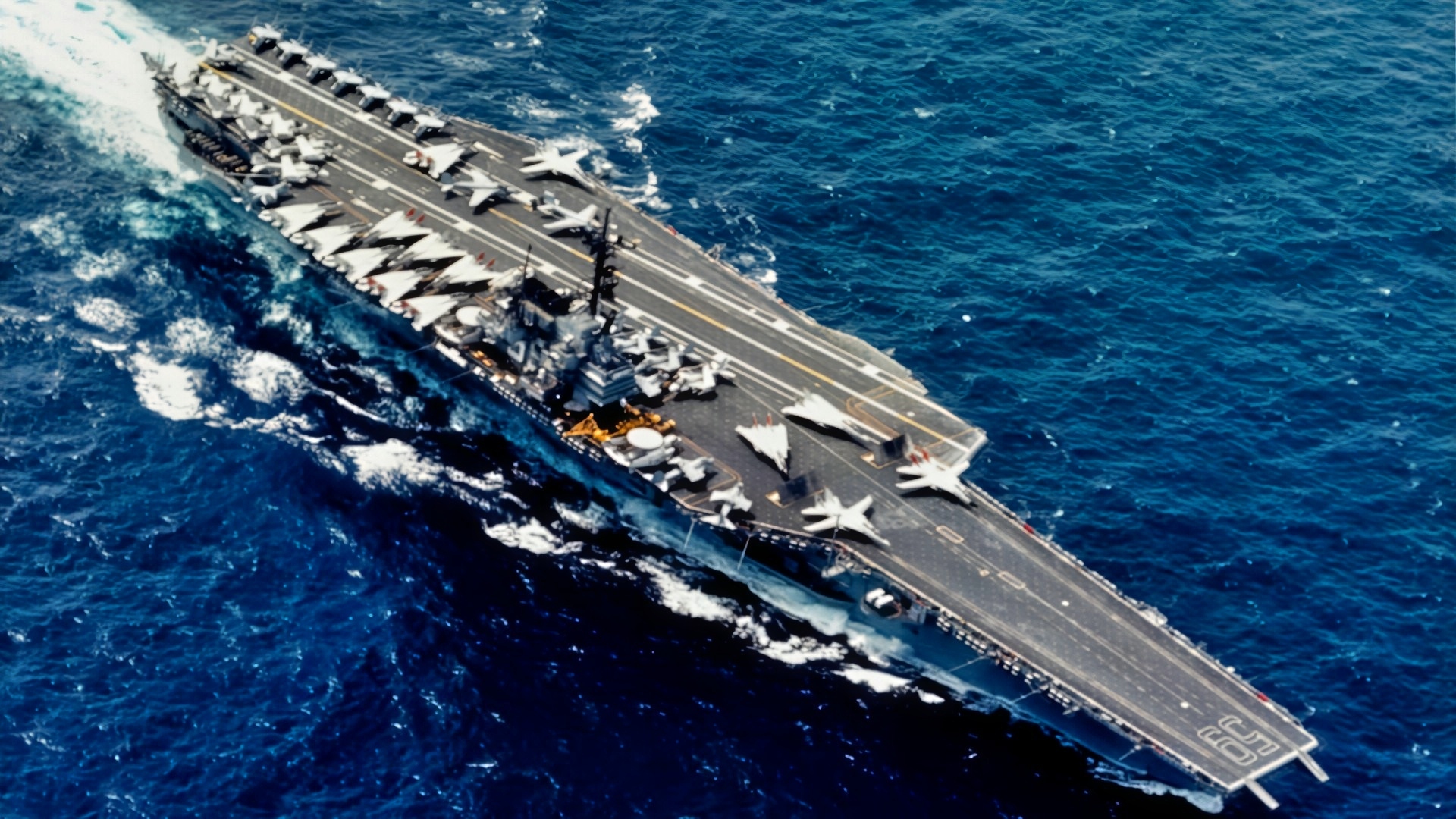
Key Points and Summary – The Forrestal-class—Forrestal, Saratoga, Ranger, and Independence—were America’s first true jet-era supercarriers, conceived to launch heavy strike aircraft and high-performance fighters at sustained tempo across global crises.
-Born in the early Cold War’s harsh arithmetic, they combined steam catapults, angled decks, deck-edge elevators, deep magazines, and generous fuel capacity into a coherent flight-deck system.
-Though conventionally powered, they delivered global reach through underway replenishment and decades of deployments, from the Mediterranean to Vietnam, the Gulf, and post-Cold War policing.
-The class endured serious mishaps—most notably the 1967 Forrestal fire—that transformed safety across the fleet.
-Retired in the 1990s, they left the blueprint followed by every American supercarrier since.
Forrestal-Class Aircraft Carriers: The Conventional Supercarriers That Changed The Game
The jet age didn’t simply ask for bigger decks; it demanded a different kind of carrier. Late-1940s and early-1950s naval aviation was shifting from compact piston aircraft to larger, heavier jets that landed faster, took off longer, burned more fuel, and carried heavier weapons. Wartime hulls—however skillfully modernized—were bumping into their limits. The Navy needed a ship engineered from the keel up to handle heavy jet operations at scale and in all weather: long catapults, robust arresting gear, wide clear lanes for safe recoveries, and internal volume for aviation fuel, ordnance, and spare parts that wouldn’t choke the flight cycle.
Strategically, the case was just as stark. Washington needed sovereign airpower that did not depend on foreign bases—credible presence in the Mediterranean and Atlantic for NATO crises, and Pacific reach for contingencies from Korea to the Taiwan Strait. The fleet’s ability to arrive quickly, sustain sorties, and move on without diplomatic constraints would shape deterrence and diplomacy alike. The Forrestal-class was the Navy’s answer: a purpose-built, jet-optimized supercarrier that could project power daily rather than merely survive a single set-piece battle.
The Geopolitical Landscape And The Threat They Faced
These ships took shape as the Cold War hardened into routine: Berlin flashpoints, a hot war in Korea, nuclear standoffs, and a submarine competition that stretched from the Greenland-Iceland-UK gap to the western Pacific. The Soviet Union fielded long-range bombers, anti-ship munitions, and a swelling submarine force. NATO’s flanks—Southern Europe, the Eastern Mediterranean, the Norwegian Sea—were pressure points where a carrier’s mere arrival could steady allies and complicate adversary plans.
At the same time, land basing was politically fragile and physically vulnerable. Airfields in range of Soviet reach might not be available—or intact—when needed. In that environment, the Forrestal-class promised mobile, resilient airfields that could steam to crisis zones, enforce no-fly demands, provide strike options, and leave without permission slips. The threat set and the diplomacy both argued for the same tool: a big deck capable of high tempo over time.
What Made Their Design Special
The Forrestals weren’t simply larger Midways. They were the first American carriers to integrate the jet deck’s essential ingredients into a single, coherent operating system:
Steam Catapults And High-Capacity Arresting Gear. Designed from day one for heavy jets, they used long steam cats to throw large aircraft off the bow and reinforced arresting gear to stop them safely—at night, in crosswinds, at the upper ranges of landing weight.
Angled Flight Deck As A Design Assumption. The angled landing area was more than a retrofit; it organized the entire deck plan. Bolters could go around without plowing into parked aircraft, and the ship could launch and recover in overlapping cycles, increasing tempo.
Deck-Edge Elevators. Moving major elevators to the deck edge unclogged the center of the flight deck, smoothing taxi paths and reducing the choreography risks that once snarled straight-deck operations. More space on deck translated to more airplanes in motion.
Deep Stores And Fueling Architecture. Aviation fuel capacity, segregated lines, smart magazine routing, and weapons elevators supported rapid re-arm and refuel cycles with safety margins learned in war. The ships were built to feed an air wing without bottlenecks.
Command, Control, And Sensors Built For Traffic. A modernized island housed improved air-traffic control, radar, and the combat information functions needed to direct dozens of jets while managing air defense and strike sequencing.
Just as important, the hull form carried space, weight, and power margin. Designers knew jet operations would keep getting heavier. The Forrestals left room—literally—for tomorrow’s gear: stronger arresting engines, new radios and jammers, bigger generators, and the changing ecology of a jet air wing.
Was Conventional Propulsion A Major Drawback?
Viewed from today’s nuclear-powered fleet, conventional boilers can look like a limitation. But in the Forrestals’ prime decades, the answer is more nuanced. Operationally, the Navy had perfected underway replenishment, and oilers kept pace with carrier groups worldwide. The ships’ conventional plants did not prevent long deployments or high sortie rates. They showed up where they were needed—and stayed.
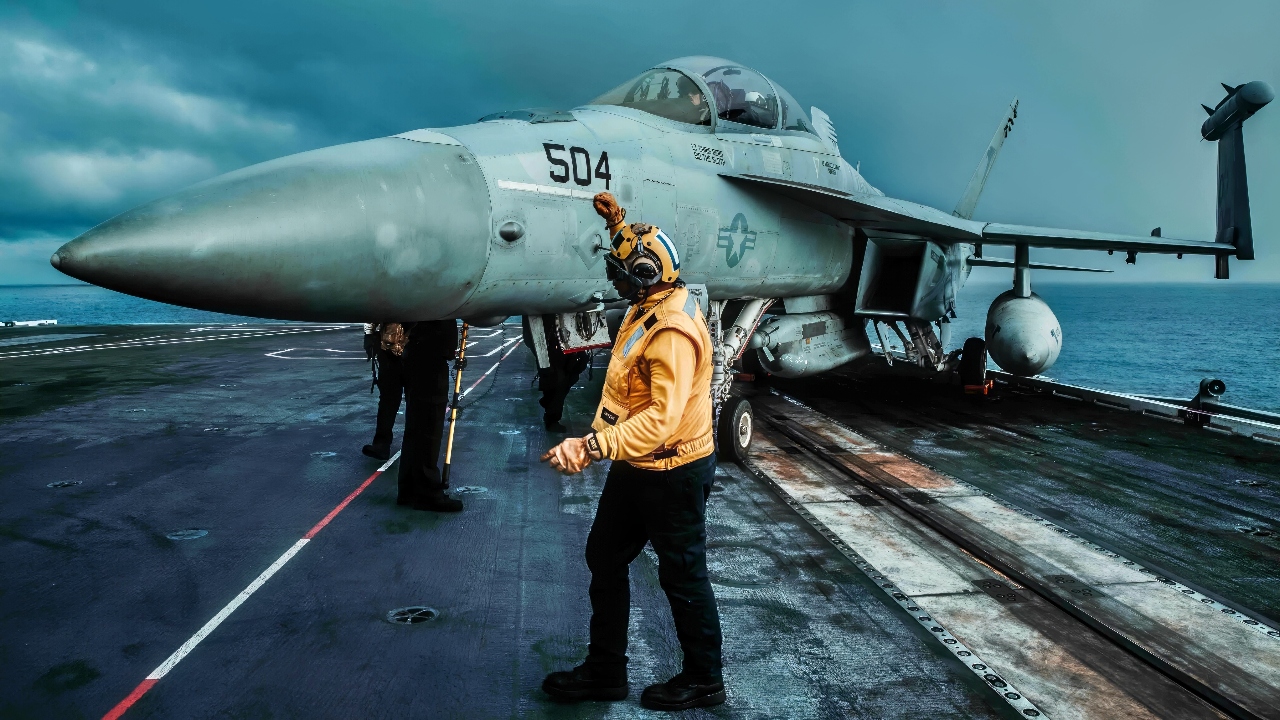
An E/A-18G Growler, attached to Electronic Attack Squadron (VAQ) 141, taxis on the flight deck of Nimitz-class aircraft carrier USS George Washington (CVN 73), while underway in the Indian Ocean, July 24, 2025. The USS George Washington Carrier Strike Group (GWA CSG) is conducting routine operations in the U.S. 7th Fleet area of operations. George Washington is the U.S. Navy’s premier forward-deployed aircraft carrier, a long-standing symbol of the United States’ commitment to maintaining a free and open Indo-Pacific region, while operating alongside allies and partners across the U.S. Navy’s largest numbered fleet. (U.S. Navy photo by Mass Communication Specialist Seaman Nicolas Quezada)
Nuclear power later proved decisive for endurance and logistics: longer periods between refueling, less oiler overhead, and margin for the unexpected. It also drove up initial cost and complexity. For the Forrestal era, conventional propulsion was a pragmatic trade that delivered four big decks faster and at acceptable cost. Their lack of reactors wasn’t a showstopper; it was a choice that fit the technology, budgets, and timelines of the 1950s—and it never kept these carriers from front-line relevance.
How They Built On Earlier Classes
The Forrestals were a consolidation of hard lessons:
From Essex, they retained the culture of damage control, ordnance discipline, and deck-handling rigor forged under fire.
From Midway, they inherited the virtues—and limits—of a bigger hull and strengthened decks, while pushing beyond retrofit compromises.
From 1950s trials and conversions, they made permanent the angled deck, optical landing systems, and steam cats, turning experiments into standard practice.
Crucially, the Forrestals were sized and laid out for the airplanes that were coming, not the ones that had just fought a war. Heavy bombers like the A-3 Skywarrior and A-5 Vigilante, all-weather strikers like the A-6 Intruder, fleet-defense fighters from F-4 Phantom to F-14 Tomcat—the class absorbed each generational change without losing the rhythm of the deck.
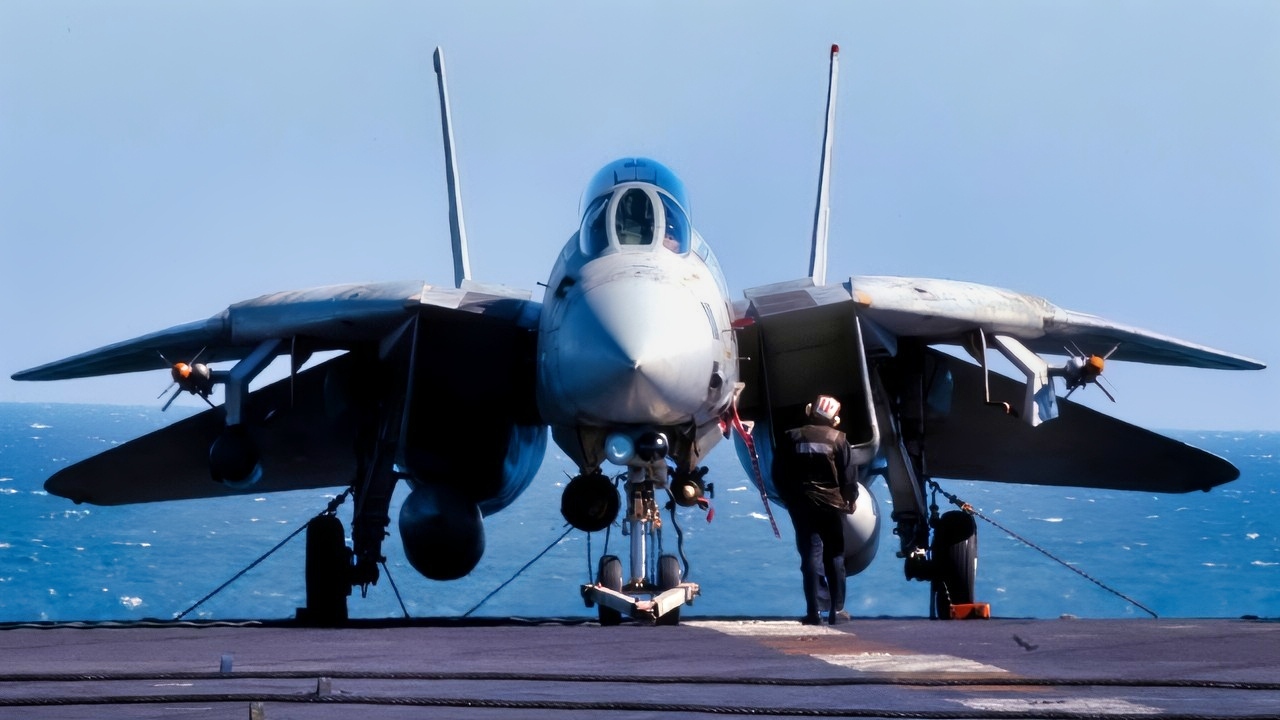
At sea aboard USS Abraham Lincoln (CVN 72)– A lone plane captain conducts a walk around inspection of his F-14D Tomcat that is assigned to Fighter Squadron Three One (VF-31). THe F-14D is armed with AIM-9 Siderwinder Missiles and a Joint Direct Attack Munition (JDAM) and a GBU-14. USS Abraham Lincoln (CVN 72) and Carrier Air Wing FOURTEEN (CVW 14) are conducting combat operations in support of Operation Southern Watch. U.S. Navy photo by Photographer’s Mate Third Class (AW/PJ) Philip A. McDaniel. Cleared for release by ALBG PAO, LCDR Jeff Bender.
Operational History: From Crisis Response To Sustained Combat
Across four hulls, the Forrestal-class became the backbone of Cold War carrier presence and a familiar silhouette in more than one ocean.
Mediterranean And Atlantic Presence. Forrestal and Saratoga were almost permanent fixtures of the Sixth Fleet, cycling through deterrent patrols, NATO exercises, and real-world flare-ups around the Middle East and Balkans. Their air wings enforced stability by simply being close, aircraft spotted and ready while diplomats bargained.
Vietnam And The Western Pacific. Ranger carried much of the class’s combat weight in Southeast Asia, deploying multiple times to the Gulf of Tonkin. Day after day she launched alpha strikes, armed reconnaissance, and barrier CAPs, absorbing the wear that long wars carve into deck plates. Forrestal also deployed to Vietnam before tragedy struck (more on that below), and returned to service to continue Atlantic and Mediterranean work.
Late Cold War To Desert Storm. As the Cold War wound down, the class remained useful. Saratoga and Ranger supported Gulf operations; Independence—relieving an older forward-based carrier—took up permanent station in Japan in 1991, giving the U.S. a constant big deck at the edge of the Western Pacific. Flying combat air patrols, enforcing sanctions, and providing quick-reaction strike options became routine.
Post-Gulf Enforcement And Presence. Through the mid-1990s drawdown, Independence and her sisters handled no-fly enforcement, maritime interdiction, and presence missions that required credible airpower without building bases ashore. Even as newer nuclear carriers took center stage, the Forrestal-class remained operationally relevant until the last ships retired.
Accidents And The Changes They Forced
Carrier aviation is not forgiving, and the class endured mishaps that reshaped the fleet’s approach to safety.
1967 Forrestal Fire. Preparing for strikes off Vietnam, a flight-deck rocket fired unintentionally, igniting fuel and detonating ordnance among tightly parked aircraft. The chain reaction was devastating, with heavy loss of life and widespread damage.
The Navy’s response was sweeping: revamped damage control training, improved firefighting gear, rethought ordnance handling, and revised deck layouts that prioritized separation and blast paths. Those changes have saved lives ever since.
1992 Saratoga Missile Incident. During a NATO exercise, Saratoga inadvertently launched Sea Sparrow missiles that struck the Turkish destroyer TCG Muavenet, killing and injuring sailors. Investigations drove reforms in weapons release procedures, training, and communications during complex, multinational drills where split-second decisions and mixed command relationships can collide.
Between those headline tragedies were countless smaller fires, hard landings, and machinery casualties resolved by crews who had internalized the post-1967 safety culture. The Forrestal era’s hard lessons became fleet muscle memory.
What Kept The Class Effective For Decades
Three ingredients sustained the Forrestals across changing eras:
1) Built-In Growth. The class carried the structural margin and electrical headroom to accept heavier arresting engines, stronger catapults, new radars, better electronic-warfare suites, and ever more power-hungry avionics. That margin delayed obsolescence and protected relevance.
2) A Deck Meant For Tempo. With deck-edge elevators, a wide angled deck, and long steam cats, these ships were sortie machines. They could launch and recover persistently, day and night, in difficult seas—what combatant commanders value most.
3) A Maintenance And Training Ecosystem. The Navy learned to sustain big decks as living systems: predictable yard periods, deep spares pipelines, standardized training, and qualification rhythms that kept air wings and deck crews sharp. The class benefited from, and helped refine, that ecosystem.
Why The Class Was Retired
By the 1990s, three forces converged:
Post-Cold War Downsizing. With fewer carriers authorized, the Navy prioritized younger, larger, nuclear-powered decks that offered better endurance and lifetime economics.
Air Wing Evolution. Aircraft gained weight and complexity. Arresting and catapult loads climbed, and electrical demand soared. Even a well-designed conventional hull faced costly upgrades to host the next generation comfortably.
Aging And Cost. Decades at sea accumulate fatigue and corrosion that are expensive to chase. Extending Forrestal-class service for another generation would have required deep investment better directed to airframes with more remaining life and to nuclear-powered platforms that reduced logistics burdens at sea.
One by one, the ships decommissioned in the 1990s. Proposals to preserve them as museums struggled against cost and feasibility. Their departure reflected arithmetic, not failure: the fleet pivoted to a nuclear baseline and fewer total decks.
Were They Handicapped By Not Being Nuclear?
It’s worth separating theory from practice. In theory, nuclear carriers bring unmatched endurance and free up replenishment capacity for escorts and air wings. In practice, during the Forrestals’ active decades, conventional power did not prevent global reach or sustained operations. Oilers were part of the plan; the plan worked. The strategic value the class delivered—presence, deterrence, and combat power—was not contingent on reactors.
Over the very long term, nuclear’s advantages compound: fewer refueling interruptions, more margin for unplanned crises, and logistics simplification across a larger fleet. Those advantages explain procurement choices after the Forrestal era, but they do not retroactively diminish what these conventional ships achieved. They did the job—over and over—because the Navy built the operational architecture to make conventional power work.
Overall Legacy: The First Truly Modern American Supercarriers
Strip away nostalgia and ask the hard question: did the Forrestal-class change what the Navy could do? The answer is yes, and in multiple dimensions.
They Set The Architecture. Deck-edge elevators, angled landing areas sized for real traffic lanes, steam catapults, deep aviation support spaces, and a flight-deck choreography tuned for jets—this is the design DNA carried by every American supercarrier since. Today’s nuclear giants still owe their daily routine to choices the Forrestals made first.
They Professionalized The Jet Deck. The class matured procedures for launch/recovery, fueling, arming, and aircraft movement under pressure. They also transformed damage control after 1967, forging a safety culture that moves from classroom to hangar deck to line shack.
They Delivered Strategic Flexibility. In the Mediterranean, they were policy by presence. In Vietnam, they were sustained combat power at sea. In the Gulf and post-Cold War enforcement, they were a steady hand on the throttle. Carriers are diplomacy with options; the Forrestals were that promise, fulfilled, for nearly four decades.
They Proved Conventional Could Be “Super.” Before nuclear propulsion became standard, these ships showed that conventional plants could underpin a global, jet-era carrier strategy. They bought time, space, and confidence for the fleet to transition, without leaving a capability gap.
That is why, when naval architects and aviators trace the lineage of the modern American supercarrier, they keep returning to these four hulls. The Forrestal-class didn’t just bridge eras—it created the era: big-deck, high-tempo, jet-centric sea power executed day after day, crisis after crisis.
Closing Verdict
The Forrestal-class was the Navy’s first clear statement that the jet deck is a system: steel arrangements, machinery choices, safety doctrine, and human choreography bound together for the singular purpose of generating combat sorties from the middle of the ocean. They were not nuclear, yet they were global. They suffered tragedy, and the fleet emerged safer. They aged out, but their design logic hardened into tradition.
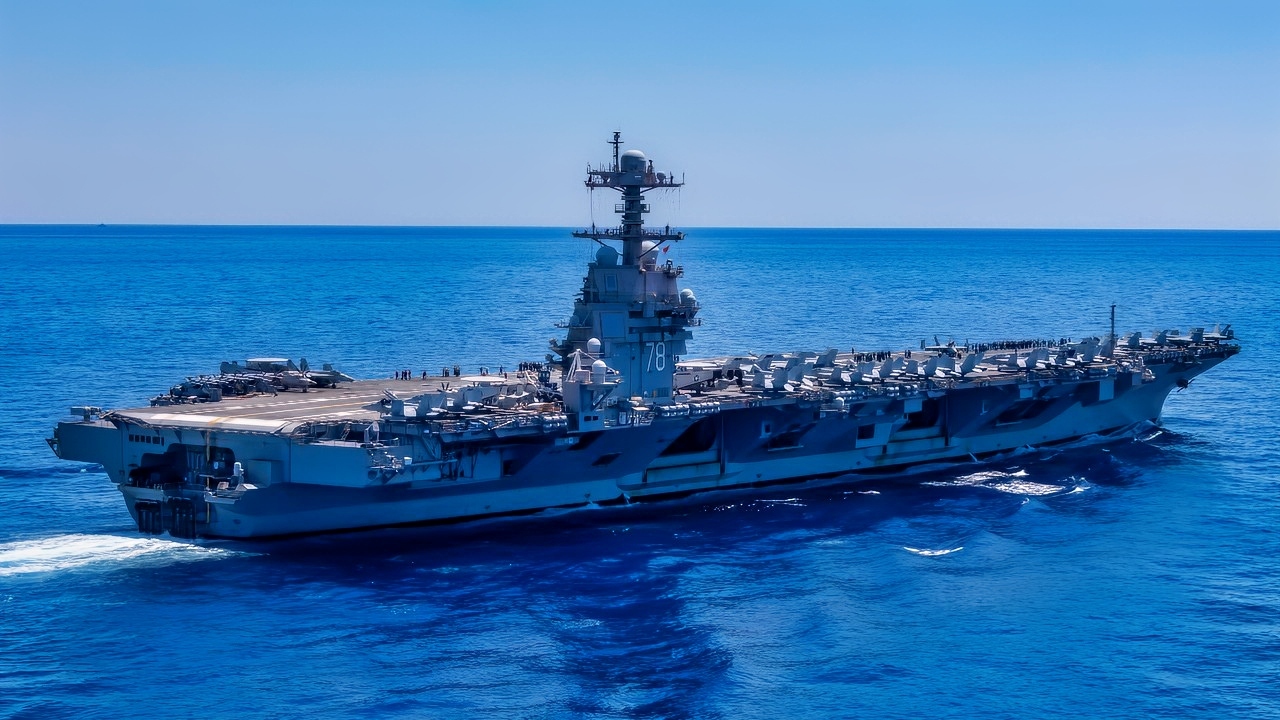
The world’s largest aircraft carrier, USS Gerald R. Ford (CVN 78) transits the Mediterranean Sea, August 1, 2025. Gerald R. Ford, a first-in-class nuclear aircraft carrier and deployed flagship of Carrier Strike Group Twelve, is on a scheduled deployment in the U.S. 6th Fleet area of operations to support the warfighting effectiveness, lethality, and readiness of U.S. Naval Forces Europe-Africa, and defend U.S., Allied, and partner interests in the region. (U.S. Navy photo by Mass Communication Specialist Seaman Brianna Barnett)
If the measure of a warship class is the degree to which it reshapes the service’s possibilities, the Forrestals rank near the top. They taught the fleet how to run the modern flight deck, proved that conventional power could carry a supercarrier strategy, and left a blueprint that every successor—nuclear or not—still follows.
About the Author: Harry J. Kazianis
Harry J. Kazianis (@Grecianformula) is Editor-In-Chief and President of National Security Journal. He was the former Senior Director of National Security Affairs at the Center for the National Interest (CFTNI), a foreign policy think tank founded by Richard Nixon based in Washington, DC. Harry has over a decade of experience in think tanks and national security publishing. His ideas have been published in the NY Times, The Washington Post, The Wall Street Journal, CNN, and many other outlets worldwide. He has held positions at CSIS, the Heritage Foundation, the University of Nottingham, and several other institutions related to national security research and studies. He is the former Executive Editor of the National Interest and the Diplomat. He holds a Master’s degree focusing on international affairs from Harvard University.
More Military
The Canada-F-35 Divorce Could Have Consequences
The B-58 Hustler Mach 2 Bomber: The Air Force’s Big Blunder?
Russia’s Su-33 Flanker Fighter Mistake Still Stings
The Navy’s Columbia-Class Submarine Mistake Still Stings
4 Hellfire Missiles, 3 Harpoon Missiles and More: The Navy Couldn’t Sink Its Own Destroyer


