

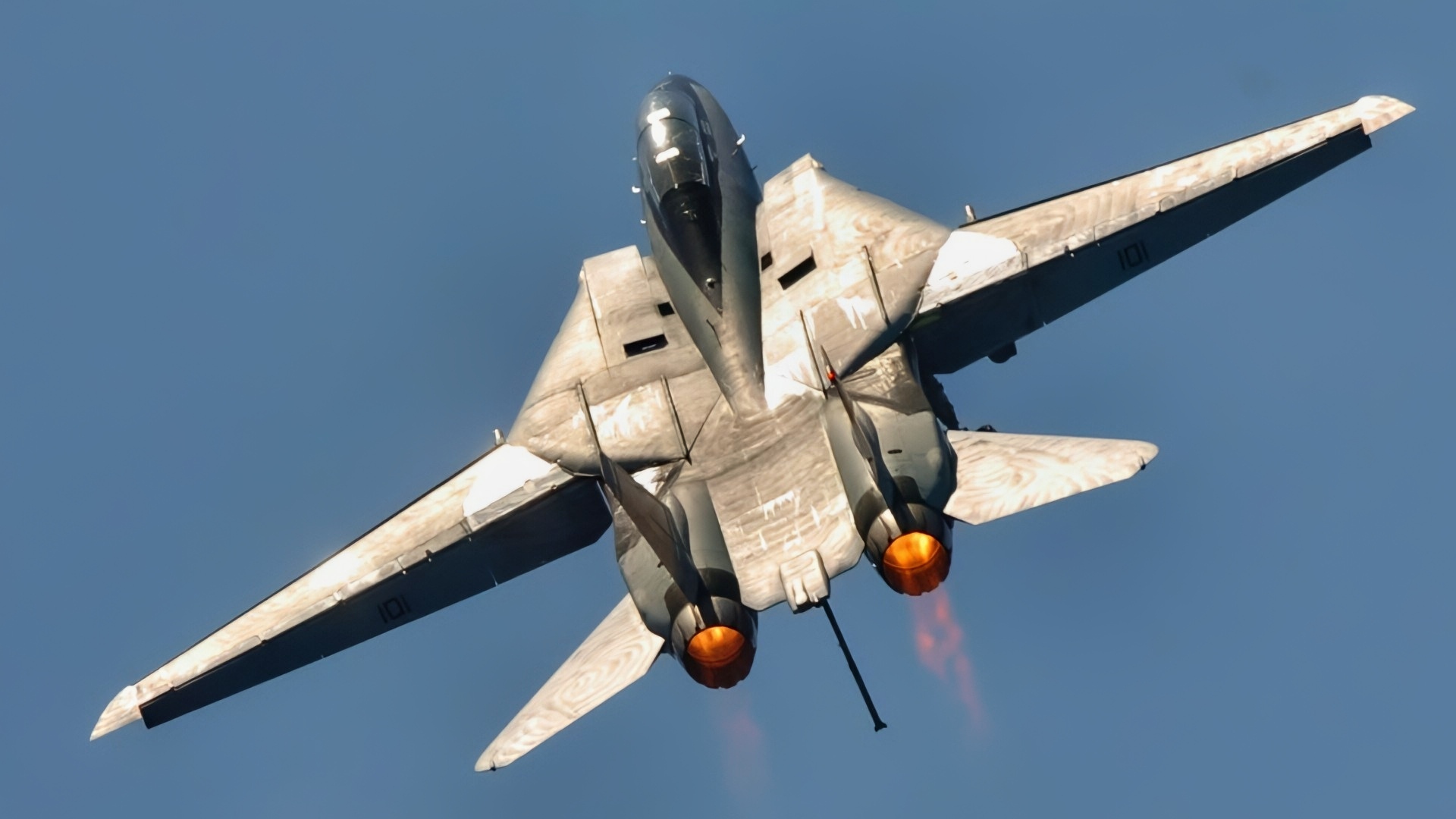
Key Points and Summary (Published on 9/20/2025 at 8:00 AM) – Born from the failure of the F-111B, the F-14 Tomcat gave U.S. carriers a purpose-built fleet defender: a big-nose radar (AWG-9), long-reach AIM-54 Phoenix, and swing-wings for both trap speed and supersonic dash.
-Many in the U.S. Navy I have spoken to throughout the years complain that they miss the F-14 Tomcat for its long-range, something the F/18 Hornet can’t compete with. Many consider the retirement of the F-14 a mistake in many respects, as many experts say the plane still had more life left.

F-14D Tomcat Onboard USS Intrepid in NYC. Image Taken by National Security Journal on 9/19/2025.
-It policed Soviet bomber corridors, shot down Libyan fighters in 1981 and 1989, then reinvented itself in the 1990s as the “Bombcat” with LANTIRN pods and precision strike roles in the Balkans, Afghanistan, and Iraq.
-The F-14D fixed engines and avionics but arrived in small numbers. High sustainment costs and a pivot to the F/A-18E/F ended Tomcat service in 2006.
-Its legacy blends engineering audacity, combat credibility, and pop-culture power.
The F-14 Tomcat: Cold War Guardian, Pop-Culture Icon, And A Lasting Benchmark
In the late 1960s, the U.S. Navy faced a very specific—and very frightening—problem. Soviet naval aviation was fielding long-range bombers armed with heavy, supersonic anti-ship missiles designed to overwhelm a carrier strike group from far outside the range of shipboard guns.
Fleet air defense needed an aircraft that could do three things at once: see far, shoot far, and still dogfight if the engagement collapsed into a knife-fight near the carrier. The Navy’s first stab at that requirement—the F-111B—proved too heavy and ill-suited for carrier operations. Washington scrapped it and kicked off the VFX competition for a purpose-built interceptor. Grumman won with a design that married a powerful radar and long-range missiles to a carrier-friendly airframe with twin tails, twin engines, and variable-sweep wings for both low-speed carrier handling and high-speed dash. The result was the F-14 Tomcat, built to meet the fleet’s air-defense problem head-on.

F-14D Tomcat in NYC on USS Intrepid. Image Credit: National Security Journal Taken on 9/19/2025.
What set the Tomcat apart from day one was systems integration as much as aerodynamics. The Tomcat’s large nose housed the AWG-9 radar—mated to the AIM-54 Phoenix missile—that could track multiple targets at long range and guide several shots simultaneously. That wasn’t a “nice to have” gimmick; it was the core of a layered defense concept that envisioned Tomcats launching Phoenix salvos against Soviet bombers well before they could release anti-ship missiles, then shifting to Sparrows and Sidewinders as the fight closed.
The airframe’s swing wings, glove vanes (on early airframes), and a big lifting body gave the jet the agility to survive that close-in merge if it came to it.
In short: the Tomcat was built to win the first engagement and to live through the second. And many say the Navy never fully replaced the capabilites of what this fighter could bring to the fight.
From Prototype To Deck-Ready Fighter
The Tomcat first flew in December 1970 and moved quickly through testing into squadron service. By September 1974, VF-1 “Wolfpack” and VF-2 “Bounty Hunters” sailed on USS Enterprise with the first deck-deployed F-14s, immediately proving the type’s worth by flying protective combat air patrols during the Saigon evacuation in 1975. Over the next decade the jet settled into its day-job: launching from the boat to intercept, identify, and—if necessary—engage Soviet Tu-95s, Tu-16s, Tu-22Ms, and their missile-armed escorts on the edges of carrier airspace. For carrier aviators of that era, “bear-hunting” wasn’t a metaphor; it was the daily grind.

F-14 Tomcat. Image Credit: Jack Buckby/National Security Journal.
Not everything about early Tomcats was perfect. The initial Pratt & Whitney TF30 engines were notorious for compressor stalls during abrupt throttle movements and at high angles of attack—an unpleasant trait in a big, two-seat fighter landing on a moving ship at night.
Grumman and the Navy iterated fixes, and later F-14B and F-14D models received far more reliable General Electric F110s that materially improved safety and performance. Meanwhile, the radar-missile combination matured. The Tomcat community practiced what its doctrine promised: track-while-scan, long-range “raid-breaking” missile shots, and then the discipline to transition to close-in maneuvering if the intercept escalated. On paper and in training, the system worked as advertised.
Combat History: Libya, The Gulf, And The “Bombcat” Era
The Tomcat’s best-known air-to-air engagements came over the Gulf of Sidra. In August 1981, two F-14As from VF-41 shot down a pair of Libyan Su-22s after one fired a missile at them—an emphatic reminder that the jet wasn’t just a missile truck but a crewed fighter that could fight and win. Eight years later, in January 1989, two VF-32 Tomcats splashed two Libyan MiG-23s in another measured intercept-turned-skirmish north of Tobruk. Those episodes weren’t the apocalyptic bomber raids the Tomcat had been built to stop, but they validated the community’s intercept discipline, crew coordination, and weapons employment under tight rules of engagement.
Desert Storm in 1991 showcased the Tomcat in a different light. With the U.S. Air Force bearing the brunt of the air-superiority tasking over Iraq and strict identification rules constraining beyond-visual-range shots, Navy F-14s did the gritty work of CAPs, strike escort, and reconnaissance. The Tomcat notched one confirmed air-to-air kill—a VF-1 crew downed an Iraqi Mi-8 Hip with a Sidewinder—while sustaining one combat loss to a surface-to-air missile. The war highlighted another truth about naval aviation: a carrier fighter that could double as a high-speed, survivable reconnaissance platform was pure gold for fleet commanders. The reconnaissance-pod-equipped Tomcats (TARPS) became the Navy’s primary tactical reconnaissance asset through the 1990s.
Out of that experience grew the jet’s second life as the “Bombcat.” As the dedicated A-6 Intruder retired and post-Cold War budgets squeezed programs, the Navy leaned into making the F-14 a precision striker. Beginning in the mid-1990s, Tomcats gained LANTIRN targeting pods and data-link updates that let them self-designate laser-guided bombs and, later, employ GPS weapons. The first combat use of the targeting pod on Tomcats came in the late 1990s, and by the time of Afghanistan (2001) and Iraq (2003), F-14s were dropping precision ordnance, cueing other aircraft, and still pulling long endurance CAPs. The image of the Tomcat as a pure interceptor gave way to a more nuanced reality: a big, stable, long-legged strike fighter with exceptional sensors, crew workload division, and a deep magazine. It wasn’t just guarding the fleet anymore; it was shaping the fight ashore.
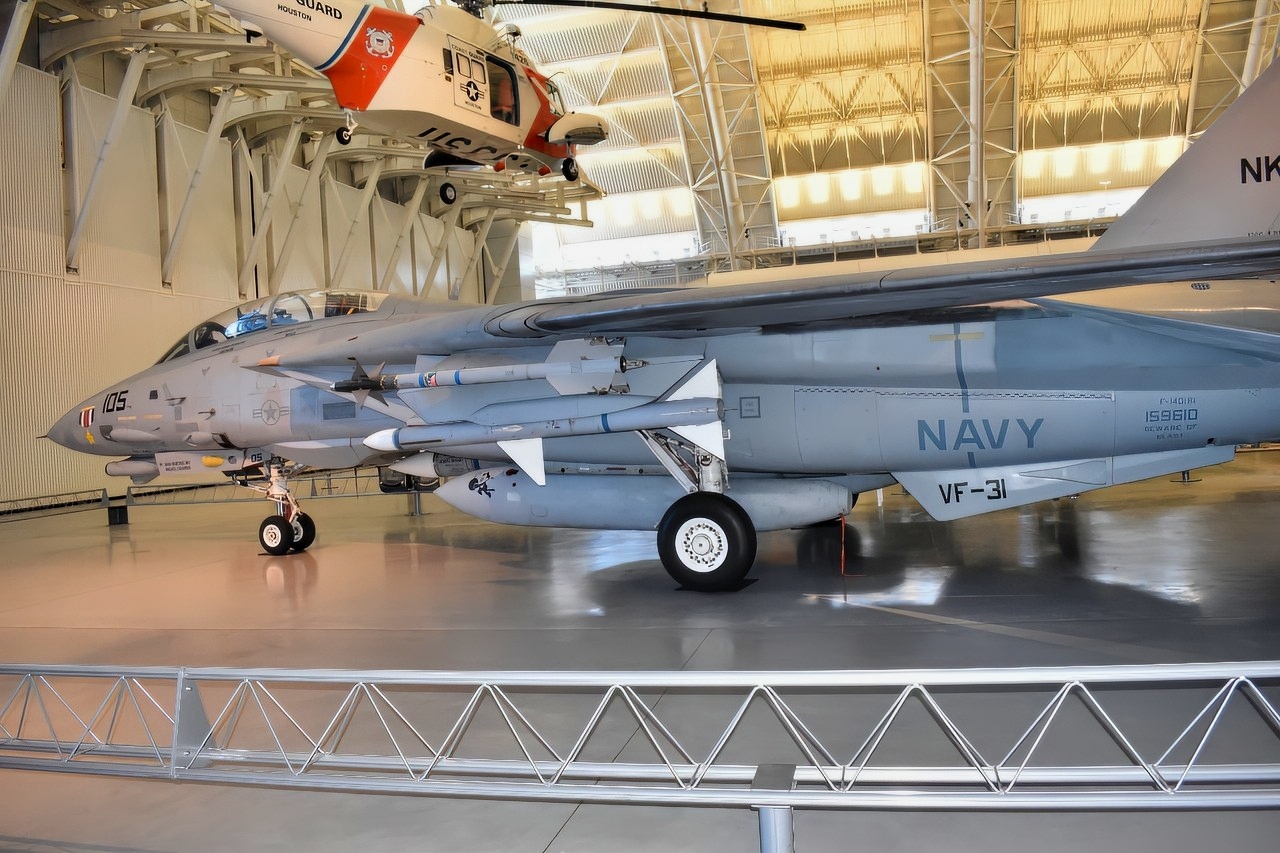
F-14 Tomcat at Steven F. Udvar-Hazy Center. Image by Brent M. Eastwood for National Security Journal.
The Top Gun Effect—And What It Really Meant
No history of the Tomcat is complete without the 1986 movie Top Gun. The F-14’s sweeping wings, thundering afterburners, and photogenic lines made it a natural star, and the Navy leveraged the exposure for recruiting and public engagement.
Did Top Gun single-handedly cause a recruiting “explosion”? The legend has outpaced the data. What’s not in dispute is that the film dramatically increased public awareness of naval aviation and put the Tomcat—already an icon on the flight deck—into living rooms and popular culture. The timing also mattered: the movie hit theaters a month after U.S. carrier aircraft struck Libya in 1986, when naval aviation was very much in the news. Culture rarely decides budgets, but it does shape narratives; Top Gun burnished the Tomcat’s image, and the community rode that wave for years.
The F-14D Tomcat: What Changed And Why It Mattered
The definitive Tomcat, the F-14D, arrived in the early 1990s with three transformative changes. First, the engines: F110s gave the big fighter the throttle response, acceleration, and reliability it always deserved. Second, the radar and avionics: the analog AWG-9 gave way to the digital APG-71, improving reliability and resistance to jamming, and the cockpit moved toward a “glass” presentation that improved situational awareness for both pilot and RIO. Third, sensors and connectivity: the D added an infrared search-and-track, modern defensive systems, and Link-16/JTIDS data-link options that let Tomcat crews plug into the larger kill web more effectively. On paper, the D model was the airplane the Navy wished it had fielded a decade earlier.
But numbers matter. The F-14D fleet remained small—limited new builds and conversions—because post-Cold War budget pressure and competing modernization priorities sapped momentum. Even as the D proved itself in the “Bombcat” role, the Navy faced a hard choice: extend and transform the Tomcat or consolidate around the newer F/A-18E/F Super Hornet. The service chose the latter, prioritizing a common, multi-role platform with lower maintenance demands and a strong growth path. That decision set the Tomcat’s sunset in motion.

F-14 Missiles at Smithsonian Outside of DC. National Security Journal Photo. All Rights Reserved.
Why Retire A Legend?
Retiring a beloved airplane is always emotional, but the logic behind the Tomcat’s 2006 farewell was straightforward – even if I don’t entirely agree and I consider it a mistake, as I have argued the plane had a few more years of life left.
First, sustainment. Even after engine fixes, the airframe was maintenance-intensive by design: variable-sweep wings, aging wiring and hydraulics, and legacy subsystems demanded man-hours the Navy would rather spend on sortie generation. Second, modernization headroom. The Super Hornet family promised a common logistics and training base across the fleet, wide weapons compatibility, and a cleaner path to future sensors and networking. Third, security. With Iran as the only remaining Tomcat operator, Washington took the unusual step of shredding retired F-14s and clamping down on spares sales to keep parts from reaching Tehran.
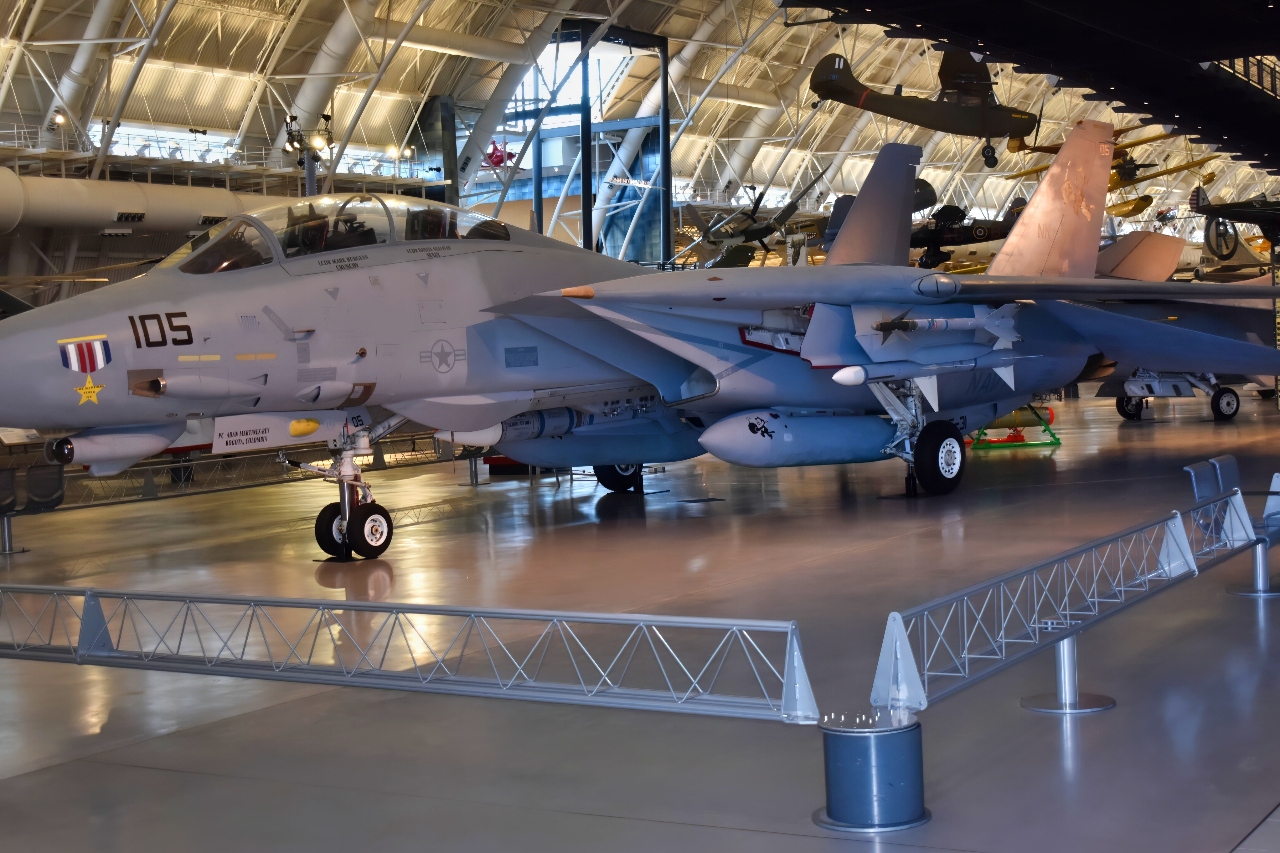
F-14D Tomcat. Image Taken By National Security Journal.
None of that diminishes what the Tomcat did; it simply explains why the Navy moved on.
The Tomcat’s final chapter was fitting. The last squadrons made combat drops over Iraq in 2006, then returned home to a raucous “Tomcat Sunset” at NAS Oceana. The airplane that defined a generation of carrier decks left service not as a museum piece but as a combat veteran of the post-9/11 wars—still relevant, still deadly, and still beloved by crews and maintainers who kept it flying.
The Tomcat’s Place In U.S. Naval Aviation History
Ask a room of aviators to list the most consequential Navy fighters and you’ll get the usual suspects—Hellcat, Bearcat, Phantom, Hornet—but the Tomcat stands apart because it successfully bridged two eras. It was conceived as a Cold War fleet shield against massed bomber raids, and it did that job in peacetime for decades, deterring the very raids it was designed to stop. Then it transformed into a precision strike and reconnaissance platform that helped define carrier air power in the 1990s and 2000s. Few aircraft pivot so gracefully from “pure interceptor” to “strike fighter” while remaining operationally relevant.

F-14 Tomcat Photo Taken on August 24 2025. Image Credit: Jack Buckby/National Security Journal.
The Tomcat also crystallized the two-crew value proposition on the boat. With a pilot focused on flying and weapons employment and a RIO managing radar, sensors, and comms, Tomcats wrung every ounce of capability out of their hardware in contested electromagnetic environments and complicated rules of engagement. That crew concept—and the culture built around it—echoed later in how the Navy thinks about distributed sensing, cooperative targeting, and human-machine teaming.
Finally, the jet’s cultural imprint matters. The Navy’s Fighter Weapons School existed long before Top Gun, but the movie turned a specialized fighter community into a national touchstone. That visibility helped the broader Navy explain why carrier aviation is expensive and indispensable, why training is ruthless, and why the service invests in aircraft that can both deter and fight. The Tomcat’s legacy isn’t just kills over the Gulf of Sidra or JDAM drops over Iraq; it’s the way the airplane made the case for sea-based air power to the American public.
Lessons Carried Forward
Set aside nostalgia, and the Tomcat still offers hard lessons that shaped what followed. First, mission systems drive the mission. The AWG-9/Phoenix concept—long-range sensing, multi-target engagement—prefigured today’s emphasis on networks, cooperative engagement capability, and kill-chain resilience. Second, growth matters. The F-14’s ability to absorb LANTIRN, digital reconnaissance, GPS weapons, and data-links extended its relevance by a decade; without that growth path, the Navy would have lost a vital capability gap when the A-6 left. Third, sustainment is strategy. The Tomcat’s retirement, controversial in some circles, was less about performance and more about what the Navy could afford to maintain at scale across a global fleet.
There’s also a human lesson. The Tomcat’s community—pilots, RIOs, maintainers, and the ship’s company that launched and recovered them—built a reputation for professionalism under pressure. From shadowing Soviet “Bears” in freezing North Atlantic air to prosecuting time-sensitive targets in Afghanistan’s mountains, Tomcat crews did what the fleet asked, even as their jet evolved beneath them. That adaptability is the thread that runs from the Tomcat to today’s carrier air wings.
The ‘Mistake’ Factor for Me
So why do I reference a ‘mistake’ that still stings when it comes to the F-14 Tomcat?
Simple, again, the F-14 had a much larger range than today’s F/A-18 Hornets. When you think about the spaces U.S. Navy aircraft carriers need to operate in—with lots of long-range missiles pointed at them—you need to start as far away from them as possible.

F-14 Tomcat on Flight Deck at USS Intrepid Museum. Image Credit: National Security Journal.
Super Hornets are well-suited for combating enemies like ISIS, which cannot defend themselves. It’s another thing when Russia or China can strike with anti-ship weapons that are accurate from over 1,000 miles or more away.
The Navy did have plans for a more advanced version of the Tomcat. In retrospect, it doesn’t seem like a bad idea at all. In the Indo-Pacific, range matters. The Tomcat, whatever flaws it had, brought a lot of that to the fight.
A Balanced Legacy
Was the Tomcat perfect? No aircraft is. Early engine issues were real. The jet was complex and expensive to keep at fighting trim. And the promise of a large F-14D fleet never materialized. But judged by the standard that matters most—did it give the Navy a decisive, flexible tool for sea control and power projection?—the answer is yes. The Tomcat bought deterrence in the Cold War, delivered combat power in the post-Cold War, and handed off to a successor fleet with its head held high.
In museums today the F-14’s wings are often swept dramatically aft, as if the jet is itching to bolt. That pose is appropriate. The Tomcat’s story is motion: a rapid pivot from a canceled predecessor to a fighter that defined fleet defense, from air-to-air thoroughbred to precision strike workhorse, from Cold War sentinel to post-9/11 veteran.
That arc is why, decades from now, when people talk about the airplanes that captured the spirit and the substance of U.S. naval aviation, the Tomcat will still be near the top of the list.
About the Author: Harry J. Kazianis
Harry J. Kazianis (@Grecianformula) is Editor-In-Chief and President of National Security Journal. He was the former Senior Director of National Security Affairs at the Center for the National Interest (CFTNI), a foreign policy think tank founded by Richard Nixon based in Washington, DC. Harry has over a decade of experience in think tanks and national security publishing. His ideas have been published in the NY Times, The Washington Post, The Wall Street Journal, CNN, and many other outlets worldwide. He has held positions at CSIS, the Heritage Foundation, the University of Nottingham, and several other institutions related to national security research and studies. He is the former Executive Editor of the National Interest and the Diplomat. He holds a Master’s degree focusing on international affairs from Harvard University.
More Military
YF-23 Black Widow II: The Best Stealth Fighter You Never Heard Of
China’s New H-20 Stealth Bomber: Is It Coming Soon?
SR-72 Mach 6 Mistake the Air Force Needs to End


Ed Schnertzman
September 21, 2025 at 2:26 pm
As a Sailor from the Reagan era, this smacked of ignorance on the part of the Pentagon IMO. Grumman had the ST-21 waiting to take on the needs of the LRI duties the 14 was made for.
While we can understand budgeting, the ammout of waste across the services could have been cleaned up to keep a better program going fwd. The 18 and the 35 are not match for adversarial 5th gen fighters from CHI and RUS. Even with the 35’s systems it lacks the speed and range and manuverability needed in a fight.
We can only hope that the CCP does not continue to develop their Naval Aviation at the pace they’re at. Our Enemies don’t care about budgets.
There are plenty of places the Pentagon could have cut (social programs, crap, we all know) and kept a world beating aircraft on the high seas.
carlos
March 22, 2026 at 4:59 pm
Today when an eventual conflict with China looks day after day more evident, the USN for sure cries when thinks in the chinese boomers armed with hypersonic anti-carriers missiles, things wayback to past, when the F-14 was conceibed as a “fleet defender” maybe the f-14 could to be used for carry some type of hypersonic missile very similar to the phoenix, or why not an “hypersonic phoenix”, sadly never will be possible thanks to this USN big mistake!!!