


Key Points and Summary – Conceived at the end of World War II and commissioned just after it, the Midway-class—Midway, Franklin D. Roosevelt, and Coral Sea—were the U.S. Navy’s first “big deck” carriers with armored flight decks and the margins to absorb radical change.
-They pioneered early jet operations, fought across the Cold War, and reinvented themselves through major modernizations that added angled decks, hurricane bows, stronger catapults, and new sensors.
-One became the Navy’s first forward-deployed carrier; another helped mine Haiphong; all three trained generations of aviators. Retired by the early 1990s, they remain case studies in design headroom, adaptability, and value delivered over half a century.
Midway-Class Aircraft Carriers: Armored Beginnings, Angled-Deck Futures
The last years of World War II taught the U.S. Navy a simple lesson: flight-deck throughput and survivability decide campaigns. Treaty-limited carriers had been stretched to their limits; the coming age of heavier, faster aircraft demanded a tougher ship with more aviation fuel protection, smarter magazine layout, and room to grow. The Navy also wanted a carrier that could absorb battle damage and get back to flying quickly—a reality of Pacific warfare that would not vanish in peacetime.
Enter the Midway-class. Designed as “CVB”—battle carriers—these ships traded the lighter, wooden flight decks common on wartime U.S. carriers for armored flight decks and robust internal subdivision. The aim wasn’t to build floating fortresses; it was to keep the flight deck—the heart of a carrier—open for business when it mattered. With more hangar volume, stronger elevators (including deck-edge placement to clear the landing area), and power for sustained 30-knot operations, the class gave admirals what they needed: a platform that could launch, recover, arm, and repair aircraft all day, then do it again tomorrow.
From Commissioning To First-Generation Jets
Timing made the Midway-class unusual. USS Midway (CVB-41) commissioned in September 1945, Franklin D. Roosevelt (CVB-42) in October, and Coral Sea (CVB-43) in 1947—too late for World War II, perfectly positioned for the messy, fast-changing peace that followed. The Navy immediately turned these new decks into testbeds. In 1946, Roosevelt hosted early U.S. carrier jet operations, proving that pure-jet fighters could trap aboard and launch by catapult from a big American deck. The lessons were not academic. Jet aircraft brought higher approach speeds, greater landing weights, and different handling quirks; only a large, stiff deck with ample arresting-gear capacity could make them practical at sea.
Operationally, the ships pulled double duty: showing the flag in the Mediterranean and Atlantic as the Cold War settled in, while the test community wrung out new catapults, arresting gear, and flight-deck procedures. The class’s armored flight deck—initially chosen for survivability—helped here as well. It tolerated the pounding of early jets and their heavier landing loads with fewer structural headaches than lighter decks would have suffered.
Learning To Fight, Then Learning To Change
When war returned in 1950, the Midway-class was ready.
Early deployments to the Western Pacific mixed piston stalwarts like the Skyraider with first-generation jets. The carriers flew close air support, interdiction, combat air patrol, and reconnaissance—familiar missions done differently under jet rules.
The value wasn’t just sorties; it was proof of concept that big-deck U.S. carriers could keep jets in the fight day after day, far from home bases.
But the ships were already marching toward their first big reinvention. Jets were getting heavier and thirstier. Ordnance loads were growing. Electronics multiplied.
The Navy faced a design dilemma: buy new supercarriers or rebuild proven hulls to bridge the gap. It did both, and the Midway-class became the most ambitious rebuild project the carrier force had ever attempted.
The Upgrade Waves: SCB-27 And SCB-125
The first modernization pulse, commonly grouped as SCB-27, strengthened the flight-deck structure; upgraded arresting gear; rearranged magazines; increased aviation-fuel protection; and replaced early catapults with more powerful units (ultimately steam catapults) able to throw heavy jets off the bow. Island superstructures grew to support radar-directed air ops, while electrical generation and workshops were expanded to feed the avionics boom.
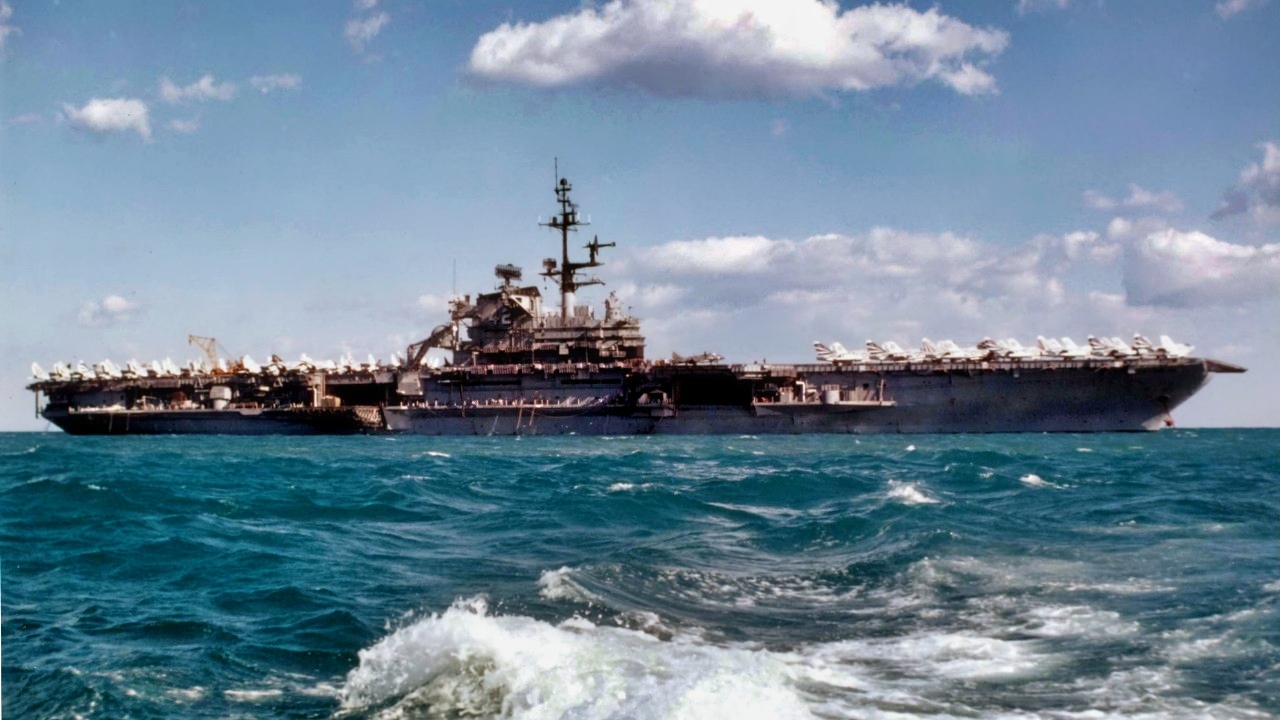
Midway-Class Aircraft Carrier. Image Credit: Creative Commons.
Then came SCB-125, the most visible transformation. The ships gained angled flight decks that separated landing and launch cycles and allowed safe “bolters” without plowing into parked aircraft. They received enclosed (“hurricane”) bows to keep green water off the flight deck, plus improved lighting and the optical landing system that refined glide-slope control for jet approaches. Deck-edge elevators migrated to positions that eased aircraft flow. All this turned an armored WWII deck into a modern jet carrier—without building a new hull.
Not every mid-century improvement was painless. The class’s combination of armored deck and added topside weight from modernizations challenged stability, especially after Midway’s later rebuilds. The Navy tackled this with hull modifications and careful weight management—an unglamorous reminder that design margin is a currency you spend, not a magic well.
Vietnam: Sustained Combat In The Jet Age
By the time Vietnam demanded sustained naval airpower, the Midway-class was in its prime. Coral Sea emerged as a workhorse in the Gulf of Tonkin, launching long cycles of A-4, A-6, A-7, and F-8/F-4 sorties during Rolling Thunder and Linebacker. The ship earned a reputation for toughness and tempo, and later figured in Sixth Fleet crises that included the 1986 confrontation with Libya—proof that a Cold War carrier didn’t have to be nuclear to matter.
Midway became the Navy’s first forward-deployed carrier when she shifted to Yokosuka, Japan, in 1973. That single basing decision changed Pacific posture for a generation: an American flight deck continuously present in the Western Pacific, cycling air wings and crews but never the ship. In 1975, Midway played a signature role in Operation Frequent Wind, the final evacuation from Saigon, including the most vivid vignette of the war’s end for carrier aviation—a South Vietnamese pilot landing a small aircraft aboard with his family after the crew pushed helicopters overboard to clear the deck. Years later, Midway’s air wing returned to war in Desert Storm, launching strikes from the Gulf in 1991 as the oldest active U.S. carrier on the line.
Franklin D. Roosevelt served globally through the 1950s and 1960s, hosted important early jet and nuclear-capable bomber detachments, and became a Mediterranean staple during Cold War crises before decommissioning in the late 1970s. She did less of the late-life heavy lifting than her sisters only because time ran out first.
Beyond Bombs And Bolters: What Made Them Productive
What separates the Midway-class from many contemporaries is not just combat, but productivity.
They qualified aviators by the thousands; hosted trials that matured carrier aviation’s most important inventions (from steam cats to optical landing systems); and acted as flexible platforms for everything from spacecraft recovery support to diplomacy. Their armored decks absorbed the abuse of jet operations while their enlarged hangars and magazines kept surging air wings fed with fuel, ordnance, and spare parts.
Day-to-day, the ships proved easier to live with than mythology suggests. Habitability upgrades brought air-conditioning, modernized berthing, and better workshops. Damage-control doctrine, forged in wartime and refined by peacetime mishaps, matured alongside improved firefighting gear and training. When deck fires did happen—as they inevitably do on any busy carrier—the crews had the muscle memory to respond.
Modernization, Round Two: Making A Good Ship Last
By the late 1960s, at least one ship in the class underwent an even deeper rebuild that changed her silhouette—larger sponsons, widened flight deck, reworked elevators, new radars, and the latest catapults and arresting gear.
The goal was not glamour; it was longevity: keep the ship relevant to evolving air wings without compromising safety. The price was weight, and the consequence was stability management that would keep naval architects busy into the 1980s. The fix—adding buoyancy and refining topside weight—worked, and the ship served for decades more, a living example of what persistence plus engineering can buy.
Meanwhile, electronics marched on. TACAN, better air-traffic control suites, modern radios, and combat information centers that looked less like World War II chart rooms and more like early networked nerve centers kept the class tactically sharp. New self-defense weapons and EW suites layered protection without turning the ships into porcupines—always the balance on a carrier that earns its keep by launching aircraft, not by bristling with guns.
The Long Goodbye: Retirement Without Irrelevance
As the Cold War pressed forward, bigger aircraft carriers and those with nuclear power came into vogue. The Midway-class should have slipped quietly to auxiliaries and scrap. It didn’t. One ship continued front-line deployments in the Pacific into the early 1990s; another stayed a Sixth Fleet stalwart into the end of the Cold War; the first to retire had already wrung out the jet era’s essential lessons and trained the people who would fly from nuclear decks.
Their retirements were still historic. One ship closed her career as a combat veteran of Desert Storm. Another left service with the affectionate nickname “Ageless Warrior.” And one became a museum, a floating classroom where visitors now walk a flight deck that once measured the balance of the Cold War. That afterlife matters: it turns steel into story, and story into institutional memory.
Combat Service, In Full
Across five decades, the class’s combat resume is unusually broad. They proved that large, armored-deck carriers could sustain jet operations in war—close air support, interdiction, CAP, and recce—from far offshore and in bad weather.
Vietnam: Carried the load during extended campaigns, from early strikes to Rolling Thunder and Linebacker, then again in 1975 for the evacuation.
Cold War Crises: Projected power and presence in the Mediterranean and Western Pacific—interceptions, freedom-of-navigation operations, and air wings ready to fight on short notice.
Desert Storm: Demonstrated that a well-maintained, well-modernized conventional carrier could still launch meaningful strike packages in a high-tempo, coalition war.
Most ship classes fight one era well. The Midway-class fought three.
Why Many Experts Rank The Midway-Class Among The Best Ever
I have heard this claim from a few diferent naval experts, but, of course, it could be debated endlessly. But a few hard truths support the claim:
They Were Designed With Headroom. The combination of armored flight decks, generous hangar volume, and strong machinery plants created space, weight, and power margins that later engineers could spend. That is why these ships could accept angled decks, heavier gear, and new electronics without becoming unsafe or unworkable.
They Bridged Eras Without Breaking. Few designs take the leap from piston to jet, from straight to angled deck, and from World War II metallurgy to Cold War electronics while remaining frontline-useful. The class did—twice.
They Produced Strategic Presence At an Acceptable Cost. The Navy squeezed decades of value from three hulls, including a forward-deployed presence that reshaped alliance politics in the Western Pacific. That efficiency, measured in patrol days and crises managed, is part of what “best” should mean.
They Made Naval Aviation Better. As testbeds and workhorses, the ships accelerated the adoption of steam catapults, optical landing systems, TACAN, modern ATC, and improved damage control. The fleet’s learning curve shortened because these decks existed.
They Stayed In The Fight. From Vietnam’s high-tempo strikes and all the way to 1991, the class didn’t just float—they fought. When a design spends fifty years delivering combat power, it has earned more than nostalgia; it has earned respect.
The Verdict: What to Make of the Midway-Class
They were born from wartime urgency, perfected in peacetime experimentation, tested in hot wars, and retired only after proving they could keep up with fleets far younger than themselves.
That is why, when professionals talk about the carriers that mattered most—not the biggest or newest, but the ships that delivered reliable power over time—the Midway-class keeps appearing near the top of the list.
Three ships, five decades, and an object lesson in what naval design can do when it starts with strength and leaves room for the future.
About the Author: Harry J. Kazianis
Harry J. Kazianis (@Grecianformula) is Editor-In-Chief and President of National Security Journal. He was the former Senior Director of National Security Affairs at the Center for the National Interest (CFTNI), a foreign policy think tank founded by Richard Nixon based in Washington, DC. Harry has over a decade of experience in think tanks and national security publishing. His ideas have been published in the NY Times, The Washington Post, The Wall Street Journal, CNN, and many other outlets worldwide. He has held positions at CSIS, the Heritage Foundation, the University of Nottingham, and several other institutions related to national security research and studies. He is the former Executive Editor of the National Interest and the Diplomat. He holds a Master’s degree focusing on international affairs from Harvard University.
Editor’s Note: We have corrected a small factual mistake thanks to a reader comment. Thanks for your feedback!
More Military
Russia’s ‘New’ Kirov-Class Battlecrusier Is Like a ‘Death Star’
The U.S. Military’s Big X-44 Manta Stealth Fighter ‘Mistake’ Still Stings
China’s New Fujian Aircraft Carrier Looks Close to Fully Operational
The Air Force Could Soon Have 32 Additional F-22 Combat Ready ‘Raptor’ Stealth Fighters
China’s J-20 Mighty Dragon vs. Russia’s Su-35 Flanker Fighter: Who Wins Summed Up in 4 Words


Michael Mondary
September 21, 2025 at 4:49 pm
USS MIDWAY was my home for 5 years.Two as a Marine and Three more as a Sailor. I was aboard for operation frequent wind and cross decked from Midway to the Coral Sea to provide electronic warfare for the evacuation.
Ghost_Tomahawk
September 21, 2025 at 5:33 pm
Only 3 were made. It’s the Korean War of carriers. People forget they existed.
Greg Toth
September 21, 2025 at 6:16 pm
They never fought in the Korean War as mentioned at the beginning of the article and were either in the Atlantic or Mediterranean during that time frame.
A nice article otherwise.
Miv Tucker
September 27, 2025 at 1:12 pm
A few more and better pics might have been nice.
Lisa l buffington
September 27, 2025 at 9:14 pm
Those jets are F-14… they are the only jet where the wing up..Hardy old city…. love my jets…hubby was a AME-1.. worked on ejection seats…rough life but did it 20yrs…Dad was on tin cans… he loved the b little ships…hubby the deck of a carrier…I got to see them take off…amazing…. would love to see one land…NavyBrat/Spouse