

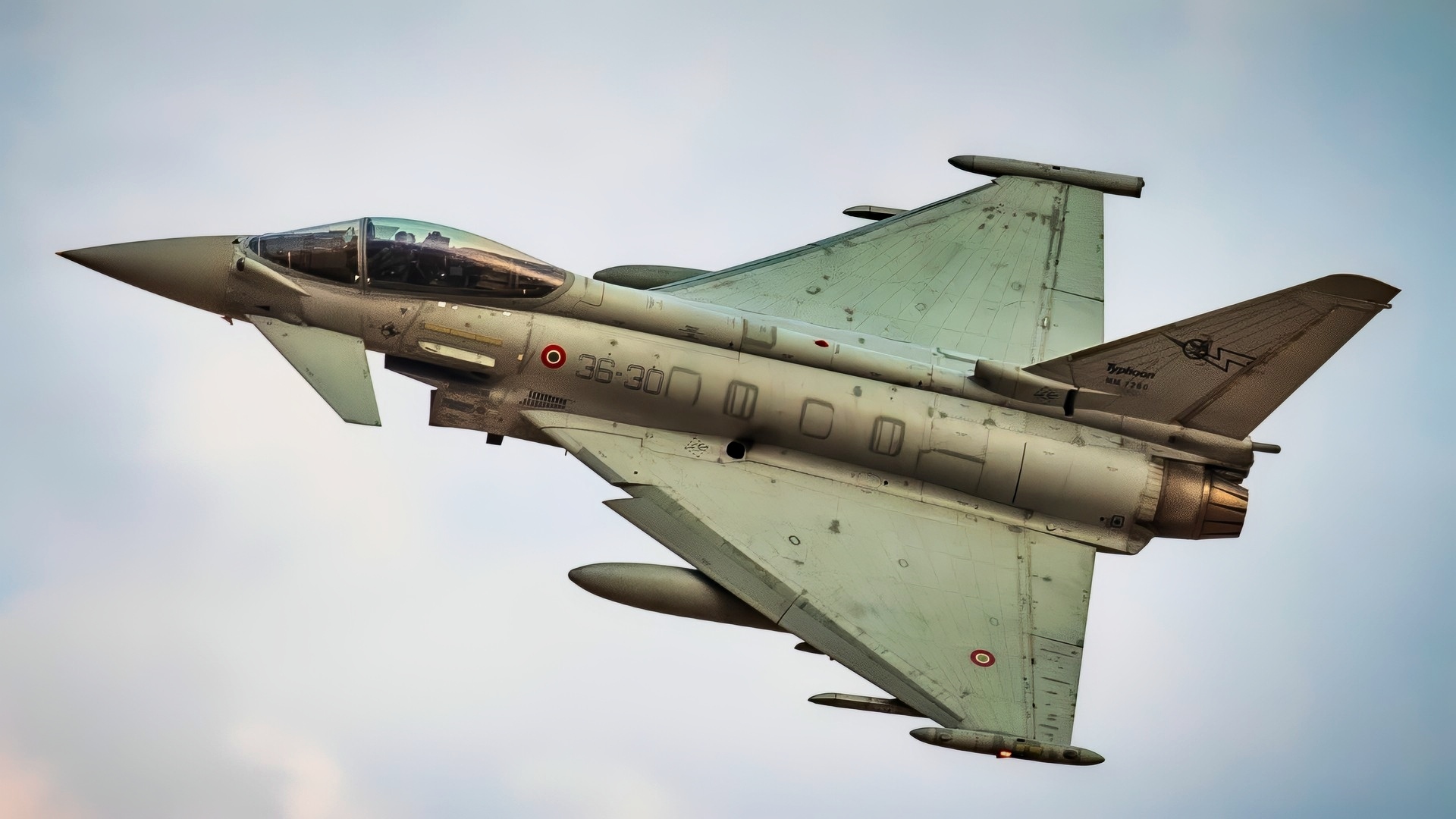
Key Points and Summary – Europe’s Eurofighter Typhoon is measured against America’s emerging F-47 (NGAD). Typhoon offers agility, E-Scan AESA, PIRATE IRST, DASS electronic warfare, and Meteor missiles, but lacks true stealth.
-The F-47 is expected to exceed Mach 2, deliver >1,000-nm combat radius, fuse sensors with AI, team with drones, and carry weapons internally.

NGAD. Image Credit. Lockheed Martin.
-Likely outcome: in BVR, the F-47’s low observability and sensing dominate; in WVR, Typhoon’s handling narrows the gap and pilot skill could decide.
-Bottom line: Typhoon remains a formidable swing-role fighter, while the F-47 promises a generational leap tailored for highly contested airspace. Specs and timelines for F-47 remain classified or provisional.
F-47 vs Eurofighter Typhoon: Can Europe’s Best Match America’s Next-Gen Jet?
The Eurofighter Typhoon is one of the most advanced fighters developed in Europe. It was built as a joint effort between many European nations and was intended to be the universal fighter of choice for the entire European Union.
It boasts a sophisticated set of EW capabilities, advanced avionics, and a high-performance power plant.
As the American F-35 has fallen out of favor, the Eurofighter has started to look more appealing to some nations.
However, America’s newest fighter has the final say in American air dominance. Descended from the NGAD program, the F-47 promises to usher in a completely new era of aerospace engineering.
But how much better is it than its European counterparts? Say there was a dogfight between the who in a mythical matchup? Who would win?
Well, the question isn’t easy to answer, primarily as little is known about the F-47 NGAD. However, based on what data we do have, here is what we know about such a matchup:
Europe’s Strongest Fighter vs America’s NGAD
Unfortunately, not much concrete information is known about the F-47’s design aside from some vague renderings. It is expected to enter service between 2025 and 2029 and is being designed with a focus on air dominance in highly contested environments, particularly against peer adversaries such as China.
Its design incorporates lessons learned from fifth-generation fighters like the F-22 and F-35, aiming to overcome limitations in range, stealth, and adaptability. The F-47 is expected to feature advanced stealth capabilities that surpass those of its predecessors, along with a combat radius exceeding 1,000 nautical miles and a top speed above Mach 2.
On the other hand, the Eurofighter Typhoon was developed by a consortium of European aerospace companies (Airbus, BAE Systems, and Leonardo) and has been in service since 2003. Originally conceived during the Cold War to counter Soviet threats, the Typhoon emphasizes agility, multirole flexibility, and interoperability among NATO allies.
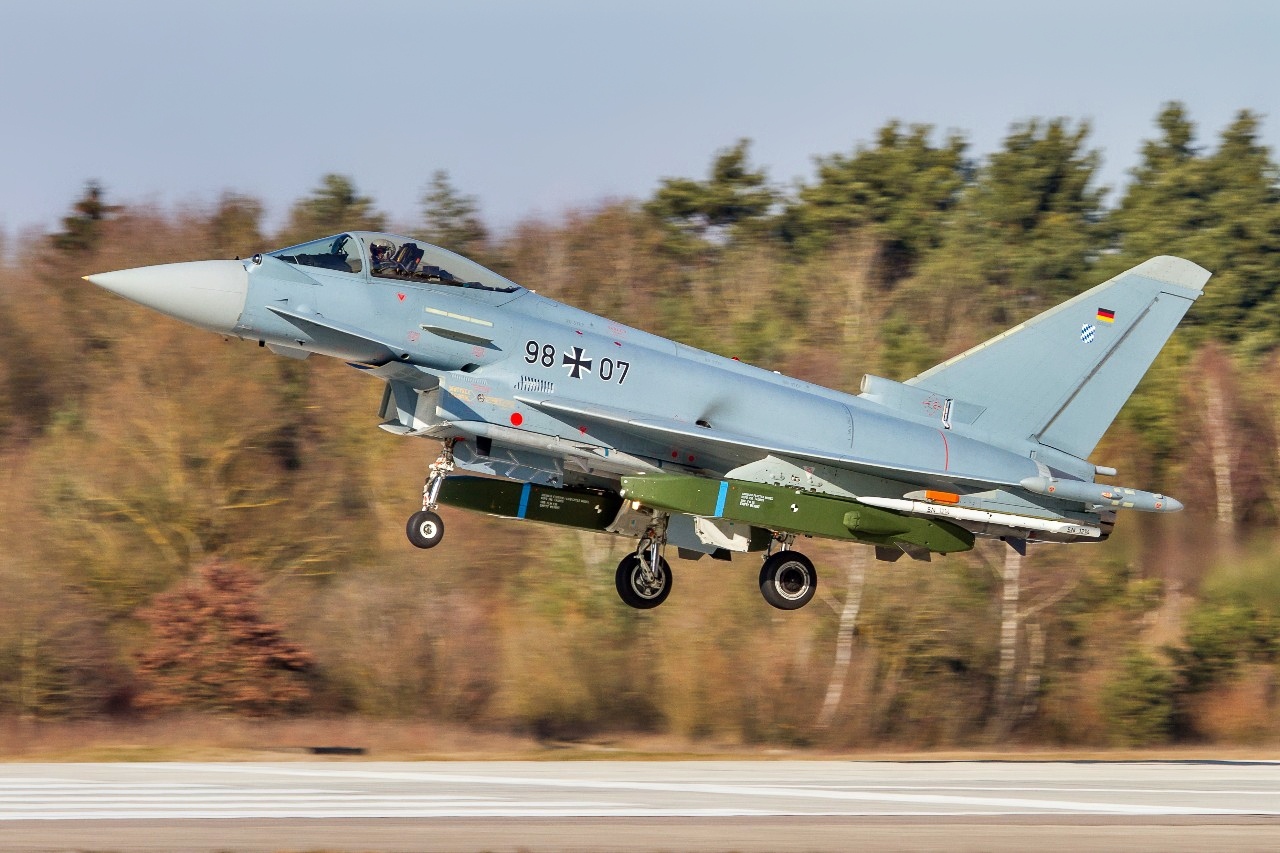
Taurus Missile on Eurofighter. Image Credit: Creative Commons.
It has evolved into a swing-role platform capable of both air-to-air and air-to-ground missions. The Typhoon can reach speeds of Mach 2 and has a combat radius of approximately 750 nautical miles. While it lacks the stealth of newer aircraft, it incorporates low-observable features and advanced electronic warfare systems to enhance survivability.
Avionics
Little is known about the F-47’s avionics as of yet. The Air Force has stated multiple times, however, that it is a quantum leap in capability.
It will likely integrate radar, infrared search and track (IRST), electronic warfare, and threat analysis into a seamless system.
This will allow the pilot to make faster, more informed decisions and maintain situational awareness in complex environments. The aircraft will also feature quantum-resistant communications and multi-domain awareness, enabling it to act as a command node for drone wingmen and other assets.
The Eurofighter Typhoon, while not as advanced in this area, still boasts impressive avionics. It is equipped with the E-Scan AESA radar, which offers a wider field of regard than traditional systems, and the PIRATE IRST system, which allows passive tracking of multiple targets.
Its Defensive Aids Sub-System (DASS) provides electronic countermeasures, missile warning, and threat prioritization. The cockpit is designed for efficiency, featuring a voice-command system and hands-on throttle and stick (HOTAS) controls.
Weaponry and Stealth
When it comes to weapons and payload, the F-47’s exact armament remains classified, but it is expected to carry advanced air-to-air missiles, possibly successors to the AIM-260.
It will likely use internal weapons bays to maintain stealth and deploy smart munitions via its drone wingmen. The Eurofighter Typhoon, by contrast, has a well-documented and versatile arsenal.
It can carry Meteor, AMRAAM, IRIS-T, and ASRAAM missiles for air-to-air combat, as well as Brimstone, Storm Shadow, Paveway IV, and SPEAR 3 for ground attack. It also features a 27mm Mauser cannon and can carry up to 7,500 kilograms of ordnance across 13 hardpoints.
Stealth and survivability are areas where the F-47 is expected to outperform the Typhoon significantly. Designed with next-level stealth in mind, the F-47 will use advanced materials, shaping, and electronic warfare systems to reduce its radar cross-section and evade detection.

Shown is a graphical artist rendering of the Next Generation Air Dominance (NGAD) Platform. The rendering highlights the Air Force’s sixth generation fighter, the F-47. The NGAD Platform will bring lethal, next-generation technologies to ensure air superiority for the Joint Force in any conflict. (U.S. Air Force graphic)
The Typhoon, while not a stealth aircraft, incorporates composite materials and low-observable features to reduce its radar signature. Its DASS suite provides robust protection against radar-guided threats, but it cannot match the stealth capabilities of a fifth-generation fighter, let alone a sixth-generation fighter.
The F-47’s powerplant is still unknown. It is reported to be highly maneuverable despite its stealth shaping, possibly incorporating thrust vectoring and adaptive flight control systems. Its top speed is confirmed to exceed Mach 2, and its extended combat radius will allow it to operate far from friendly bases.
The Eurofighter Typhoon is renowned for its agility, thanks to its delta-canard configuration and high thrust-to-weight ratio. It can supercruise and execute tight turns, making it a formidable opponent in close-range dogfights.
Who Wins in 4 Words: The Context Truly Matters
In a one-on-one combat scenario, the outcome would depend heavily on the engagement range.
In a beyond visual range (BVR) encounter, the F-47 would have the upper hand. Its superior stealth would make it difficult for the Typhoon to detect, and its advanced sensors and AI targeting systems would allow it to launch missiles before the Typhoon could respond.
While the Typhoon’s Meteor missiles are highly capable, the F-47’s stealth and countermeasures would likely reduce their effectiveness.
In a within-visual-range (WVR) dogfight, the situation becomes more complex. The Typhoon’s agility and thrust vectoring could give it an edge in close-quarters combat. However, if the F-47 retains its stealth advantage even at short range, it could still lock on to the Typhoon and intercept it.
The outcome depends on how well the F-47 balances stealth with maneuverability and how effectively it can counter the Typhoon’s superior agility.
About the Author: Isaac Seitz
Isaac Seitz, a Defense Columnist, graduated from Patrick Henry College’s Strategic Intelligence and National Security program. He has also studied Russian at Middlebury Language Schools and has worked as an intelligence Analyst in the private sector.
More Military
The Massive B-36J Bomber Has a Message for the U.S. Air Force
Russia’s Su-47 Fighter: Moscow Only Made 1 For Good Reason
B-52J vs. B-21 Raider: The Air Force Might Have a Bomber Problem


Ass
September 20, 2025 at 1:38 am
No contest
Kim Taylor
September 22, 2025 at 4:01 pm
This entire article is a nothingburger.