

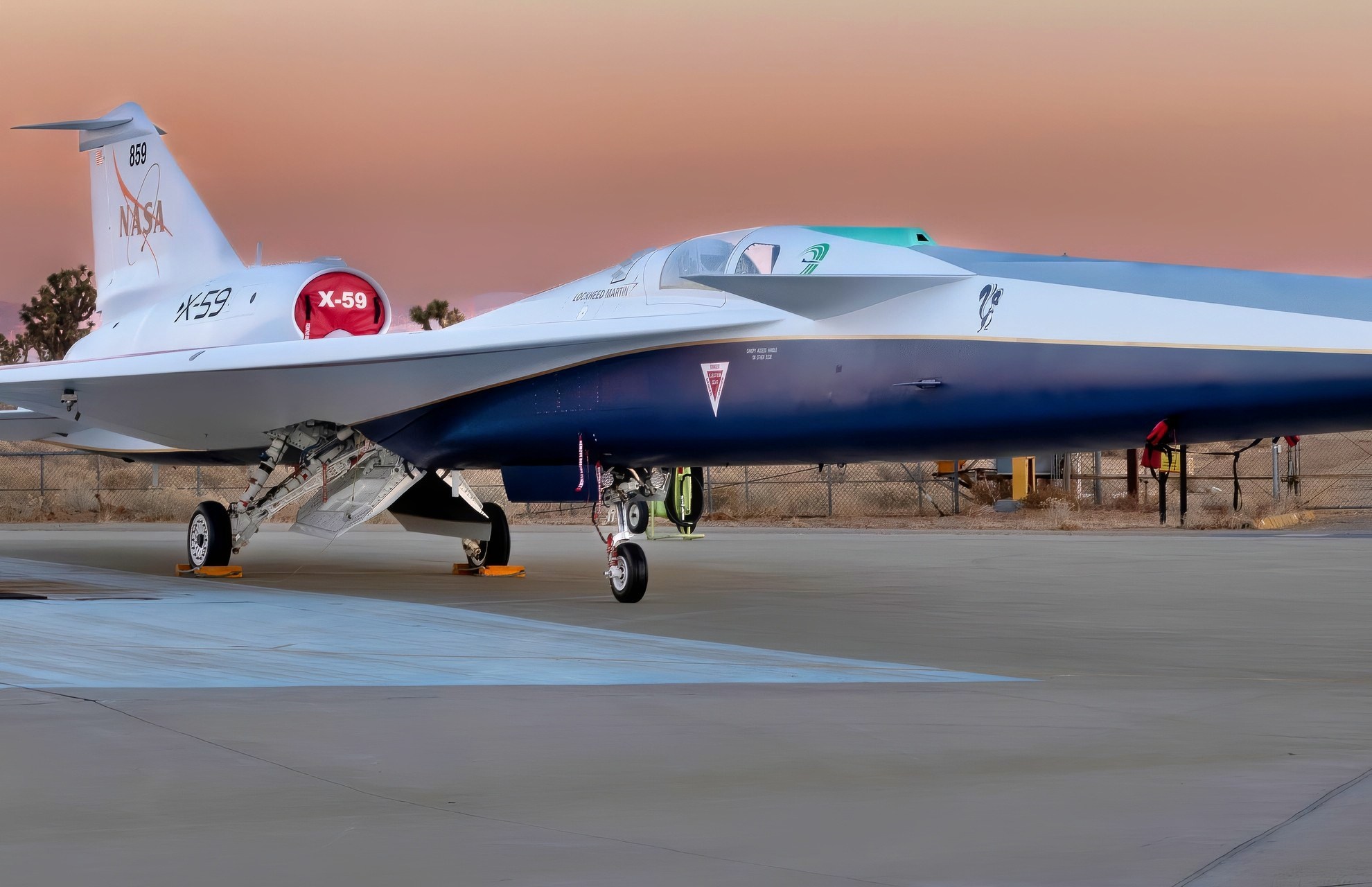
Key Points and Summary – NASA and Lockheed’s X-59 just flew, proving “quiet supersonic” can replace the sonic boom with a “gentle thump.”
-Designed to cruise at Mach 1.4 and 55,000 feet, the X-59 will gather community noise data to help set new overland rules—opening the door to two-hour DC–LA flights.
-Beyond commercial travel, the tech hints at military payoff: if adapted, Mach-class airlift could move troops, armor, and munitions twice as fast, reshaping expeditionary timelines and wide-area maneuver in future conflicts.
-The big picture: quieter supersonic flight isn’t a paper concept anymore; it’s a policy and logistics disruptor waiting to scale.
The X-59 Revolution
Anyone interested in traveling from Washington, DC, to Los Angeles at 925 mph might soon be able to get there in about two hours, less than half the time of the fastest currently available commercial airplanes.
Indeed, supersonic travel may have just become a reality, as Lockheed Martin has flown a first-of-its-kind supersonic aircraft, reducing the “sonic boom” to a “gentle thump.”
The ability to travel at supersonic speeds is, of course, here today, in the realm of 4th- and 5th-generation fighter jets, yet the sound-barrier breaking “boom” noise has made domestic supersonic commercial flight untenable, until now.
Should the X-59 aircraft evolve as expected, commercial passengers may quite realistically be able to fly coast to coast across the US in a few hours, rather than the current flight time of more than 5 hours.
The X-59 is engineered to travel at 925 mph and 55,000 feet; it reaches Mach 1.4, roughly twice the speed of today’s fastest commercial airliners.
Lockheed X-59
“The X-59’s successful development and flight testing will inform the establishment of new data-driven acceptable noise thresholds related to supersonic commercial flight over land, paving the way for a new generation of supersonic aircraft that can efficiently and sustainably transport passengers and cargo twice as fast as aircraft today,” a Lockheed statement said.
The X-59 took off from Skunk Works’ facility at US Air Force Plant 42 in Palmdale, California, before landing near NASA’s Armstrong Flight Research Center in Edwards, California.
“The X-59 performed exactly as planned, verifying initial flying qualities and air data performance on the way to a safe landing at its new home,” the Lockheed essay said.
Lockheed and NASA successfully completed the flight as part of a joint effort to explore the prospect of ultra-high-speed commercial flight.
“X-59 is a symbol of American ingenuity. The American spirit knows no bounds. It’s part of our DNA – the desire to go farther, faster, and even quieter than anyone has ever gone before. This work sustains America’s place as the leader in aviation and has the potential to change the way the public flies,” said Sean Duffy, acting NASA Administrator.
Military Applications?
While the NASA-Lockheed joint venture is decidedly aimed at commercial flight, the ability to transport hundreds of forces, weapons, and equipment at Mach 1.4 would undoubtedly have some clear military implications.
The fastest current US Air Force cargo plane, the C-17 Globemaster III, can travel at speeds up to 518 mph while carrying tanks. Mach speeds bring substantial tactical significance.
The X-59: Joining the U.S. Military?
Should the X-59 technology evolve as expected, weapons developers are likely to envision engineering a US Air Force tank and a troop-transporting cargo aircraft capable of traveling at 925 mph.
This advancement would be tactically significant in the event of a great-power conflict, as tanks, artillery, armored vehicles, and forces could be transported to a required combat location twice as quickly.
This could change the pace of assault, offer new methods of “closing with an enemy,” and expedite Combined Arms Maneuver operations.
The potential military significance here is difficult to overstate, given the Army’s long-standing focus on expeditionary warfare and deployability.
Traditionally, heavy armor has proven quite difficult to deploy, mobilize, or maneuver quickly within a combat theater.
However, if tanks and infantry carriers can travel at Mach 1.4 from one combat location to another where they are urgently needed, armored warfare tactics could change dramatically.
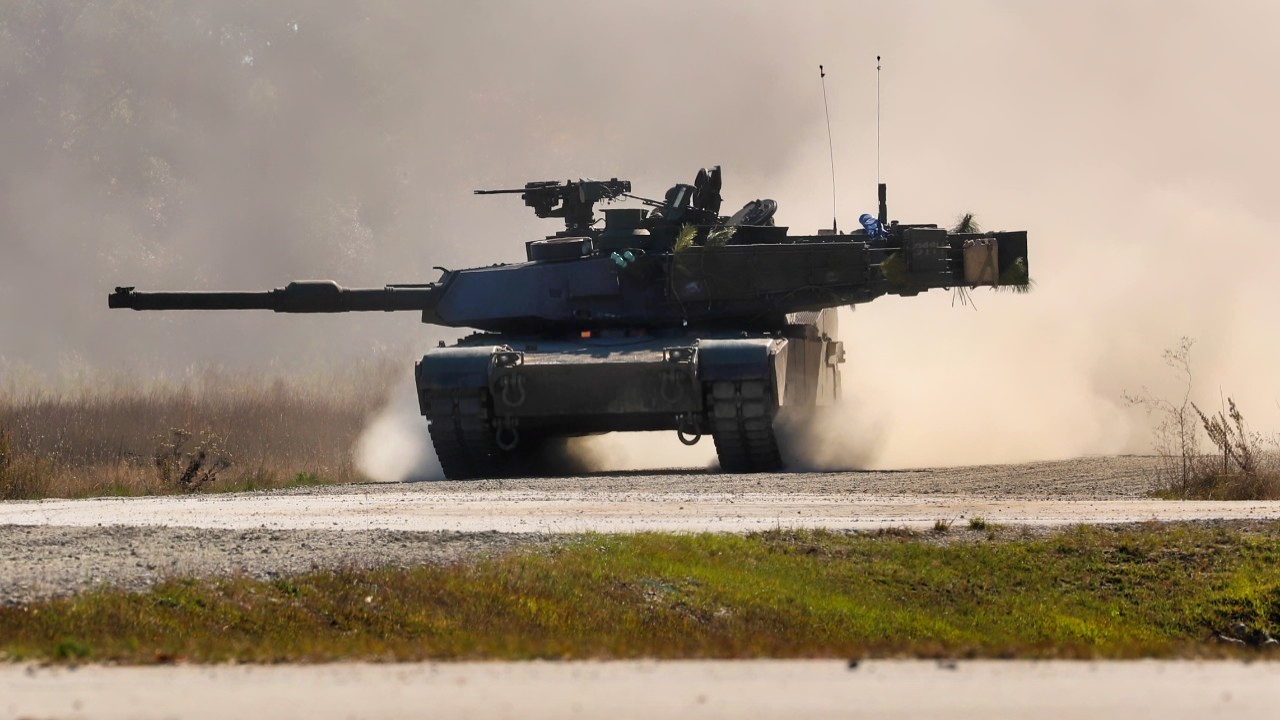
A M1A2 Abrams SEPv3 Main Battle Tank navigates a range during a Combined Arms Live Fire Exercise (CALFEX) at Fort Stewart, Georgia, Nov. 8th 2023. Tank crews honed their skills to ensure proficiency of eliminating targets while coordinating with other tank crews. (U.S. Army photo by Pfc. Luciano Alcala)
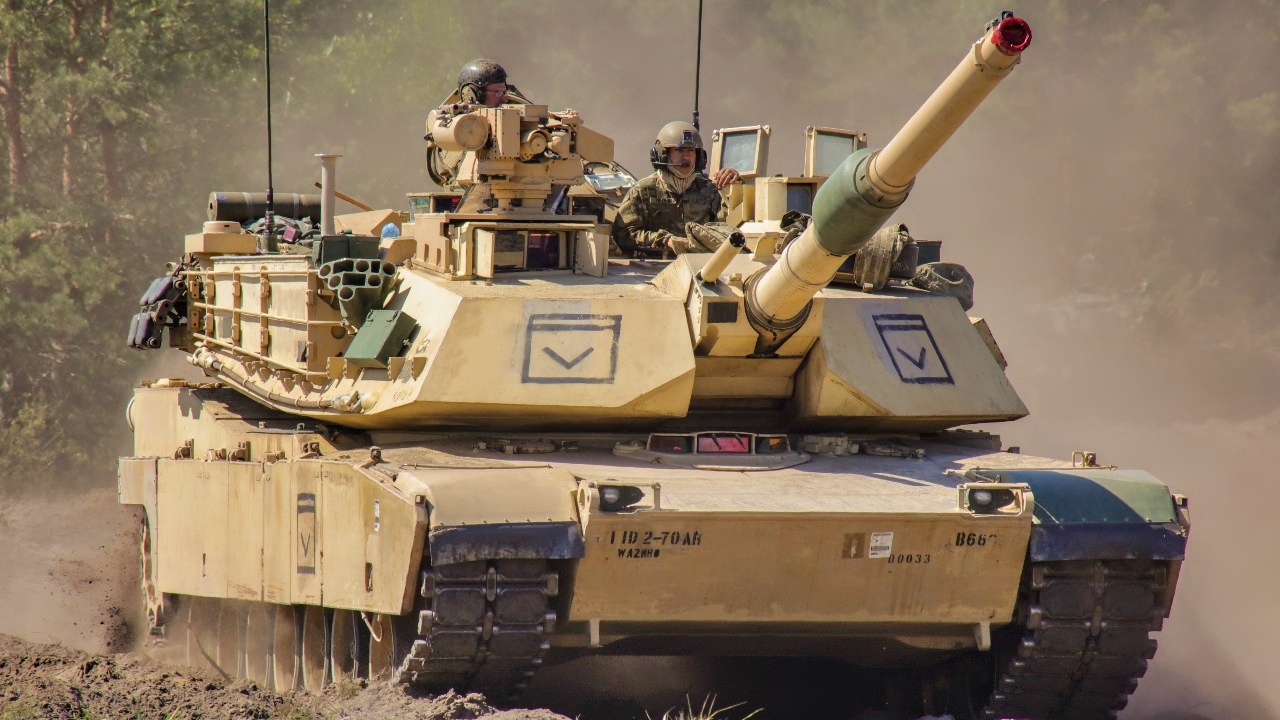
U.S. Soldiers assigned to 2nd Battalion, 70th Armor Regiment, 2nd Armored Brigade Combat Team, 1st Infantry Division supporting the 4th Infantry Division, maneuver an M1A2 Abrams tank while participating in a combined arms rehearsal during Anakonda23 at Nowa Deba, Poland, May 14, 2023. Anakonda23 is Poland’s premier national exercise that strives to train, integrate and maintain tactical readiness and increase interoperability in a joint multinational environment, complimenting the 4th Inf. Div.’s mission in Europe, which is to participate in multinational training and exercises across the continent while collaborating with NATO allies and regional security partners to provide combat-credible forces to V Corps, America’s Forward deployed corps in Europe. (U.S. Army National Guard photo by Sgt. 1st Class Theresa Gualdarama)
For many years, the Army has been working to become more expeditionary by engineering lighter-weight platforms, unmanned systems, and multi-domain networking.
A simple ability to move heavy armor from one combat location to another at twice the speed opens up previously impossible land war maneuver possibilities.
There is also the question of force mobilization, as combat contingencies may urgently require troop reinforcements.
The speed of travel for infantry and weapons at scale could completely change the outcome of a given war circumstance.
Wide Area Maneuver
Speed of travel is also of great consequence in the context of a modern or future battlefield, given that the ranges of sensors and weapons, and the fast-evolving multi-domain character of warfare, mean that combat theaters will continue to grow much larger and more expansive than ever before.
Weapons and formations will operate at much greater distances and communicate more quickly and easily across air, land, and sea domains.
Simply put, the battlefield is becoming more expansive in an almost exponential manner, so the speed of travel in combat over great distances would be of great tactical consequence.
About the Author: Kris Osborn
Kris Osborn is the President of Warrior Maven – Center for Military Modernization. Osborn previously served at the Pentagon as a highly qualified expert in the Office of the Assistant Secretary of the Army—Acquisition, Logistics & Technology. Osborn has also worked as an anchor and on-air military specialist at national TV networks. He has appeared as a guest military expert on Fox News, MSNBC, The Military Channel, and The History Channel. He also has a Master’s Degree in Comparative Literature from Columbia University.
More Military
Canada’s F-35 Fighter Debate Summed Up in 3 Words
The U.S. Air Force’s B-52J Bomber Crisis
Mach 5.1 X-51 Waverider ‘Hypersonic Scramjet’ Has a Message for the Air Force
Beast Mode: How the F-35 Stealth Fighter Bolts on 22,000 Pounds of Bombs


Andrew
November 2, 2025 at 6:24 pm
I think you’ll find supersonic travel was already realised nearly 50 years ago…
Andrei Luzinov
November 4, 2025 at 3:27 pm
As soon as US collides with Russia or China everything quicky turn into thermonuclear apocallysis. But this cannot be sold so let continue listen stories but millitary nightnares.