

The return of hostilities between the United States and Iran has led to a double-digit increase in oil prices in the span of just a week.
According to oilprice.com, oil prices were set for a 12 percent weekly gain, the largest one-week jump since April.
“The re-escalation in the Middle East and the abrupt halt to the recovery of Strait of Hormuz flows pushed crude futures prices to the highest in over a month,” the report said.
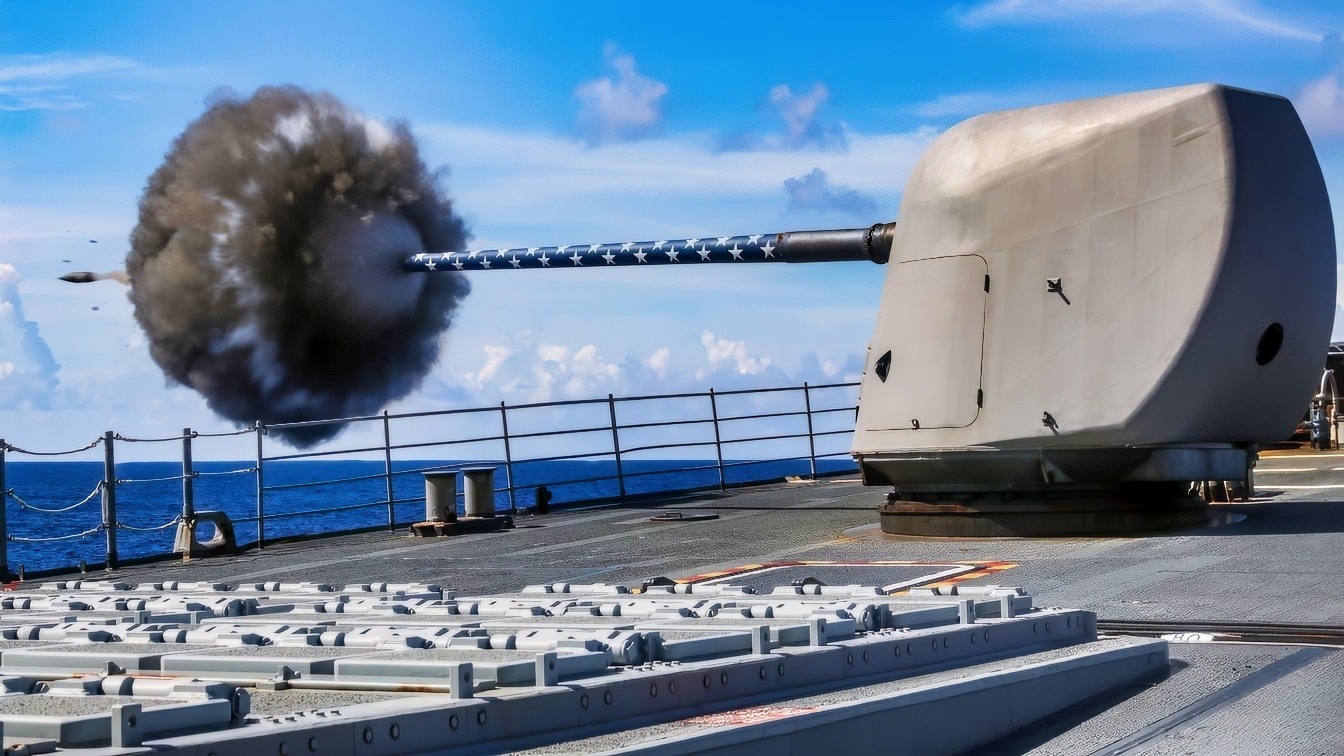
PACIFIC OCEAN (July 29, 2025) The Ticonderoga-class guided-missile cruiser USS Princeton (CG 59) fires its forward Mark 45 5-inch gun during a weapons maintenance shoot, July 29, 2025. The Carl Vinson Carrier Strike Group is underway conducting routine operations in the U.S. 3rd Fleet area of operations. (U.S. Navy photo by Mass Communication Specialist 1st Class Jacob I. Allison)
Brent Crude futures were listed at $85.06 on Friday, after going over $86 earlier in the week. WTI Crude reached $79.88 per barrel.
The gains in oil prices come as the U.S. has initiated another blockade of the Strait of Hormuz, while continuing to strike at targets in Iran. The goal of the blockade is to “deprive Iran of the ability to export its oil,” and that shock to supply has affected oil prices worldwide.
Per CNBC, Kuwait said this week that Iran attacked its water, desalination, and power plant. Iran, CNBC said, has claimed that it attacked U.S. targets in Bahrain, Jordan, Kuwait, Oman, Qatar, and Syria.
All of that is starting to affect gas prices in the U.S.

NAVAL AIR STATION NORTH ISLAND, Calif. (July 10, 2024) USS George Washington (CVN 73) arrives at Naval Air Station North Island, July 10, 2024. USS George Washington and crew are in the process of completing a homeport change, replacing USS Ronald Reagan (CVN 76) as the forward-deployed U.S. Naval Forces Japan aircraft carrier at Fleet Activities Yokosuka, Japan.(U.S. Navy photo by Mass Communication Specialist 1st Class Keenan Daniels)
Per AAA, the average gas price in the United States is approaching $4 per gallon, up 10 cents from the previous week to $3.94. The national average was over $4 throughout April and May, and for most of June, before dropping after the mid-June ceasefire deal was reached.
Tanker Traffic “Erodes”
On Thursday, the first full day of the new blockade, only 13 ships passed through the Strait of Hormuz, down from 21 the day before, the New York Times reported, citing the maritime data firm Kpler.
This blockade, the Times said, has the potential to affect oil prices even more than the previous one in the spring did, because “global oil reserves are even lower as national and commercial stockpiles were tapped to minimize shortages.”
The Wall Street Journal reported something similar on Friday: if gas prices rise, they will likely remain higher for longer.
“President Trump has succeeded at times in calming crude-oil markets even as the Iran war rages on. But he doesn’t have the same sway over gasoline prices, which ultimately matter more to consumers,” the Journal said.
And as noted earlier this week, the drop in gas prices during the pause in the war was enough to bring inflation down in the United States in June. But with the war resuming and the Strait of Hormuz closing again, that relief is unlikely to last.
“Gasoline prices are already back above June levels, meaning the next inflation report will heat up again,” Ipek Ozkardeskaya, senior analyst at Swissquote Bank, said this week, per The BBC.
The Latest U.S. Strikes
U.S. Central Command said in a statement Thursday night that “U.S. forces, including fighter jets, aerial drones, and warships, launched precision munitions that hit dozens of Iranian military targets such as coastal surveillance and air defense sites, military logistics infrastructure, and maritime capabilities. This was the sixth consecutive night of U.S. strikes against Iran.”
It was the sixth night of U.S. strikes since hostilities resumed.
“Every inch of territory is equally important,” Iranian Brig. Gen. Seyyed Majid Mousavi said Friday, CBS News reported. “Our effective and targeted strikes against the enemy, launched from across Iran, will continue until security and calm are restored along the southern coastline and in the Strait of Hormuz.”
Iran, as of Friday morning, claimed that 38 people had been killed and 400 wounded in U.S. strikes in the last month.
“Among the casualties are 22 injured women, three women killed, nine injured minors under the age of 18, and one child killed,” Hossein Karmanpour, head of the ministry’s information center, said this week, per CBS News.
Additionally, CBS, citing the AFP news service, reported that while Iran has claimed to have struck a military base used by U.S. forces in Syria, a Syrian military source has denied that this is the case.
“We deny any Iranian bombardment targeting the Al-Tanf area,” a Syrian military source told AFP.
MORE – Russian Soldiers in the Ukraine War Might Last Just 30 Minutes
About the Author: Stephen Silver
Stephen Silver is an award-winning journalist, essayist, and film critic, and contributor to the Philadelphia Inquirer, the Jewish Telegraphic Agency, Broad Street Review, and Splice Today. The co-founder of the Philadelphia Film Critics Circle, Stephen lives in suburban Philadelphia with his wife and two sons. For over a decade, Stephen has authored thousands of articles that focus on politics, national security, technology, and the economy. Follow him on X (formerly Twitter) at @StephenSilver, and subscribe to his Substack newsletter.


