

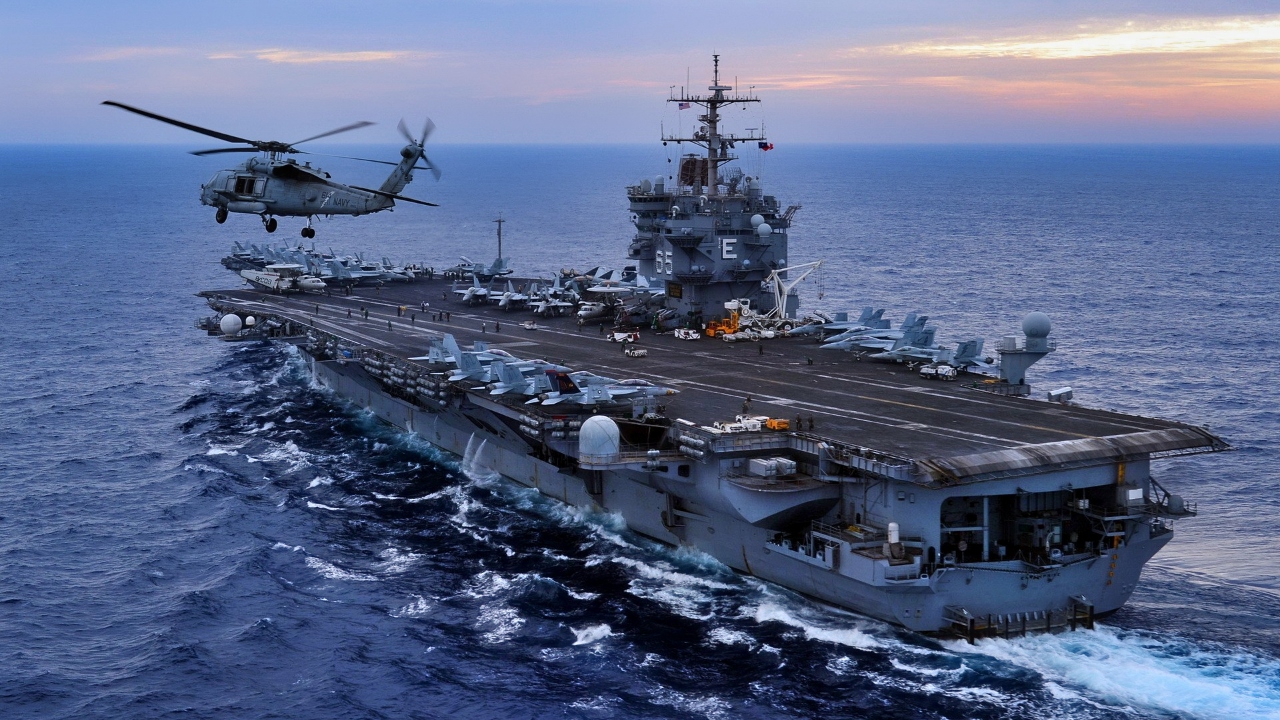
Key Points: Dismantling the USS Enterprise (CVN-65), the world’s first nuclear-powered aircraft carrier, presents the US Navy with an unprecedented, complex, and costly challenge.
-Standard disposal methods like sinking for target practice (SINKEX) or conversion to a museum are impossible due to residual hazardous materials and the eight nuclear reactors deeply integrated into its structure, which require invasive removal.
-The multi-year scrapping process, estimated to cost over half a billion dollars under the preferred plan, involves careful handling of these materials. Lessons learned from the “Big E’s” disposal will establish procedures for retiring the subsequent Nimitz-class nuclear carriers.
Sinking the USS Enterprise Would be Easier Than Scrapping Her
The USS Enterprise, CVN-65, was the first nuclear-powered aircraft carrier.
Launched in 1958, it was the eighth vessel in the US Navy to carry the Enterprise name. Like her World War II predecessor, her crew nicknamed her “The Big E.”
The vessel had a long, distinguished career in modern US Navy history, including the blockade of Cuba during the Cuban Missile Crisis; aerial combat and bombardment missions during the Vietnam War; the evacuation of the US Embassy during the fall of Saigon; the bombing of Al Qaeda and Taliban installations after 9/11; and duty in the Persian Gulf in support of Operation Enduring Freedom.
She made her final deployment in 2012 and was deactivated later that year. She was decommissioned in 2017.
At the time of inactivation, the Big E was the third-oldest commissioned vessel in the United States Navy after the wooden-hulled USS Constitution and USS Pueblo (AGER-2).
USS Enterprise was a tough ship and would have been a most challenging carrier to sink in combat. But as it turns out, it may be easier to sink than scrap her.
Scrapping Nuclear Powered Carriers is a First
The USS Enterprise has been sitting in the HII Shipyard in Newport News, VA, for over a decade while the Navy decides the best way to dismantle it. In late fall 2023, the Navy decided to relocate the Enterprise to a private shipyard, where she will be dismantled and scrapped.
According to the draft plan, first reported by The Kitsap Sun, that option would cost $554 million to $696 million and take five years, compared to the other two alternatives, which would last 15 years and cost $1.102 billion to $1.358 billion.
The Navy also considered a no-action alternative, where the Navy would store the USS Enterprise long-term.
The Navy established the first Nuclear-Powered Aircraft Carrier (CVN) Inactivation and Disposal Program Office (PMS 368) within the Program Executive Office Aircraft Carriers (PEO CVN).
This group will set up the multi-billion-dollar effort required for dismantling and disposing of the former USS Enterprise (CVN 65) and the future inactivation, dismantlement, and disposal of USS Nimitz (CVN 68)-class aircraft carriers.
Lessons learned on Enterprise will be used to inform potential disposal options for the 10 Nimitz-class ships in the aircraft carrier fleet as they retire over time.
SINKEX Not a Consideration For USS Enterprise
The Navy has a way of disposing of old ships: it provides the vessels for target practice for the active duty training of ships and aircraft. The Navy calls these operations SINKEXs.
However, with the Enterprise and other nuclear-powered aircraft carriers, they can’t be used for a SINKEX.
Although the reactors and nuclear fuel rods have been removed, the Navy’s Puget Sound Naval Shipyard and Intermediate Maintenance Facility said in a statement that there are still “legacy radiological and hazardous wastes” on board.
CVNs Can’t Be Museums
Many former crew members and citizens would love to see the carriers turned into museums for the public to enjoy for generations. But this can’t be done either. Andy Burns, a former surface warfare officer and flight officer, explained why this isn’t feasible.
He said nuclear-powered ships are built around their reactors and the associated machinery. Removing the reactors without essentially taking the ship apart is impossible. For obvious reasons, the Navy doesn’t want to (and can’t, per environmental laws and regulations) simply leave them in place.
Nuclear subs are chopped up when decommissioned, and their reactors are removed, sealed up, and shipped off to a long-term secure storage facility in eastern Washington.
“Enterprise will probably have to be similarly disassembled, and unlike the Nimitz class boats, she has eight reactors.
That process will be so invasive that reassembling her afterward would be cost-prohibitive, if not practically impossible,” he added.
The Navy Has Experience With Removing Reactors, Just Not With Carriers
The Navy has removed and disposed of 142 reactor compartment packages since 1986, so this isn’t completely new. However, they have never had to do so with a 1,100-foot-long supercarrier.
Because submarines are built in sections, the workers in the shipyard cut out the sections of a submarine that houses the reactor. And the subs have just a single reactor; the USS Enterprise has eight. Follow-on carriers of the same class have only two reactors.
Nuclear power plants inside an aircraft carrier were still in infancy when construction began in 1958.
The Enterprise will still take a long time to disassemble, but the work done on her scrapping will make things easier for the other carriers because of the lessons learned.
And The Big E won’t be gone entirely. The Navy is saving 18 tons of steel from scrapping, which will go into the next Ford-class carrier, the Enterprise.
About the Author: Steve Balestrieri
Steve Balestrieri is a National Security Columnist. He served as a US Army Special Forces NCO and Warrant Officer. In addition to writing on defense, he covers the NFL for PatsFans.com and is a member of the Pro Football Writers of America (PFWA). His work was regularly featured in many military publications.
This first appeared last month and is being recirculated due to reader interest.


Jim S. VF33
April 3, 2025 at 10:38 am
No mention of operation sea orbit. 1964 world cruise.