


As the series of successful Ukrainian strikes on Russia’s oil and gas infrastructure has demonstrated, Kyiv can inflict meaningful, long-term damage on several key nodes in Russia’s energy extraction, refining, and export, though Ukraine would be unlikely to force a complete Russian energy shutdown. Still, the ongoing Ukrainian strike campaign has forced Russia to shutter some of its oil output, but Russia has adapted by rerouting some energy product flows and has managed to continue energy exports at substantial, though somewhat crimped, volumes.
What Ukraine’s Energy Infrastructure Strike Can Achieve

Aerial drone image of Bradley Fighting Vehicle crews from the 1st Armor Brigade Combat Team, 3rd Infantry Division, conducting Table XII gunnery at Fort Stewart, Ga. December 7, 2016.
One of the largest impacts of the Ukrainian campaign has been on Russia’s energy refining and logistics capacity, rather than necessarily on Russia’s ability to extract energy — that is, pump oil — from the ground. Reuters, a wire service, reports that Ukrainian strikes reduced Russia’s refining capacity by about 700,000 barrels per day from January to May of this year, while the IEA maintains that Russia’s crude output in April was down by approximately 460,000 barrels per day. That means, simply, that Ukrainian strikes are not just causing costly but repairable explosions. Instead, they are creating recurring bottlenecks that reduce fuel availability and make servicing and maintaining infrastructure more complex and costly. Over time, this will eventually pinch Russia’s energy revenues and consequently its ability to finance the ongoing invasion and occupation of Ukraine.
The export of oil and gas is the largest source of Russian budget funding, and the longer Ukraine can put pressure on Russia’s refineries and pipelines, the less profitable Russia’s energy ventures become. Repairs, shuffling of air defenses, and strain on spare parts stockpiles all add up.
The Limitations Ukraine Faces
Despite some of the significant successes Ukrainian strikes have had — Ukrainian President Volodymyr Zelensky famously dubbed them Ukraine’s “long-range sanctions” — there are limits to what these strikes can achieve.
Here, geography plays to Russia’s advantage, as its energy sector is both large and geographically dispersed, allowing for some redundancy within the system. It is also a hedge against a single, highly destructive knock-out blow.
The fact that Russia still manages to send energy exports abroad to international customers is evidence that efforts to soften Ukraine’s blows have been at least partially successful.

S-70 Drone VIA X Screenshot. Image Credit: X Screenshot.
But Ukraine plays a precarious game. Attacking Russia’s infrastructure risks raising global oil prices, which can partially offset revenue otherwise lost, as Russian energy taxation is more closely tied to production and pricing than to exports.
The risk is that Ukrainian strikes can hurt Russia badly without necessarily creating the conditions for a steep and prolonged collapse in Russian state income.
Ukraine’s Improving Drone Capabilities
Ukraine’s long-range drone ecosystem is improving in several areas, most notably in range, evasion of interception, and production numbers. Ukraine reportedly has interceptor drones capable of hitting targets hundreds of kilometers, and in some cases thousands of kilometers, away.
One of the most recent Ukrainian strikes occurred at an oil refinery in Yaroslavl, nearly 450 miles from the Ukraine-Russia border, which produced about 300,000 barrels per day. Reuters published a more complete list of strikes on Russian energy infrastructure, which can be read in full here.
Tit-for-tat Strikes
Germany recently completed delivery of badly needed air defense equipment to Ukraine, but the need for additional air defense interceptors and batteries remains acute. “We thank Germany for its constant contribution to protecting people; thousands upon thousands of lives have been saved thanks to such strong support,” President Zelensky wrote on X, formerly Twitter. “But,” he added, “we also need missiles for air defense systems so that we have sufficient capabilities to repel Russian attacks.”
Possible Long-term Outcomes: Energy Production Degradation, not Collapse
One of the more likely longer-term outcomes for Russia’s energy production capacity is not necessarily a complete collapse, but rather a degradation.
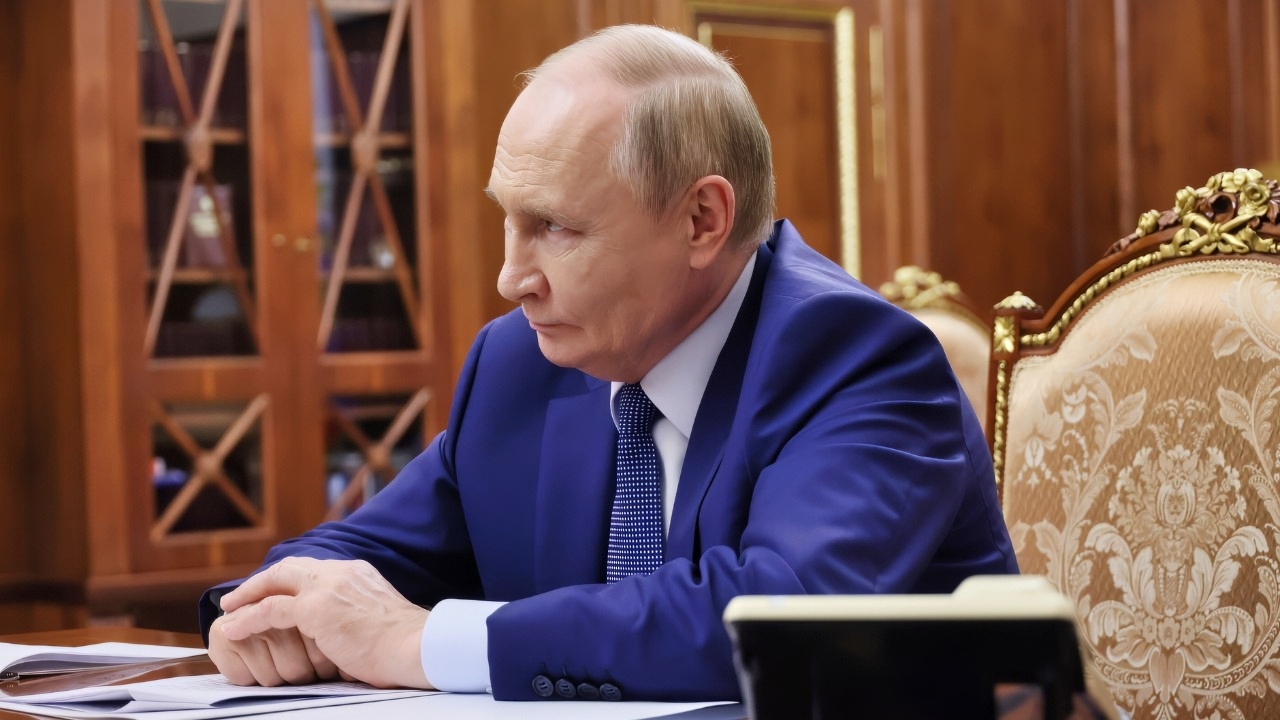
Putin in 2025 Looking Stern. Image Credit: Creative Commons.
Ukraine can continue to make refining, storage, and energy exports more expensive and less reliable. Evidence of this is already crystallizing — reports indicate that Russia’s refining network is under intense strain, and several major refineries are either offline or operating at reduced capacity.
Still, Russia has some leeway and can repair damage, reroute product flows, and, perhaps most importantly, improve air defenses at particularly important sites. Ukraine’s air campaign is certainly capable of eroding Russia’s energy capabilities in the medium to long term, but inflicting broad, long-lasting damage is less likely.
The Ukrainian drone campaign against Russia’s energy infrastructure is certainly exerting new and acute pressure on Russia’s ability to finance and wage war on Ukraine — but it likely won’t be able to win the war in Kyiv’s favor all on its own.
About the Author: Caleb Larson
Caleb Larson is an American multiformat journalist based in Berlin, Germany. His work covers the intersection of conflict and society, focusing on American foreign policy and European security. He has reported from Germany, Russia, and the United States. Most recently, he covered the war in Ukraine, reporting extensively on the war’s shifting battle lines in the Donbas and writing about its civilian and humanitarian toll. Previously, he worked as a Defense Reporter for POLITICO Europe. You can follow his latest work on X.


