

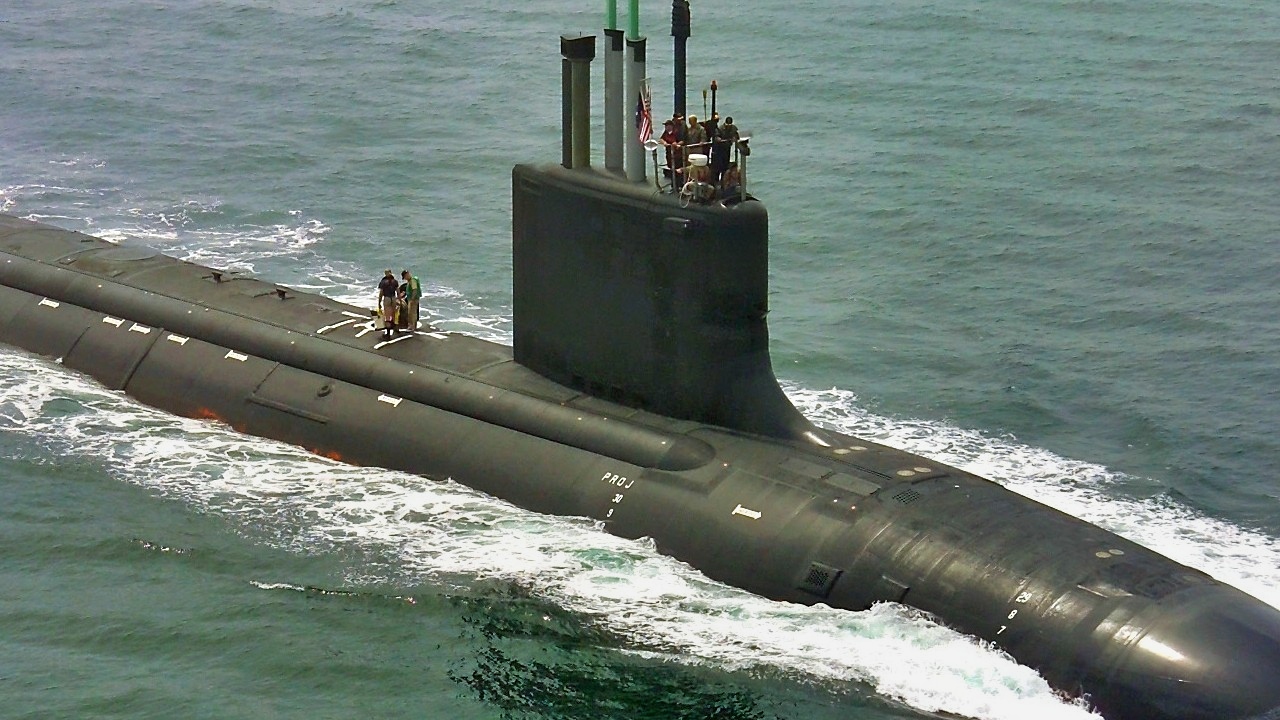
The latest iteration of the Virginia-class will have a greatly expanded missile capacity and a significantly upgraded sonar capability.
The United States Navy has been procuring the Virginia-class submarines since 1998. The first of the class entered service in 2004.
The submarines in the class have been the first since the end of the Cold War and were designed as a cheaper option compared to previous submarine designs.
To that end, they were the first submarines designed extensively using Computer-Aided Design, or CAD, and are optimized for post-Cold War mission profiles.
Why the Virginia-Class? A Seawolf-class Alternative
The Virginia-class was initially envisioned as a more cost-effective alternative to the US Navy’s highly advanced but expensive Seawolf-class.
Those submarines had been explicitly designed as submarine hunters built to find and destroy the most advanced Soviet submarines in existence.
But, thanks to the end of the Cold War and the economic crisis in the former Soviet Union, many of the most advanced Soviet submarine projects were delayed indefinitely, severely curtailing the Seawolf-class to just three submarines.
Block V Virginia-class
Compared to the four preceding Virginia-class iterations, the latest Block V will significantly differ in capabilities and outward appearance. Thanks to the addition of four vertical launch tubes aft of the sail, the Block Vs will be about 84 feet longer and boast significantly more offensive firepower. These launch tubes can pack seven Tomahawk cruise missiles inside.
Though more missile tubes do indeed translate to more weaponry, the Block Vs will also be armed with the latest, upgraded Tomahawk missile that expands the weapon’s capability from a land-attack weapon and adds an anti-ship capability, too.
Though speculative, it is possible that the Block Vs could become the first submarines to be equipped with hypersonic weapons, depending on the development timeline of the US Navy’s hypersonic weapon program.
And, of course, the submarines will retain a torpedo capability as well as the ability to lay new and highly advanced underwater mines.
A helpful guide and infographic provide a detailed breakdown of Block V’s offensive capabilities.
Ping, Ping, Ping
In addition to weaponry, the Block V Virginias will also boast a new sonar array, the Large Vertical Array flank sonars, complementing their Light Weight Wide Aperture Arrays, which are arranged on the side of the submarine’s hull.
In addition to the more significant amount of weaponry afforded by the extra Virginia Payload Modules, “the Navy is introducing acoustic and other improvements to the Virginia-class design that are intended to help maintain the design’s superiority over Russian and Chinese submarines.”
The improvements embodied by the Block V Virginia-class will make the submarines some of the most heavily armed submarines in United States naval history and turn them, in essence, into cruise missile submarines.
There is also potential for some Virginias to be exported to Australia as part of the AUKUS submarine technology sharing agreement between the United States, the United Kingdom, and Australia, though this would likely not happen before the early 2030s.
Cost Overruns
One of the more recent snags to hit the Virginia-class has been ballooning costs. The Fiscal Year 2024 defense spending bill allocated $9.4 billion for two Block V Virginias.
Still, an increase in supply costs and labor costs meant that the money provided for the two submarines was about $2 billion short.
About the Author: Caleb Larson
Caleb Larson is an American multiformat journalist based in Berlin, Germany. His work covers the intersection of conflict and society, focusing on American foreign policy and European security. He has reported from Germany, Russia, and the United States. Most recently, he covered the war in Ukraine, reporting extensively on the war’s shifting battle lines from Donbas and writing on the war’s civilian and humanitarian toll. Previously, he worked as a Defense Reporter for POLITICO Europe. You can follow his latest work on X.


