
For months, the Strait of Hormuz has faced intense disruption, with traffic down by as much as 95%. The narrow waterway, which typically carries one-fifth of the world’s oil supply, has seen commercial traffic plummet amid hostilities between Iran, the United States, and Israel. Despite the disruption, oil prices per barrel have yet to reach some of the most severe estimates. In March, Wall Street analysts predicted that oil could soar to $200 per barrel. Today, Brent Crude hovers around $93 per barrel, and West Texas Intermediate (WTI) is about $91.
Prices have increased as pump prices reach record highs in the United States, and both Asian and European markets are looking to the United States and other suppliers to make up for the shortage of Gulf oil.

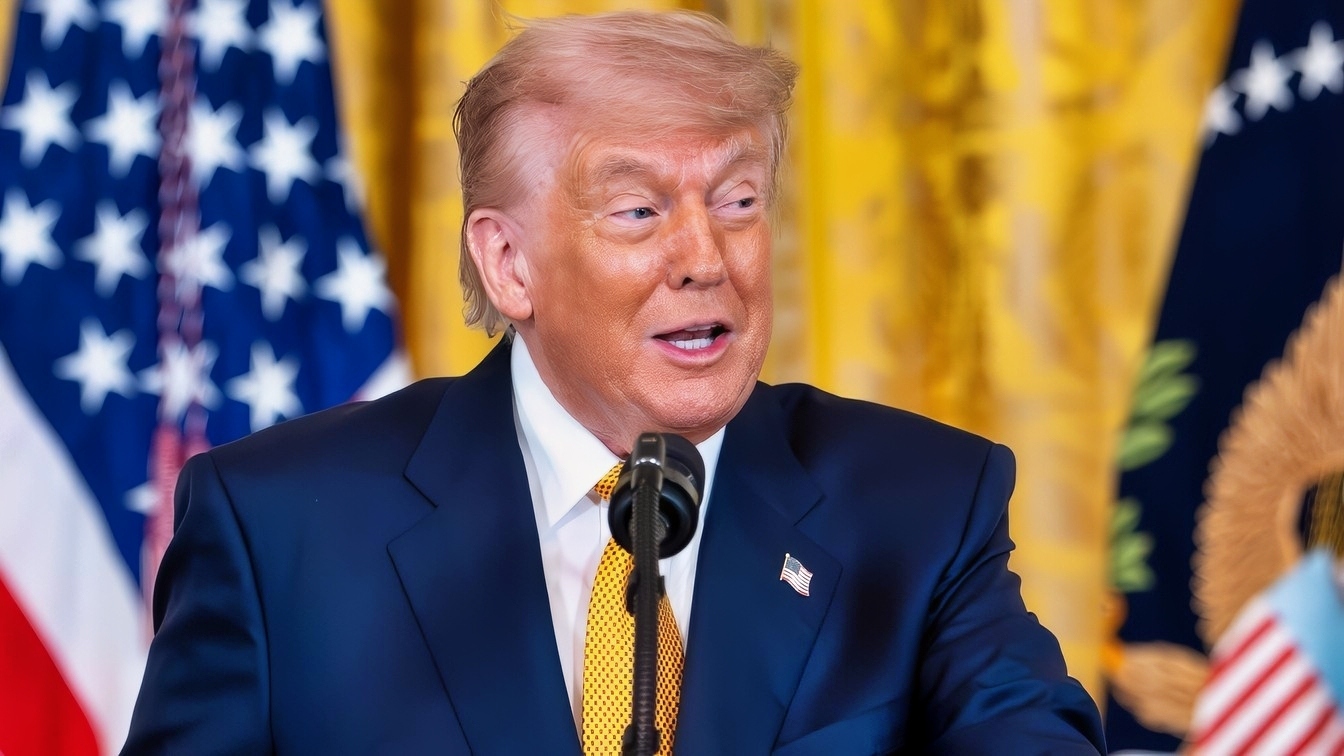
President Donald Trump is joined by Secretary of Commerce Howard Lutnick, Vice President JD Vance, British Ambassador Peter Mandelson, U.S. Trade Representative Jamieson Greer, and Secretary of Agriculture Brooke Rollins, while announcing a trade agreement with the U.K., Thursday, May 8, 2025, in the Oval Office. (Official White House Photo by Emily J. Higgins)
But Brent crude has consistently remained well below the catastrophic levels many forecasters predicted. Analysts have generally credited a combination of clandestine tanker movements and drawdowns from strategic reserves for the relative price stability so far, but President Donald Trump now claims there was another factor at work: a secret U.S. effort to help millions of barrels of oil continue to reach international markets.
The Strait of Hormuz Crisis Hasn’t Peaked Yet
The Strait of Hormuz is one of the world’s most important waterways, with as many as 20 million barrels of crude oil and petroleum products flowing through it each day before the war with Iran began.
The waterway moved petroleum products from producers including Saudi Arabia, Iraq, Kuwait, Qatar, and the United Arab Emirates. But when commercial traffic through the strait began to collapse earlier this year, forcing oil processing facilities to wind down operations in the Gulf, energy markets braced for disaster.
Today, the International Energy Agency says that global oil supply is projected to fall by 3.9 million barrels per day across 2026, with around 10.5 million barrels per day of Gulf oil production currently offline. Despite this, the market has remained surprisingly resilient.
“Ghost” Oil Shipments May Have Played A Part
One explanation for why the market has remained surprisingly resilient so far is what analysts have called “ghost” shipments. Millions of barrels of crude could have continued moving through Hormuz despite reductions in commercial traffic. Reports in May described how at least two supertankers and one liquefied natural gas (LNG) tanker switched off their Automatic Identification System transponders, allowing them to pass through the strait – at great risk – without appearing on publicly available ship-tracking platforms.
Analysts at J.P. Morgan estimate that clandestine flows in the last two weeks of May surpassed 2 million barrels per day.
Unofficial movements like this can have a substantial impact on supply disruptions, easing them by ensuring shipments reach buyers.
That “leakage” of oil from the Hormuz has been widely credited with preventing prices from reaching catastrophic levels. Bob McNally of the Rapidan Energy Group, in a statement to CNN, explained
“We assume Hormuz traffic has been 0% to 10% of prewar flows, but with this leakage, it could be a little higher. It’s not nearly enough to avoid big and bullish inventory draws, but it does take some of the edge off.”
Ship-to-ship transfers and other informal arrangements may also have allowed some crude exports to leave the Strait of Hormuz despite the heightened tensions. As McNally noted in CNN, the measures aren’t enough to fend off a crisis entirely, but they again help explain why global inventories have not immediately collapsed.
Alternative Routes Also Kept Oil Moving
Relative market stability has also been achieved through alternative routes, including Saudi Arabia’s increased reliance on the East-West pipeline. The 746-mile-long pipeline, which can accommodate seven million barrels per day, transports crude oil from Saudi Arabia’s oil fields to export terminals on the Red Sea coast. The United Arab Emirates also used similar infrastructure designed to bypass the Strait of Hormuz – but, again, those alternative routes could only accommodate a fraction of the oil that typically passes through the Strait of Hormuz, and could not prevent oil production from slowing regardless.
Major consumers also adjusted their behavior, with China’s reduced imports easily being the biggest factor at play. China’s seaborne crude imports fell to between 6.5 million and 7.5 million barrels per day in May, down from 8.1 million barrels per day in April. Refiners, meanwhile, drew approximately 1 million barrels per day from inventories built up over the last year. China is believed to hold roughly 1.2 billion to 1.4 billion barrels of crude oil in strategic and commercial storage – one of the largest emergency reserves in the world.
Trump’s Incredible Claim
Speaking on June 10 following renewed strikes on Iran, President Donald Trump claimed that the United States had facilitated the movement of more than 100 million barrels of oil through the Strait of Hormuz during the crisis. The president also claimed that Iran was unaware.
According to the president, U.S. forces escorted commercial vessels and helped redirect shipments that might otherwise have been stranded by the conflict. If accurate, it would represent another contributing factor to why oil prices have remained below analysts’ most severe predictions.
About the Author: Jack Buckby
Jack Buckby is a British researcher and analyst specializing in defense and national security, based in New York. His work focuses on military capability, procurement, and strategic competition, producing and editing analysis for policy and defense audiences. He brings extensive editorial experience, with a career output spanning over 1,000 articles at 19FortyFive and National Security Journal, and has previously authored books and papers on extremism and deradicalization.


