


Operation Epic Fury has created the largest ideological split within MAGA since the movement emerged — and prominent critics, including Tucker Carlson and Megyn Kelly, believe the conflict runs counter to American interests and undermines the promises Donald Trump made on the 2024 campaign trail. The MAGA divide is generational. Younger MAGA grew up during Iraq and Afghanistan and is more skeptical of intervention; older conservatives are more receptive to military action.
MAGA and the Iran Clash

President Donald Trump delivers remarks before signing an executive order creating a task force for the 2028 Los Angeles Olympics, Tuesday, August 5, 2025, in the South Court Auditorium of the Eisenhower Executive Office Building at the White House. (Official White House Photo by Joyce N. Boghosian)
Operation Epic Fury has created, arguably, the largest ideological split within MAGA since the movement emerged, prompting an important question: can a movement built largely around ending “endless wars” survive its leader initiating a major Middle Eastern conflict?
For nearly a decade, Trump and MAGA foreign policy branding have revolved around criticisms of Iraq and Afghanistan, nation-building, and the neocons.
But now, the US is conducting major operations against Iran in a campaign that has already caused domestic economic harm, without an assured strategic upside.
And while Epic Fury may not kill MAGA, the conflict pressures one of the movement’s foundational ideas.
The Contradiction
Trump has long been critical of traditional Republican foreign policy; when
He emerged on the campaign trail in 2015, his vision offered a stark contrast to the Bush-era GOP, with an emphasis on America First, a focus on domestic priorities, and a general pessimism about foreign interventions, even NATO.
Trump’s core critique was intuitive: why spend trillions on nation-building overseas while our domestic problems grow worse?
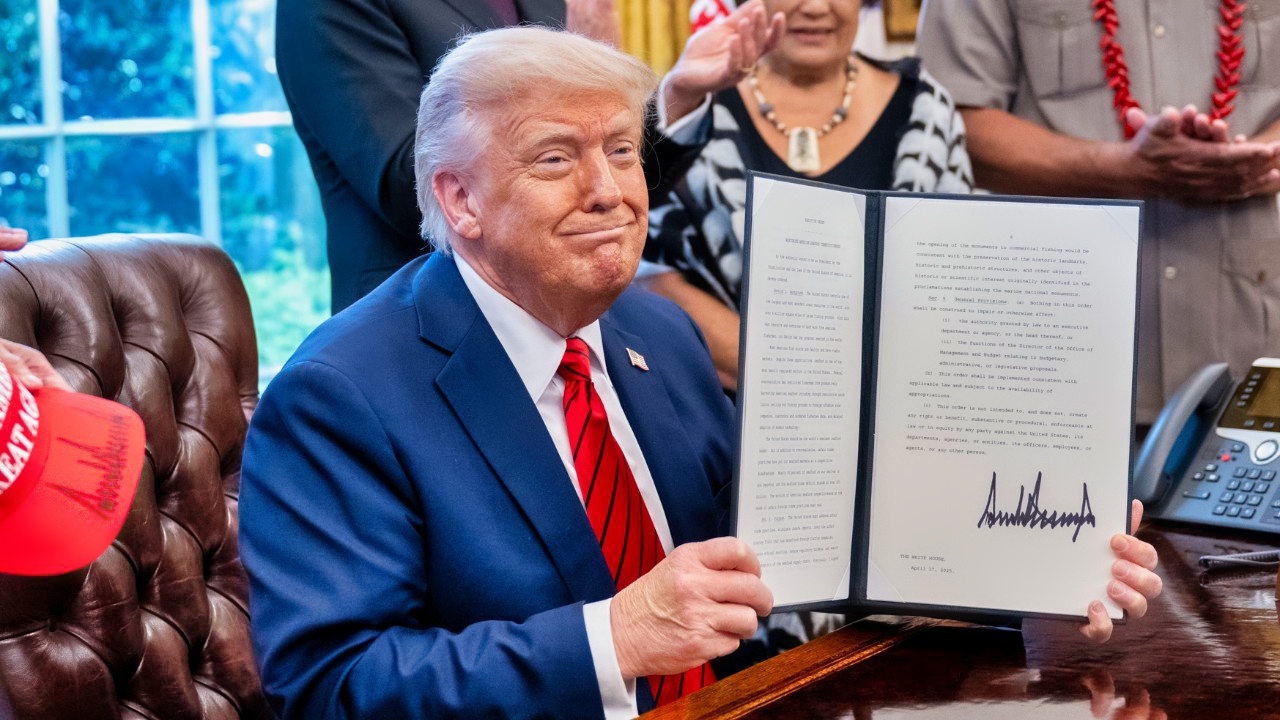
President Donald Trump signs Executive Orders, Thursday, April 17, 2025, in the Oval Office. (Official White House Photo by Molly Riley)
It was a populist message that resonated with the then-forming MAGA base and, in isolation, hit on themes that the far left, too, had long endorsed.
But many of Trump’s supporters, encouraged by his foreign policy restraint, see Epic Fury as the very type of intervention they thought they were voting to preclude. Prominent critics include Tucker Carlson and Megyn Kelly, who believe the conflict runs counter to American interests and undermines the promises Trump made on the campaign trail.
Pre-Iran Glimpses
But the contradiction did not begin with Iran; it has just represented the ultimate expression of that contradiction. Trump, while often critiqued as an isolationist, isn’t a true isolationist. Rather, Trump’s foreign policy has often relied heavily on aggressive deterrence and maximum pressure—a coercive nationalism. Trump used extreme rhetoric against North Korea, for example.
And more pointedly, Trump launched a special operation to extract Maduro from Venezuela—a hyper-aggressive intervention, if limited in duration.
But neither the situations in North Korea nor Venezuela ever became sustained wars; they merely hinted at the contradiction central to Trump’s foreign policy. Iran crossed the line, however, from threats into actual conflict.
Fault Lines Inside MAGA
MAGA features a generational divide. Younger MAGA affiliates are more skeptical of intervention. Many grew up during Generation Kill, recognized the shortcomings of Iraq and Afghanistan, and are, as a result, less attached to traditional interventionist thinking.
Older conservatives, meanwhile, are more supportive of Epic Fury; they are more receptive generally to military action, strength projection, alliance commitments, etc. And the support of Israel, too, has created a MAGA divide.
Again, younger MAGA is asking why US interests and Israeli interests are so tightly linked, while traditional conservatives—especially the evangelical blocs and hawkish Republicans—remain strongly pro-Israel.
The Economic Problem
At the end of the day, it’s economics, not ideology, that holds the most influence. MAGA, or any movement, habitually tolerates a degree of ideological inconsistency. But tolerance for economic pain is another story.
The disruption in the Hormuz disruption has pushed gas prices toward $5 per gallon.
Working-class populists, of which MAGA is comprised, are sensitive to inflation, energy prices, cost of living, etc. The war has directly influenced gas prices and overall costs, causing economic frustration. This has the potential to create political damage.
But don’t expect MAGA to outright die.
MAGA Resilience
MAGA wasn’t built around a single issue; the MAGA coalition is broader than anti-war politics, including immigration restrictions, economic nationalism, cultural issues, and, generally, populism and anti-establishment politics.
And, of course, an allegiance to Trump the individual. So while Epic Fury highlights a genuine contradiction in Trump’s foreign policy, there are still several prominent issues holding the MAGA movement together.
And Trump, for all his shortcomings, must be credited with unique political resilience; he has weathered pandemics disputes, January 6th, internal battles, the Never Trump movement, and various DOJ investigations. He always seems to come out the other end.
So MAGA isn’t likely to die as a result of Epic Fury. The better question is what form of MAGA emerges from this conflict: the version that endorses populist isolationism, or aggressive nationalism?
About the Author: Harrison Kass
Harrison Kass is a writer and attorney focused on national security, technology, and political culture. His work has appeared in City Journal, The Hill, Quillette, The Spectator, and The Cipher Brief. He holds a JD from the University of Oregon and a master’s in Global & Joint Program Studies from NYU. More at harrisonkass.com.


