

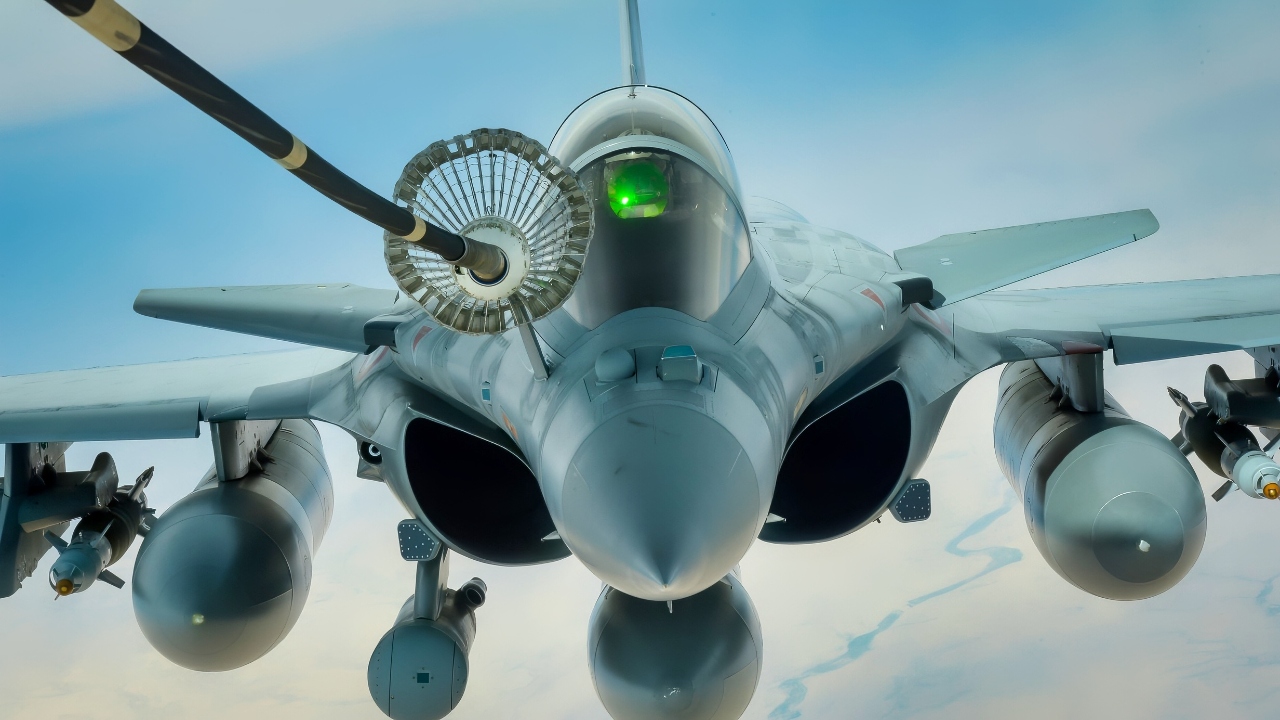
PUBLISHED on 3:31 PM EDT – Key Points and Summary – France is testing the new F4.3 standard for its Dassault Rafale fighter, a major upgrade designed to keep the combat-proven jet at the cutting edge of air warfare.
-This latest evolution enhances the Rafale’s sensor fusion, weapons integration, and connectivity.
-Key new features include the next-generation MICA NG air-to-air missile, an upgraded SPECTRA self-protection suite, and a TALIOS targeting pod now equipped with artificial intelligence for automatic target recognition.
-This comprehensive update ensures the versatile “omnirole” fighter will remain a principal and formidable asset for the French military well into the 2040s.
The New Dassault Rafale 4.3 Fighter Configuration is Now In Testing, Says DGA
WARSAW, POLAND – The French Ministère des Armées (Ministry for the Armed Forces) published an announcement on July 30, 2025, revealing that the Direction générale de l’armement (Directorate General of Armaments or DGA) has concluded a significant campaign to review operational capabilities of the Rafale fighter.
This performance demonstration is meant to review and forecast the entire fleet performance once all aircraft have been brought up to the latest F4.3 standard configuration.
This campaign was carried out at the DGA Flight Test Centre in Istres, which was a major step to achieving the formal qualification of this new standard for Dassault Aviation’s current and most modern combat aircraft. The primary objective of this campaign, which is known as Revue d’Aptitude à l’Utilisation (Fitness for Use Review or RAU), was to evaluate the current-day maturity of the Rafale F4.3 standard.
This review is accomplished by evaluating the new configuration in conditions that would simulate real-world operational missions. This exercise would cover a wide range of potential mission scenarios, which, as expected, include air-to-air, air-to-ground, and air-to-sea domains.
There is a particular emphasis in this exercise on the combined system performance, sensor fusion, weapons integration, and enhanced connectivity of the aircraft. This particular phase was essential to validate technological enhancements prior to the final definition and full qualification of the F4.3 configuration.
The Modern-Day Dassault Rafale
The Dassault Rafale is a French-made twin-engine, delta-wing, multirole jet fighter aircraft designed and built by Dassault Aviation.
The aircraft flew as a prototype in the late 1980s and continued forward with development in the 1990s—a process that included the installation of a new, French-designed SNECMA M-88 engine. These replaced the American GE F404 engine that was flown in the Rafale A demonstrator aircraft.
The aircraft was then introduced into service in 2000, with the Rafale C and B models being produced both for land-based use with the Armée de l’air et de l’espace (French Air and Space Forces) and the Rafale M for carrier-based operations with the Marine Nationale (French Navy).
The Dassault Rafale has demonstrated a high level of survivability during recent operations conducted by the branches of the French armed services. This survivability is achieved by use of an “optimized airframe and a wide range of advanced and low-observable sensors,” reads one of the latest assessments of the aircraft by French defense media. The Rafale is planned to remain in service as France’s principal combat aircraft until at least 2040.
Production of the first aircraft officially began in December 1992, but production was put in hibernation in November 1995 due to political and economic uncertainties.
The production processes were then back online in January 1997 after the Ministry of the Armed Forces and Dassault had agreed on a production run of 48 aircraft (28 to be procured and 20 options) for deliveries scheduled to be completed between 2002 and 2007.
The 4.3 Standard
The current Rafales are equipped with two SAFRAN/SNECMA M88-4E engines that make the aircraft capable of supercruise. This engine produces a high thrust-to-weight ratio and powerful performance at all altitudes.
In the electronics fit, the aircraft is equipped with a Thales RBE2-AA AESA radar, a SPECTRA electronic warfare suite, and an OSF infrared search and track system for enhanced situational awareness. The aircraft was designed with 70 percent composite materials used to reduce both radar and infrared signatures.
For armament, the Dassault Rafale fighter has an internal 30mm GIAT 30 cannon and can carry up to 9.5 tonnes of ordnance externally that is distributed across 14 hardpoints. These include the MBDA MICA and Meteor air-to-air missiles, SCALP-EG cruise missiles, Exocet anti-ship missiles, and ASMP-A nuclear missiles.
The most recent F4.1 standard was certified by DGA in March 2023. This configuration features a new generation of capabilities and onboard systems. These include an upgraded IRST sensor providing passive day/night detection. It also enhances the tracking of low-observable aircraft across the infrared spectrum.
There are new collaborative modes between the different sensor modules to improve detection, tracking, and engagement coordination. The pilot can employ the new Thales SCORPION helmet-mounted sight for rapid target acquisition. This is, in turn, linked to larger, high-resolution lateral cockpit displays that support pilot awareness and efficiency.
The new 4.3 standard will permit the Rafale to perform missions with the next-generation MICA NG air-to-air missile. The aircraft will also be equipped with an upgraded SPECTRA self-protection suite, a CONTACT software-defined radio, and a TALIOS nacelle, which, equipped with artificial intelligence algorithms, will have an “automatic target designation/recognition” mode.
The latest RAU campaign has enabled the DGA and its partners to evaluate the real-time operational potential of the Rafale F4.3 configuration’s onboard systems, tactical communications, and sensor suite, all of which are pivotal to the aircraft’s next-generation combat performance.
The results of this exercise will serve as a baseline for the remaining phases of development and support the path towards the full qualification of the Rafale F4.3 standard.
This 4.3 standard will be a major step forward in France’s air combat capabilities and will ensure the Rafale’s continued role into the future as a base airpower asset within the French armed forces.
About the Author: Reuben F. Johnson
Reuben F. Johnson has thirty-six years of experience analyzing and reporting on foreign weapons systems, defense technologies, and international arms export policy. Johnson is the Director of Research at the Casimir Pulaski Foundation. He is also a survivor of the Russian invasion of Ukraine in February 2022. He worked for years in the American defense industry as a foreign technology analyst and later as a consultant for the U.S. Department of Defense, the Departments of the Navy and Air Force, and the governments of the United Kingdom and Australia. In 2022-2023, he won two awards in a row for his defense reporting. He holds a bachelor’s degree from DePauw University and a master’s degree from Miami University in Ohio, specializing in Soviet and Russian studies. He lives in Warsaw.
Military Matters
The F-22 Raptor Just Keeps Getting Better


