


The “buzzing the tower” scene from the original “Top Gun” film actually happened. A Navy F-14 Tomcat pilot named John Chesire buzzed an ATC tower in Waterloo, Iowa at 500 feet. The air traffic controllers specifically requested the flyby. Chesire was flying low and slow across Iowa on his way to an airshow in Cedar Rapids. The ATC operators wanted to see the F-14 in person. Chesire swept the wings back to 68 degrees and briefly lit the afterburners. Another famous F-14 flyby happened over the aircraft carrier USS America (CV-66).
The F-14 Tomcat Top Gun Buzz the Tower Scene Was Real
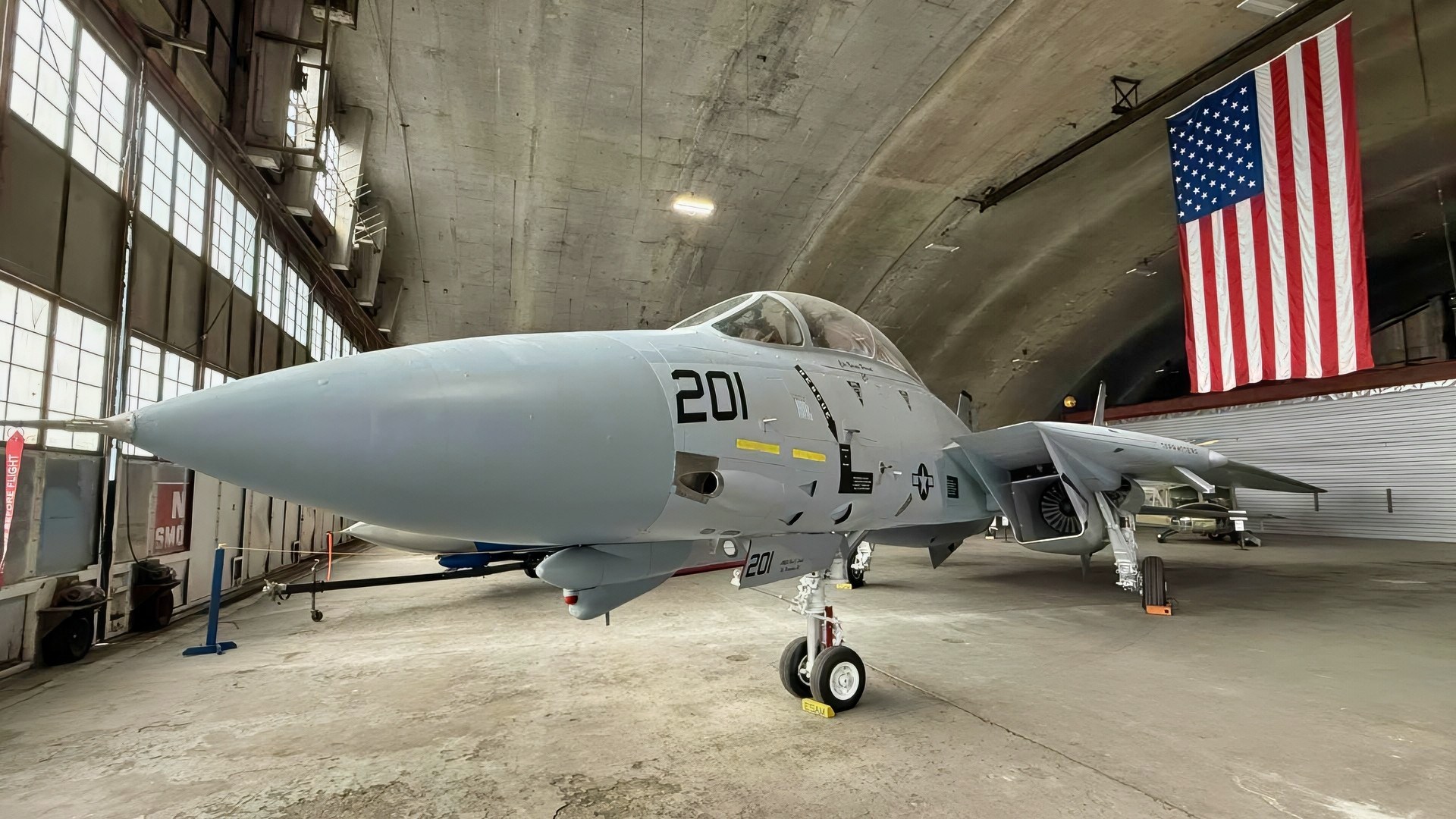
F-14 Tomcat Fighter in Hanger NSJ Photo.

F-14 Tomcat. National Security Journal Photo.
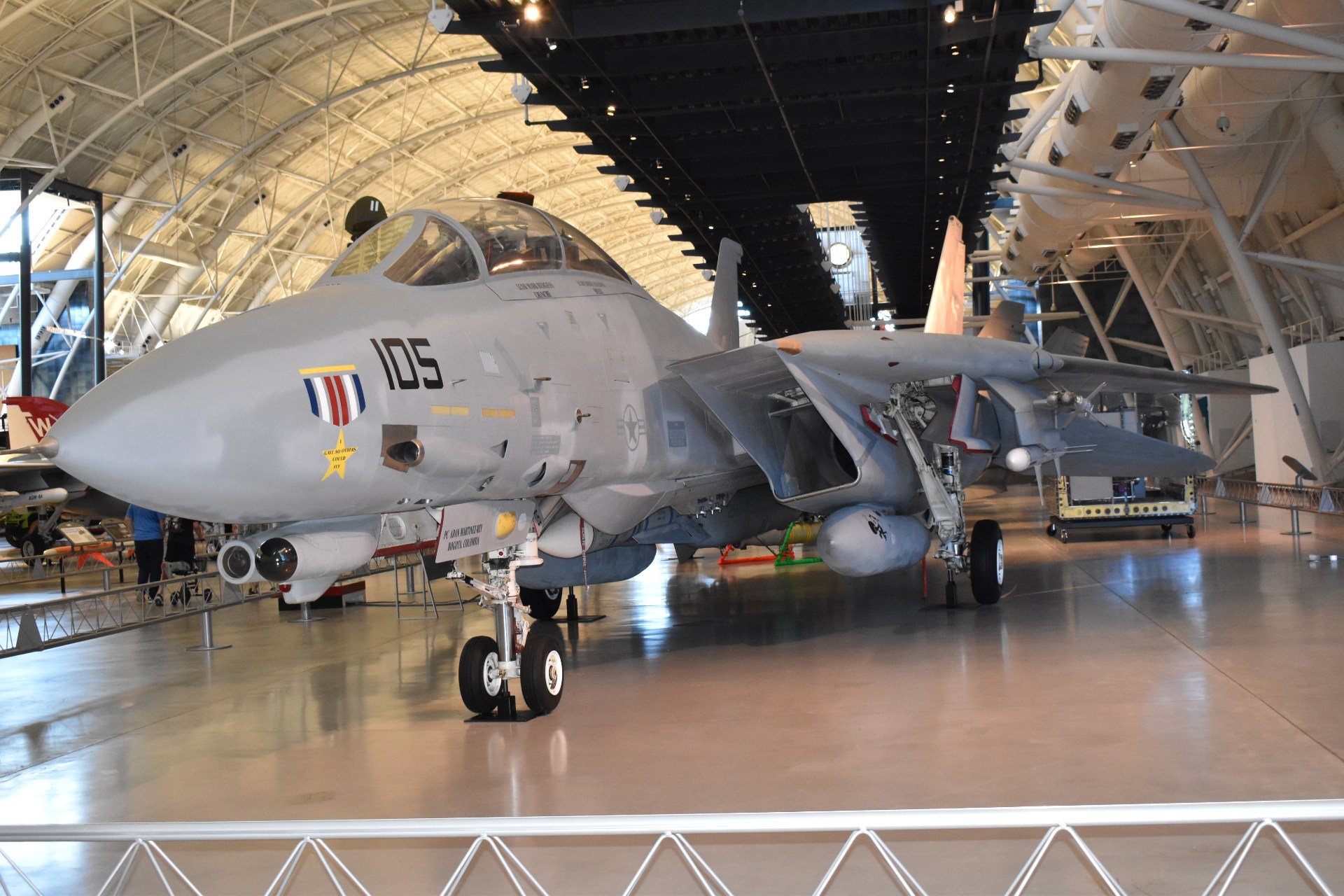
NSJ F-14 Photo.
We all remember the iconic scene in the first “Top Gun” film. Maverick, played by Tom Cruise, tells his Radar Intercept Officer (RIO), “Sorry, Goose, but it’s time to buzz the tower.” The F-14 Tomcat then screams by the tower, causing the Air Boss officer in the tower to spill his just-filled coffee cup all over his uniform.
He then cusses a blue streak, while Maverick and Goose do a barrel roll while laughing and Goose singing “Great Balls of Fire.”
It was one of the most iconic scenes in the film.
One that the actual pilot who filmed the scene (no CGI) said was the opportunity of a lifetime. But a pilot performed the stunt at the request of air traffic controllers.
Navy Aviators Loved The Iconic F-14 Tomcat
Naval aviators loved the F-14 Tomcat for its unmatched long-range fleet defense capabilities, its high-speed, high-altitude interceptor performance with powerful AIM-54 Phoenix missiles, and its versatile variable-sweep wings that provided both agility for dogfights and speed for high-speed flight.
Its powerful radar, capable of tracking multiple targets simultaneously, and its two-man crew, which enabled enhanced situational awareness, made it a dominant air superiority fighter.
The variable-sweep wing design, combined with advanced fire-control systems and the AIM-54 Phoenix missile, made the F-14 capable of engaging multiple targets at long distances while still performing close-in combat and engaging in dogfights.
The Tomcat was born from the Cold War, where the Navy expected the Soviets to unleash a torrent of bombers over the world’s oceans, firing a fusillade of missiles at the Navy’s carrier task forces.
The US missile defenses on the ships were very effective, but the ships needed advanced fighters to defend against the bombers and then engage the fighters accompanying them.

F-14 Missiles at Smithsonian Outside of DC. National Security Journal Photo. All Rights Reserved.

F-14D Tomcat at Smithsonian In Washington DC. Image by Brent M. Eastwood/National Security Journal.

F-14D Tomcat Fighter NSJ Original Image. Taken by Dr. Brent M. Eastwood.
Buzzing The Tower For Real … By Request No Less
Dario Leone of aviationgeekclub.com tracked down a real incident in which an F-14 buzzed the tower at the controllers’ request.
He quoted former Tomcat pilot John Chesire, who performed the flyby.
“I once flew across the plains of Iowa, low and slow on my way to an airshow in Cedar Rapids,” Cheshire said. “Growing up as a kid on a farm in Iowa, I figured that some farm kid and their parents might enjoy seeing an F-14 for the first time, flying low over their farm.”
Cheshire said that when he neared Waterloo, Iowa, the Air Traffic Controllers could not believe they had an F-14 under their control, so low at only 500 feet AGL. That’s when he got a most unusual request.
“They asked me to turn around and circle them so that they could come outside their control room and see for themselves a Navy F-14 Tomcat.
“While I did stay relatively slow, I was at 500ft AGL. I swept the wings back to 68 degrees from their full forward position and briefly lit the afterburners,” he said.
“I may have cycled both the wings and ABs a couple of times for them. The ATC guys apparently really liked it and thanked me profusely as I continued to my destination,” he added.
Another Buzzing Of The USS America
Leone also documented another low-level flyby, this time of an American supercarrier, the USS America (CV-66). The F-14 pilot, Dale “Snort” Snodgrass, was the man who flew right over the ship.
“It’s not risky at all with practice… It was my opening pass to a Tomcat tactical demonstration at sea, Snodgrass said.
“I started from the starboard rear quarter of the ship, at or slightly below flight deck level. Airspeed was at about 250 knots with the wings swept forward. I selected afterburner about ½ mile behind, and the aircraft accelerated to about 325-330 knots.
“As I approached the ship, I rolled into an 85-degree angle of bank and did a 2-3 G turn, finishing about 10 – 20 degrees off of the ship’s axis. It was a very dramatic and, in my opinion, a very cool way to start a career demo.
“The photo was taken by an Aviation Boson’s Mate (by an ABE3 who was the petty officer third class Sean E. Dunn, who was in charge of Launching & Recovering Equipment) who worked the flight deck on the USS America.
“Just as an aside … the individual with his arms behind his back is Admiral Jay Johnson,” who became the Chief of Naval Operations for the Navy.
Meet The F-14 Tomcat
The 1970s have to be considered the golden age of US aviation. During that decade, the United States developed three outstanding fighter aircraft that are still in use fifty years later.
The US Air Force developed the F-15 Eagle and the F-16 Falcon, both of which it still operates in variants that look indistinguishable from the originals. The Navy developed the F-14 Tomcat, which may or may not still have a few flyable versions left in Iran, although Israeli air strikes in June may have destroyed the final few models left.
When the discussions began for a replacement of the F-4 Phantom jets in the Navy’s carrier air wings, an evaluation was done on the F-111 Aardvark, the Air Force’s fighter-bomber. This would have maintained commonality between the Air Force and the Navy; however, the Aardvark was far too heavy for carrier operations.
The Navy instituted the VFX program to address the issue. Grumman designed its Model 303, which proposed a variable-geometry, two-seat, twin-engined design built around the Hughes AWG-9 weapons system.
Grumman had gained considerable experience with “swing-wing” technology from its earlier XF10F Jaguar, which was built only as a prototype. However, the wing design of the A-6 Intruder greatly influenced the F-14’s technology.
The F-14 Was The Navy’s Best Fighter And Recruiting Tool
The F-14 Tomcat was fast enough to intercept Soviet bombers, had radar and missiles capable of detecting and shooting them down over long distances, and the maneuverability to engage in dogfights and defeat agile enemy fighters.
It was one of the world’s best fighters at the time.
It saw considerable duty in Libya, the Gulf War, Iraq, and Afghanistan. The last F-14 retired from active service with VF-213 in 2006.
One of the more intriguing aspects of the F-14 was that it saw the most combat of all US fighters since Vietnam, yet it shot down only five enemy fighters.
However, the Iranians, who owned 78 F-14s that were purchased from the United States back when the Shah was still in power, claimed that during the Iran-Iraq War, they had shot down dozens of Iraqi Soviet-made aircraft with the Tomcats.
The Hollywood film “Top Gun” centered around a cocky, hotshot pilot, but the actual star of the film was the Tomcat. Navy recruiting skyrocketed due to the film, and it remains an icon of American military war films.
Replacement by the F/A-18 Super Hornet
The F/A-18E/F Super Hornet offered greater versatility at a lower cost and with better logistical support, making it a more economical choice for the Navy’s future needs.
The Super Hornet wasn’t as fast, but it was more reliable, easier to maintain, and better suited for aircraft carrier operations. For the Navy, it made more sense to switch over than to keep investing in an older design.
The Super Hornet was a superior multirole aircraft compared to the Tomcat. And it performed better as a dogfighter at lower speeds.
But the Super Hornet could never touch the reputation of the F-14, and the buzzing of the ATC. “I feel the need … the need for speed.”
About the Author: Stephen Balestrieri
Steve Balestrieri is a National Security Columnist. He served as a US Army Special Forces NCO and Warrant Officer. In addition to writing on defense, he covers the NFL for PatsFans.com and is a member of the Pro Football Writers of America (PFWA). His work was regularly featured in many military publications.


