

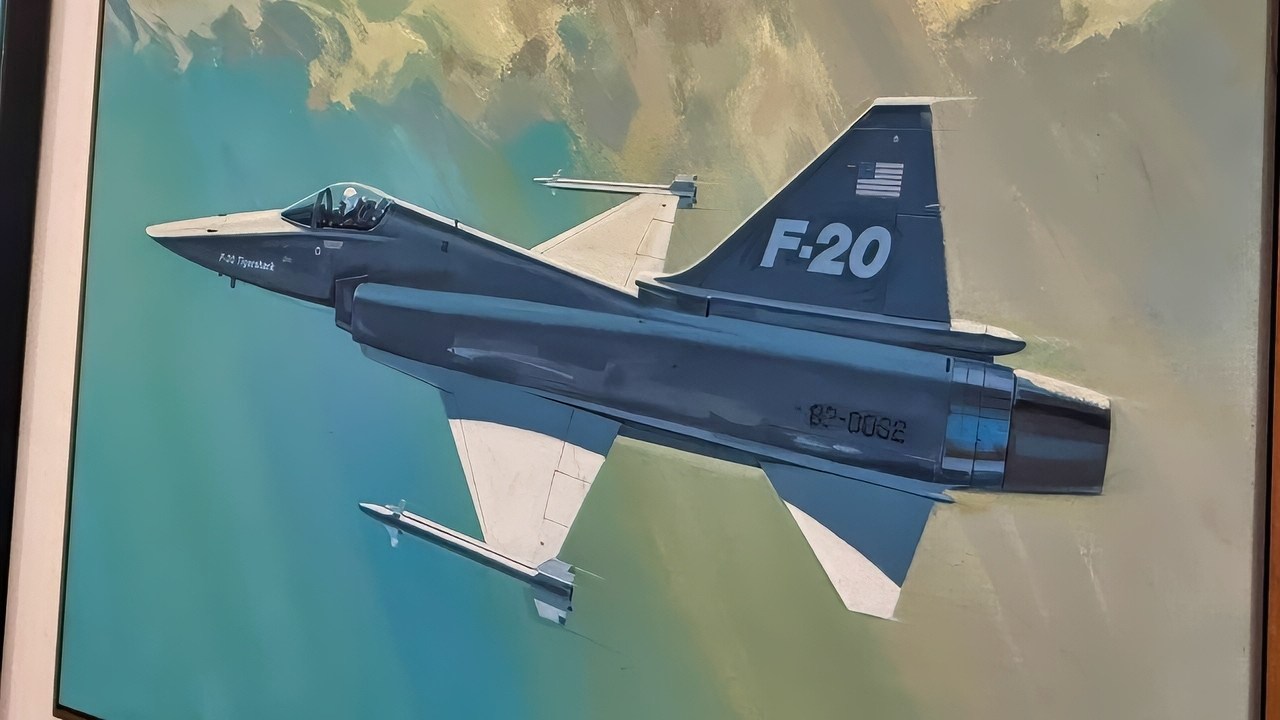
In 1983, Northrop unveiled a Mach 2.1 fighter that cost $9 million — one quarter the price of an F-14 Tomcat — built on private money and powered by General Electric’s new F404 engine. The F-20 Tigershark could hit 1,611 miles per hour, fire AIM-9 Sidewinders from its wingtips, and operate from austere airfields with the maintenance footprint of a Cold War light fighter. Forty years later, not a single foreign country ever bought one, and the United States has never built anything like it again.
The F-20 Tigershark Market Was Crushed By The F-16
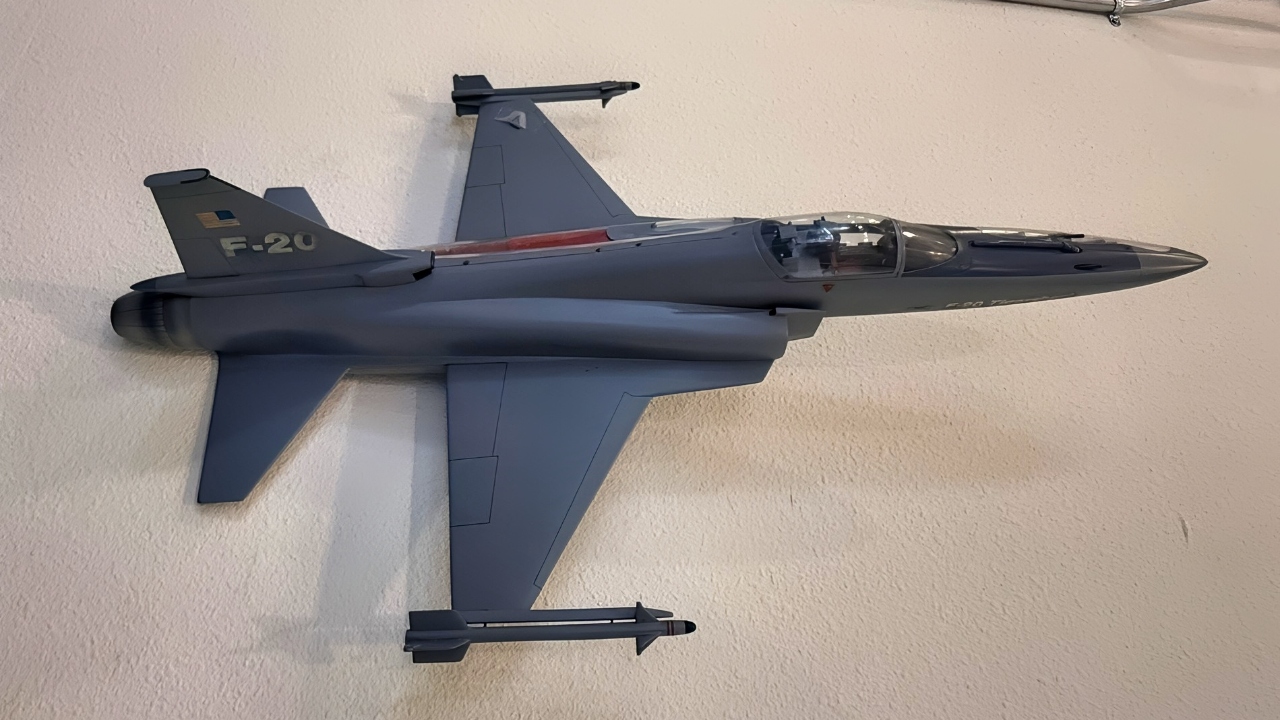
F-20 Tigershark Model at Western Museum of Flight. Image Credit: Harry J. Kazianis/National Security Journal Image Taken on August 16, 2025.
The Northrop F-20 Tigershark was an advanced fighter when it first entered service in 1983. Initially, it was called the F-5G, an upgraded version of the F-5E with a much more powerful engine and a modern avionics suite that included a vastly improved radar.
But the Pentagon, especially during the Carter years, was at best lukewarm about helping sell US-made warplanes to nations unless they adhered to his human rights parameters.
The F-20 Tigershark also didn’t sell because the government was of little help; it faced stiff competition from the F-16, which had the advantage of US Air Force support, a superior loadout, and was already widely available for export.
Two Prototype Crashes Hurt The Marketing Of The Aircraft
While a highly capable, affordable, and privately funded aircraft, it failed to secure a single foreign buyer, a situation worsened by two fatal prototype crashes in 1984 and 1985.

F-20 Tigershark in Red. Image Credit: Creative Commons.

F-20 Tigershark. Image Credit: Creative Commons.
The US government’s policy shift towards exporting existing aircraft, such as the F-16, rather than developing new ones, further limited the F-20’s market prospects.
Foreign nations assumed that because of the US’s support for the F-16, the F-20 was a second-tier aircraft, and even the Madison Avenue-type marketing with the famous Chuck Yeager couldn’t help. No one bought the F-20…and that was a shame.
The Tigershark just suffered from bad timing.
The F-20’s Development History
The F-20’s development began in 1975. Initially designated the F-5G, a variant of and an upgrade of the Northrop F-5E Tiger II, AKA “Freedom Fighter.”
The F-5E was already being sold to U.S. allies around the globe (Brazil, Ethiopia, Switzerland, South Korea, and Taiwan) as a low-cost export fighter. The F-5G/F-20 cost up to $9 million and was cheap and easy to maintain.
The F-20 was unveiled at the Paris airshow in 1983.
At the time, the F-5 market was still viable, and the aircraft was loaded with new technology, which was why its designation was changed from the F-5G to the F-20. It was essentially a new aircraft.
The Tigershark Was Packed With New Technology
The new, more powerful General Electric F404 GE-100 engine enabled the aircraft to reach Mach 2.1, or 1,611 miles per hour. The beyond-visual-range (BVR) air-to-air capability was cutting-edge at that time, and a full suite of air-to-ground modes capable of firing most U.S. weapons.
The standard armament package consisted of two M39A2 20mm autocannons, each with 280 rounds of ammunition, and two AIM-9 Sidewinder air-to-air missiles carried on the wingtips.
The F-20 also featured an early heads-up display and “hands-on throttle stick controls,” all of which were cutting-edge technology in 1983.
The F-20 Tigershark was competitive with contemporary fighter designs, such as the General Dynamics F-16/79, a modified export-oriented version of the F-16A/B powered by the outdated General Electric J79 engine. Still, it was much less expensive to purchase and operate.
Top Gun Used The F-5 As ‘Enemy’ Aircraft
In an outstanding article by Ehud Yonay, he pointed out in 1983, “The F-5 is actually a family of planes, starting with the F-5A back in 1964 and culminating last year with the F-5G Tigershark (now called F-20).
“All are elegant, zippy beauties with body lines so trim they look like canoes with wings. The only fighter plane made in California, the F-5 is an anomaly in the high-budget defense business.
“It is not only small, effective, and easy to repair, but it is also very cheap. The F-5E Tiger IIs used by Top Gun instructors to simulate Russian MiGs cost around $5 million each, and even the top-of-the-line Tigershark lists at only $9 million — one quarter the price of a single F-14 Tomcat.”
Coincidentally, the article by Yonay, in which he described pilots going through the Navy’s Top Gun school, Hollywood producers Don Simpson and Jerry Bruckheimer stated explicitly that the inspiration for the famous “Top Gun” film was the article “Top Guns” by Ehud Yonay, from the May 1983 issue of California magazine, which featured aerial photography by then-Lieutenant Commander C.J. “Heater” Heatley.
Two aviators were featured in the article, Lieutenants Alex “Yogi” Hnarakis and Dave “Possum” Cully, an F-14 Tomcat aircrew from the Fighter Squadron 1 (VF-1) Wolfpack.
The following paragraph makes it clear where Simpson and Bruckheimer drew their inspiration.
“Yogi had flown jets in flight school – the T-2 Buckeye and A-4 Skyhawk – but moving up to the F-14 Tomcat meant crossing the magic line that separates the men from the boys, like first-time sex, glorious and terrifying.
“The difference is the afterburner, an engine component that at the pull of a throttle begins to burn huge amounts of fuel at incredible speed, resulting in a burst of power that no ordinary jet engine can duplicate and no plane but a fighter ever needs.”
The mystery “MiG-28” that Tom Cruise flew inverted in the infamous scene was a painted-up hot-rod F-5E.
F-20 Sales Never Got Off the Ground
Northrop was banking on the F-20 sales taking off. But it never did. Politics played a huge role in its demise.
The Air Force and the Reagan administration knew that every F-16 sold to a foreign allied country would lower the overall costs of F-16s. F-20 sales were discouraged.
The government banned the sale of F-20s to Taiwan. President Carter felt it was too provocative to China. The Reagan administration declared that Taiwan did not need advanced fighters, as the existing F-5E aircraft were deemed sufficient to maintain a balance of power at the time.
That was a mistake that cost Northrop and the US, as there could have been a market for countries seeking a smaller, cheaper fighter aircraft.
There were two crashes of F-20 prototypes, which were later found to result from pilots pulling hard G-force turns that blacked them out. Those really hurt any hope of getting the foreign sales off the ground.
The F-20 was a great aircraft that came along just as the US was heavily invested in the F-16.
About the Author: Steve Balestrieri
Steve Balestrieri is a National Security Columnist. He served as a US Army Special Forces NCO and Warrant Officer. In addition to writing on defense, he covers the NFL for PatsFans.com and is a member of the Pro Football Writers of America (PFWA). His work was regularly featured in many military publications.


