


The infamous flat spin that kills Goose in the 1986 film Top Gun is a real engine failure mode of the F-14 Tomcat — the Pratt & Whitney TF30 engine was responsible for roughly 28% of all F-14 crashes and the loss of more than 40 aircraft over the platform’s service life. The TF30 had been designed for the F-111 strike bomber, which flew straight-line missions with smooth airflow into the engine intakes — but the F-14 was a high-G fleet interceptor that pulled aggressive maneuvers, exactly what the TF30 couldn’t handle, and with engines spaced 9 feet apart, an asymmetric thrust failure could produce an unrecoverable flat spin. The problem wasn’t fully resolved until the late 1980s, when the F-14D received the General Electric F110-GE-400 — adding 12% more thrust per engine, improving climb rate by 60% and intercept radius by 62%.
The F-14 Tomcat Was a Legend With Some Real Problems
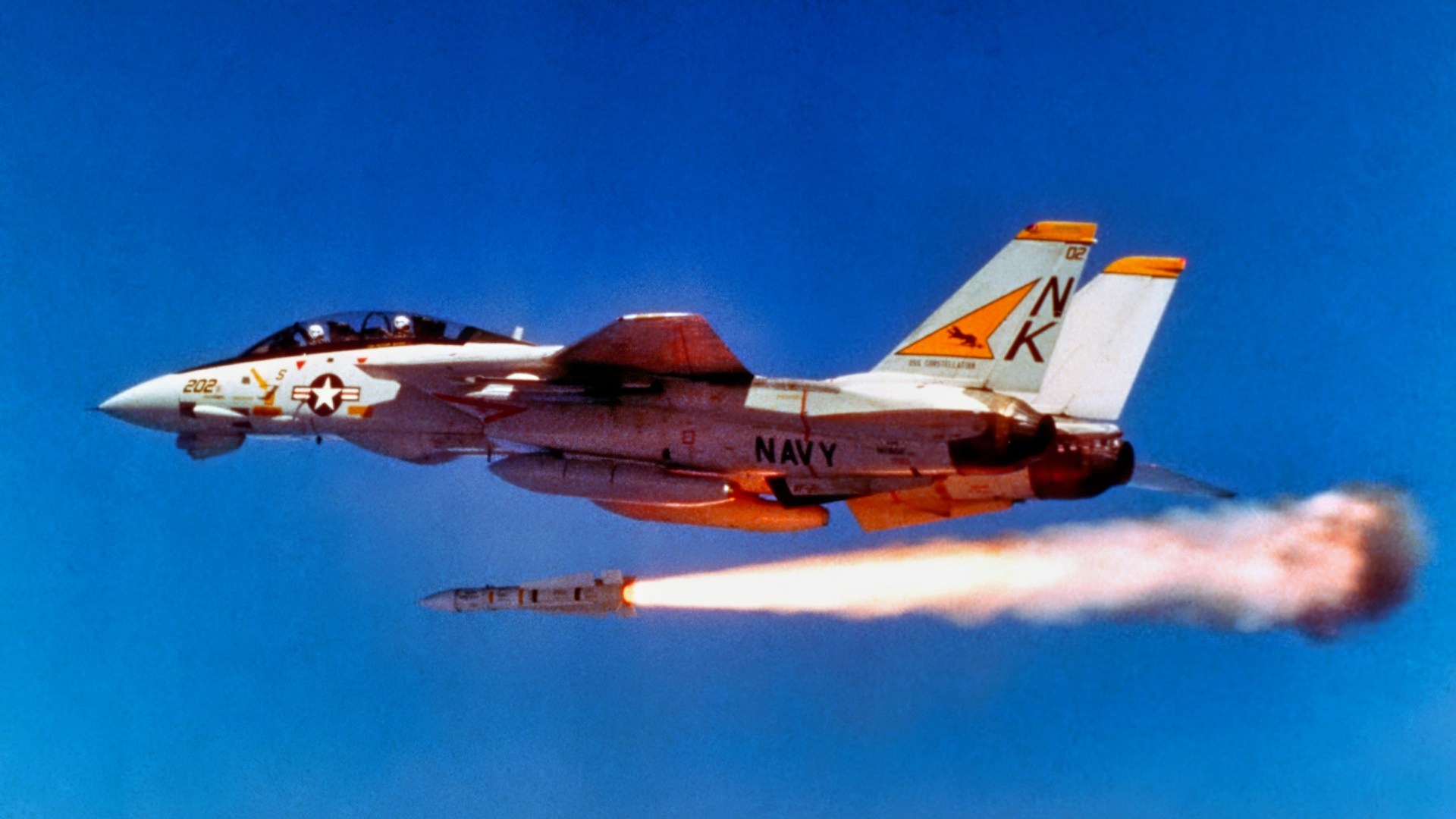
F-14 Tomcat Firing a Missile. Image Credit: Creative Commons.
The iconic F-14 Tomcat evolved into a dominant fleet interceptor, but early in its life, the aircraft was hamstrung by its engines.
An advanced airframe with a mismatched powerplant, the early Tomcat had to fight its original TF30 engines.
But when the TF30 was swapped for the F110, it didn’t just improve performance—it fundamentally changed how the F-14 could be flown and fought.
The Original Problem
The TF30 wasn’t built for the Tomcat; it was built for the F-111, a more conservative strike aircraft.
Accordingly, the TF30 was not designed for the high-G maneuvering and dogfighting that were inherent to Tomcat operations.
The problem here was that the TF30 required smooth, straight airflow—which was exactly what it got aboard the F-111.
But the TF30 struggled with high angles of attack and rapid throttle inputs—common circumstances in F-14 operations.
So the engine was simply incompatible with the F-14’s mission and should never have been installed.
F-14 Tomcat Technical Failure Modes
The TF30, requiring smooth airflow, suffered a variety of problems aboard the F-14.

On board USS Harry S. Truman (CVN 75). An F-14B Tomcat assigned to the”Swordsmen” of Fighter Squadron Three Two (VF-32) launches off of one of four steam powerd catapults on the flight deck. The Harry S. Truman carrier strike group is on a six-month deployment in support of the global war on terrorism and is currently conducting carrier qualifications of the east coast of the Untied States. US Navy photo by Photographer’s Mate Airman Ryan O’Connor. (Released by HST Public Affairs)
Compressor stalls, for one, caused by disrupted airflow, occurred during hard turns and aggressive throttle movement.
The TF30 also had asymmetric thrust problems; with engines spaced 9 feet apart, if one stalled, it created a massive yaw imbalance.
The result could be a flat spin, typically unrecoverable, one of the most dangerous failure modes (coincidentally, depicted in Top Gun, when Goose dies).
In total, the TF30 was a factor in 28 percent of Tomcat crashes, resulting in the loss of over 40 aircraft.
So the TF30 didn’t just limit F-14 performance—it killed aircraft, and it killed aviators.
Fly the Engine
F-14 pilots were forced to fly the engine, managing the throttle carefully, avoiding sudden inputs.
This resulted in a much more conservative flight envelope, undermining the F-14’s original purpose.

F-14 Tomcat Fighter National Security Journal Photo Fall 2025
In combat, the Tomcat was limited; pilots could not aggressively maneuver without risking an engine stall mid-flight.
The net effect was that the F-14’s theoretical performance levels were not achievable in practice.
The Fix: The F110
In the late 1980s, the F110-GE-400 was installed on the F-14D. The improvements were significant, offering a boost from 20,900 pounds per engine to 23,400 pounds, along with digital engine control.
Pilots no longer had to employ throttle restrictions—they could go from idle to full afterburner without restriction, opening up another dimension of performance for the aircraft.
Finally, the engine matched the airframe, unlocking the F-14’s ultimate potential. The climb rate improved 60 percent.
The intercept radius increased by 62 percent. Endurance improved 30 percent.
Carrier operations were made safer with greater dry thrust and reduced reliance on afterburner.
And the F110’s modular design made the engine and aircraft easier to service aboard an aircraft carrier.
In short, the F110 was a transformative addition—making the F-14 faster, safer, and more sustainable.
The Tactical Impact
With the F110, pilots could pull high AoA and maneuver aggressively without fear of engine failure.
This expanded the flight envelope, making the Tomcat a more dangerous aircraft to face in combat.
Throttle freedom was enhanced; pilots could go from idle to afterburner and back without fear of stalling.
This enabled rapid energy changes, which were critical for air combat maneuvering.
This created a fleet-wide confidence boost, allowing a shift from defensive flying to offensive maneuvering.
The Tomcat mission expanded accordingly, improving intercept capability and strike flexibility.
The F110 turned the F-14 into the fighter designers had envisioned when they drew up the blueprints.
F-14 Tomcat: The Strategic Impact
Fleet readiness improved with the F110. The F-14 suffered fewer accidents and benefited from higher availability.
Cost efficiency was improved, too, through a reduced maintenance burden and fewer aircraft losses.
In sum, this served as a force multiplier, extending the Tomcat’s service life and enabling continued reliance into the 2000s.
The massive F110 upgrade served as a bitter reminder of a missed opportunity: it arrived late, with many F-14As using the TF30 for decades, resulting in impaired performance.
The delayed modernization limited the Tomcat’s full potential for years—but served as an important reminder that aircraft performance depends on system integration.
Even the most advanced airframe, when paired with the wrong engine, will underperform.
About the Author: Harrison Kass
Harrison Kass is a writer and attorney focused on national security, technology, and political culture. His work has appeared in City Journal, The Hill, Quillette, The Spectator, and The Cipher Brief. More at harrisonkass.com.


