


When it debuted, it was the world’s leading air superiority fighter. Dual-engined, with sleek lines and a robust radar-mitigation capability, the F-22 Raptor was the U.S. Air Force’s dream platform. Built to wrest control of the skies from Soviet aircraft, the stealth fighter was years ahead of its peers.
So why was the Raptor production line permanently closed down after less than 200 of them had been built?

U.S. Air Force Maj. Paul “Loco” Lopez, Air Combat Command F-22 Raptor Demonstation Team commander, flies the F-22 Raptor, demonstrating its combat capabilities at FIDAE (Feria Internacional del Aire y del Espacio) in Santiago, Chile, April 7, 2018. The Raptor is a multirole fighter capable of supporting both air-to-air and air-to-ground missions worldwide.
The shuttering of the F-22 Raptor production line was not attributable to any single factor, but is rather a reflection of a changed strategic environment in which the F-22 was not the right tool for the job, as well as a strong and ultimately successful congressional push to prevent the technologies that went into the Raptor from leaving the United States.
The Raptor was conceived of during the Cold War as a solution to both increasingly advanced Soviet fighter designs, which challenged the United States air superiority fighter at the time, the F-15, as well as sophisticated Soviet air defenses that threatened to negate the technological superiority then enjoyed by United States warplanes.
Stealth technology held great allure. Its proponents argued that it would allow American jets to fly through even highly contested aerial environments with near impunity.
In 2009, the threat that the Raptor had been built to stare down and defeat — massed formations of advanced Soviet fighter jets over Europe — had evaporated.
Instead, the United States was conducting counterinsurgency operations in the Middle East against enemies that lacked the robust air defenses the Raptor’s designers expected it to face.
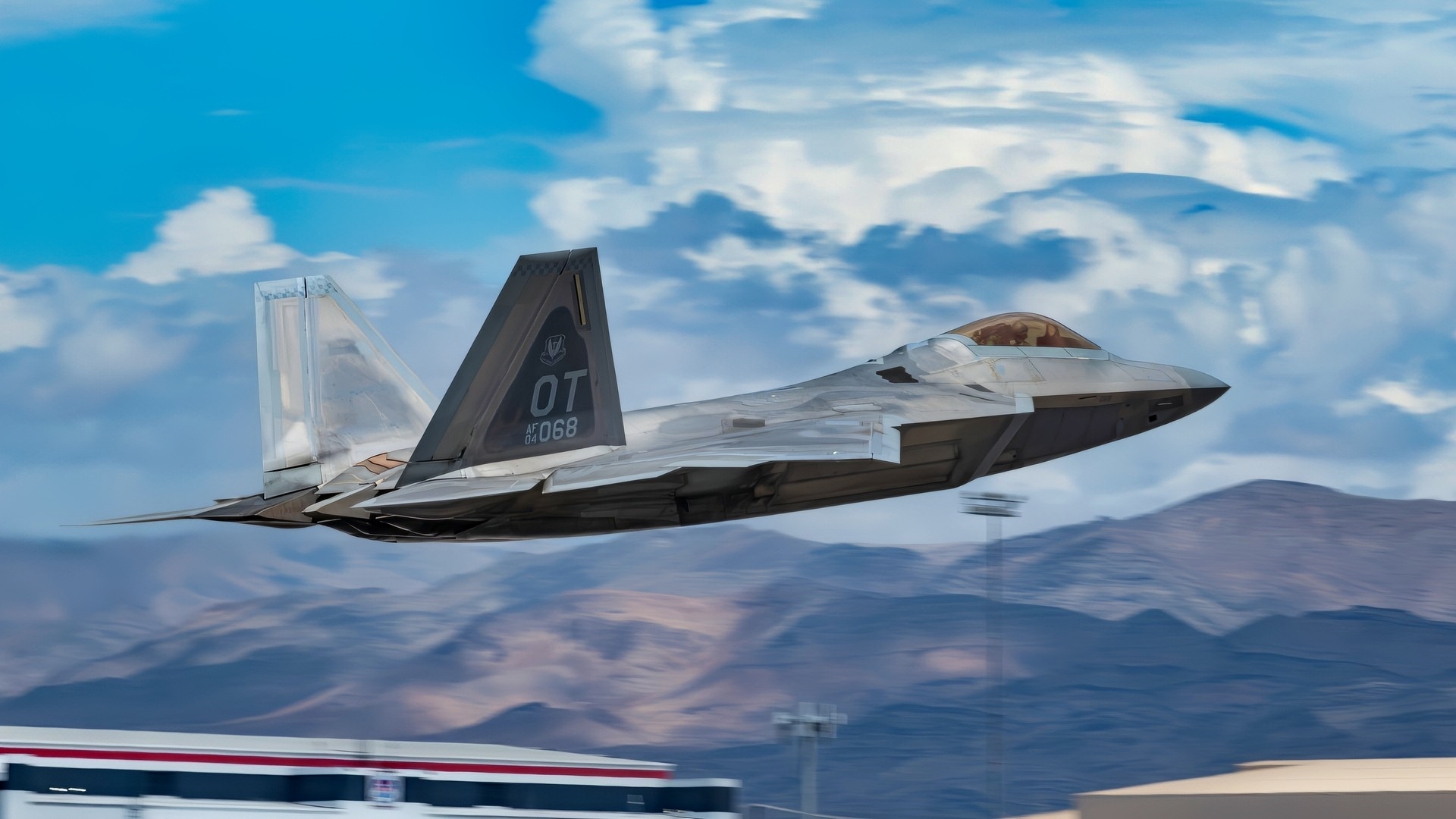
A U.S. Air Force F-22 Raptor fighter jet assigned to the 422nd Test and Evaluation Squadron (TES), takes off for a mission at Nellis Air Force Base, Nevada, Aug. 26, 2025. The 422nd TES is a geographically separated unit of the 53rd Test and Evaluation Group, Eglin AFB, Florida. (U.S. Air Force photo by William R. Lewis)
Dovetailing with that very different threat environment was the F-22’s lack of utility to ground troops.
Though it is still arguably the world’s preeminent air superiority fighter, it cannot provide robust and sustained ground support. Costs would also prove to be detrimental to the jet’s longevity.
Show Me the Money
At around 140 million dollars per jet, the F-22 is an extremely expensive plane to build.

U.S. AIR FORCE ACADEMY, Colo. – Two F-22 Raptors perform a flyover and air demonstration during noon meal formation at the U.S. Air Force Academy in Colorado Springs, Colo., April 12, 2023. Events such as these aim to cultivate warrior ethos, a future-focused mindset, and supplement existing character, leadership, and officer development efforts with the cadets. (U.S Air Force Photo by Trevor Cokley)
High maintenance and readiness costs were an issue. Had the U.S. Air Force purchased the 750 F-22 Raptors it originally intended to buy, unit cost would have declined significantly.
Instead, research and production costs were spread across a relatively small fleet, boosting the price tag of each jet.
In essence, the Raptor program was both highly expensive and inapplicable to fighting terror groups in Iraq and Afghanistan. In light of those constraints, it is perhaps more understandable that the program was truncated so severely.
In parallel to these developments, the Department of Defense was preparing to accept the F-35 Lightning II into service across the U.S. Air Force, Navy, and Marine Corps.
One platform, available in three variants, was promised to keep overall program costs low while also giving each service a bespoke fighter jet to meet its unique needs.
Single-engined and less refined than the Raptor, the F-35 offered, on paper, a cost-effective solution and multirole capability, more akin to a Swiss Army Knife than the Raptor’s scalpel.

An F-35B Lightening II with Marine Fighter Attack Squadron 121, 3rd Marine Aircraft Wing out of Marine Corps Air Station Yuma, Ariz., stopped at Joint Base Elmendorf-Richardson, Alaska en route to Marine Corps Air Station Iwakuni, Japan, Jan. 12, 2017. The VMFA-121 was the first operational F-35B squadron in the Marine Corps, with its relocation to 1st Marine Aircraft Wing at Iwakuni. The F-35B was developed to replace the Marine Corps’ F/A-18 Hornet, AV-8B Harrier and EA- 6B Prowler. The Short Take-off Vertical Landing (STOVL) sensor technology, and electronic warfare systems bring all of the access and lethality capabilities of a fifth-generation fighter, a modern bomber, and an adverse-weather, all-threat environment air support platform. U.S Air Force Photo by Staff Sgt. Mike Campbell. Joint Base Elmendorf-Richardson, AK, UNITED STATES

A U.S. Air Force F-35A Lightning II assigned to the 56th Fighter Wing, Luke Air Force Base, Arizona, performs a strafing run during Haboob Havoc, April 24, 2024, over Barry M. Goldwater Range, Arizona. Haboob Havoc is a total force exercise that provides a way for pilots from various bases to demonstrate their skills across a diverse range of aircraft, including F-35 Lightning IIs, F-16 Fighting Falcons, and A-10 Thunderbolt IIs, while also testing their abilities in different mission sets such as dogfighting and gun runs. (U.S. Air Force photo by Airman 1st Class Mason Hargrove)
Some senior leadership acknowledged that the F-35 would be less capable than the Raptor for air superiority missions, but that the two jets could fight together and offer a high-low mix of capabilities that would serve American interests.
Congress ultimately sided with then-Defense Secretary Robert Gates, who argued that F-22s were not the right solution for an era of “small wars.” The Senate voted 58 to 40 to end F-22 production. Including test aircraft, a total of 195 Raptors were ultimately manufactured.
And with that decision, the aircraft’s industrial base withered dramatically.
Stop Means Stop
The Raptor production shutdown was not a pause; it was the dismantling of the F-22 production ecosystem.
Key supplies moved on to other projects and shut down their Raptor portfolios, and much of the tooling used to manufacture Raptor subsystems was mothballed, repurposed, or destroyed.
Despite perennial calls to restart production, doing so would be both prohibitively expensive and significantly more complex than pressing a start button at an aviation assembly facility.
As the United States Air Force prepares to accept their latest air superiority fighter, the F-47, a sixth-generation aircraft, restarting the Raptor production line would be counter to prevailing logic and arguably a significant detraction from the F-47 fighter.
The decision in 2009 to close production was, at the time, a significant strategic bet, and one that was, in that era, not illogical.
The premise that the United States would not face a near-peer air force and would not require a large number of cutting-edge air superiority fighters for Middle Eastern engagements was clear.
In today’s climate, however, the return to great-power competition has occurred. Instead of fighting Islamist insurgents, the specter of a grinding, high-end fight against China or Russia has emerged.
About the Author: Caleb Larson
Caleb Larson is an American multiformat journalist based in Berlin, Germany. His work covers the intersection of conflict and society, focusing on American foreign policy and European security. He has reported from Germany, Russia, and the United States. Most recently, he covered the war in Ukraine, reporting extensively on the war’s shifting battle lines from Donbas and writing on the war’s civilian and humanitarian toll. Previously, he worked as a Defense Reporter for POLITICO Europe. You can follow his latest work on X.


Jared Owensby
April 30, 2026 at 6:27 am
Caleb, you spent an entire article trying to justify why Democrats made the biggest defense blunder of the decade. The truth is, Obama wanted F-35 and we couldn’t have both. The USAF didn’t want to shut down the F-22. The Senate vote was due to Democrat super majority. Nothing about this was strategic, it was politics and yet again the military is suffering because of it. “Obama and the Democrats screwed our Defense posture by implementing a bloated and less capable JSF program.”. That’s what your headline should read.
GhostTomahawk
April 30, 2026 at 11:59 am
This wasn’t the call of the Air Force. It was Barack Obama’s call. Not only can the air force not make more. They can’t repair the ones they have. Only cannibilization can repair F22s. F35s are far more expensive and are inferior to the F35 and F18.
JohnR
May 1, 2026 at 1:17 pm
F-22 should not have its production shutdown, huge moron blunder by Obama and SecDef Gates.
Siempre
May 6, 2026 at 9:52 am
Obama killed the F22 to transfer the money to Democrat Washington State and Boeing and the boondoggle F35 which was has cost 1 trillion dollars and become a massive failure. F35 was designed as a cheap companion to the F22 and never as air supremecy . Now, the plane is turned into a flying camel designed by committee to be All things to everyone. A political decision with no care about national defense cost a TRILLION DOLLARS.
X
May 6, 2026 at 10:20 am
There’s a new one coming. Nothing to see here.
Mike Jefferson
May 6, 2026 at 1:17 pm
As others have observed, this was largely the decision of 0bama and the Dems who wanted to divert money into corruption and green scams. The big challenge with the F-22, apart from the expense is that it is a land based platform. Screw the uropeons and any China conflict would involve navies and icbm’s.
Kevin Adams
May 6, 2026 at 2:34 pm
If they destroyed the tooling, that woukd be a,first. Typically, the tooling is kept to make repair parts
Robert Hollar
May 6, 2026 at 8:06 pm
There was a big and is a big problem with the f22 program and that was the Navy… While I agree the F22 shouldn’t have shuttered production the Navy also messed up by retiring it’s only air superiority fighter, the f14… The Air Force needs two platforms for its missions traditionally that was the f16 and f15.
The F16 was actually supposed to be shared with the navy in modified trim but they threw that out the window… The F22 in reality was killed by the blunder that is the navy backing out on making joint fighters. We don’t have the money to support 4 individual fighter/multi-roll platforms. The DoD and the Navy still hasn’t learned and they are again developing another air superiority fighter and forgoing teaming up with the Air Force and it’s probably going to again be thrown in the trash and waste our tax dollars.
While we can ultimately blame Obama and the sec def a lot of the problems with the various weapon systems we have has been congress, the DoD, and the sec def… The B52 makes no sense to drop money into and has poor global reach and less payload than the B1 but we never invested money to fix those weapon systems. The Army complains to congress about the AF retiring the a10 even though they won’t cough up the money to fix the air frames, the 4 or 5 next gen fighter programs, Army can’t figure out what tank it wants, the dumb 6.8 spear in a rifle platform that isn’t good for our mission sets, ect… Can keep going with all this…. The DoD is a mess of bloat programs and nobody is willing to fix it.
Achicken Inthewoods
May 7, 2026 at 6:47 pm
Aw, Sad Rapter noises.