

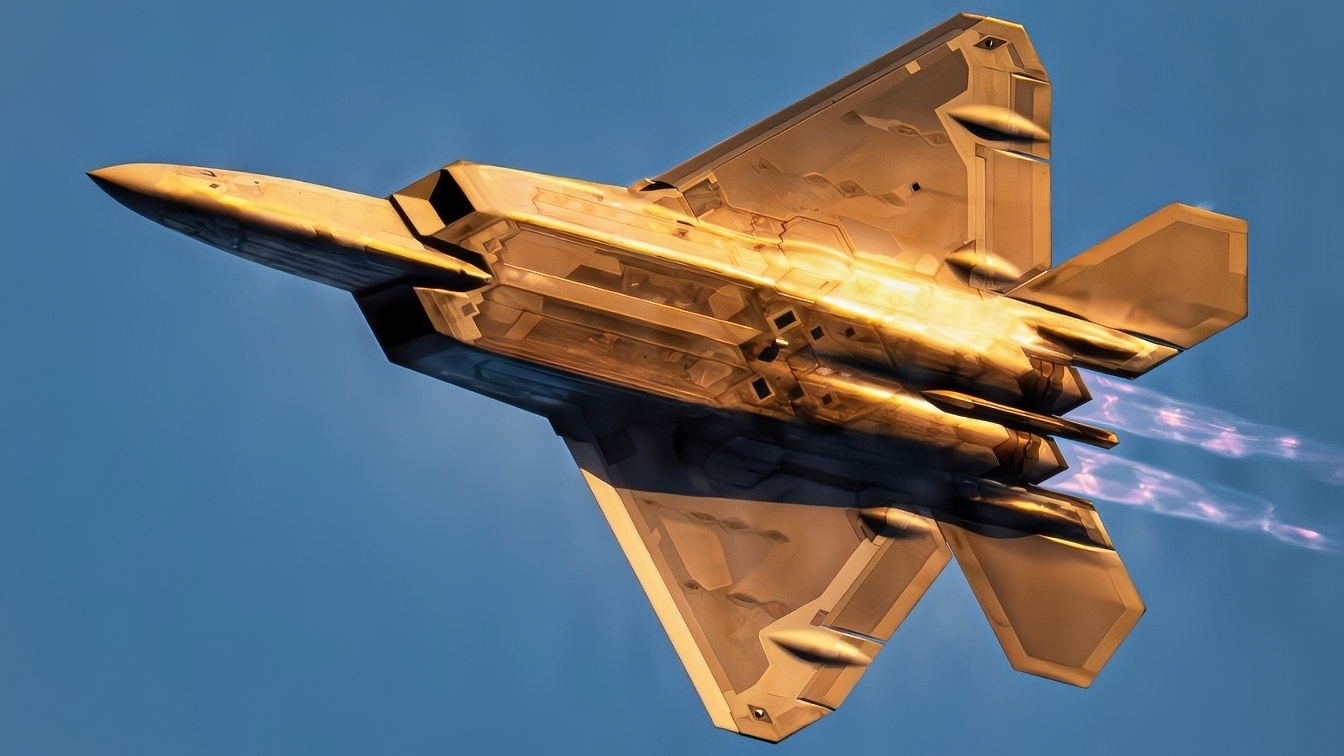
Summary and Key Points: The U.S. Air Force originally planned to build 381 F-22 Raptors. Only 187 were built. Approximately 120 are combat-ready today. The aircraft was designed in the late 1980s and early 1990s around the Intel i960 processor architecture — a closed system where adding capabilities often requires millions of code changes rather than a simple patch.
-The F-35, by contrast, uses Open Mission Systems for modular upgrades. The Raptor is rated for 8,000 hours of certified airframe life, and the small fleet has burned through hours faster than expected.
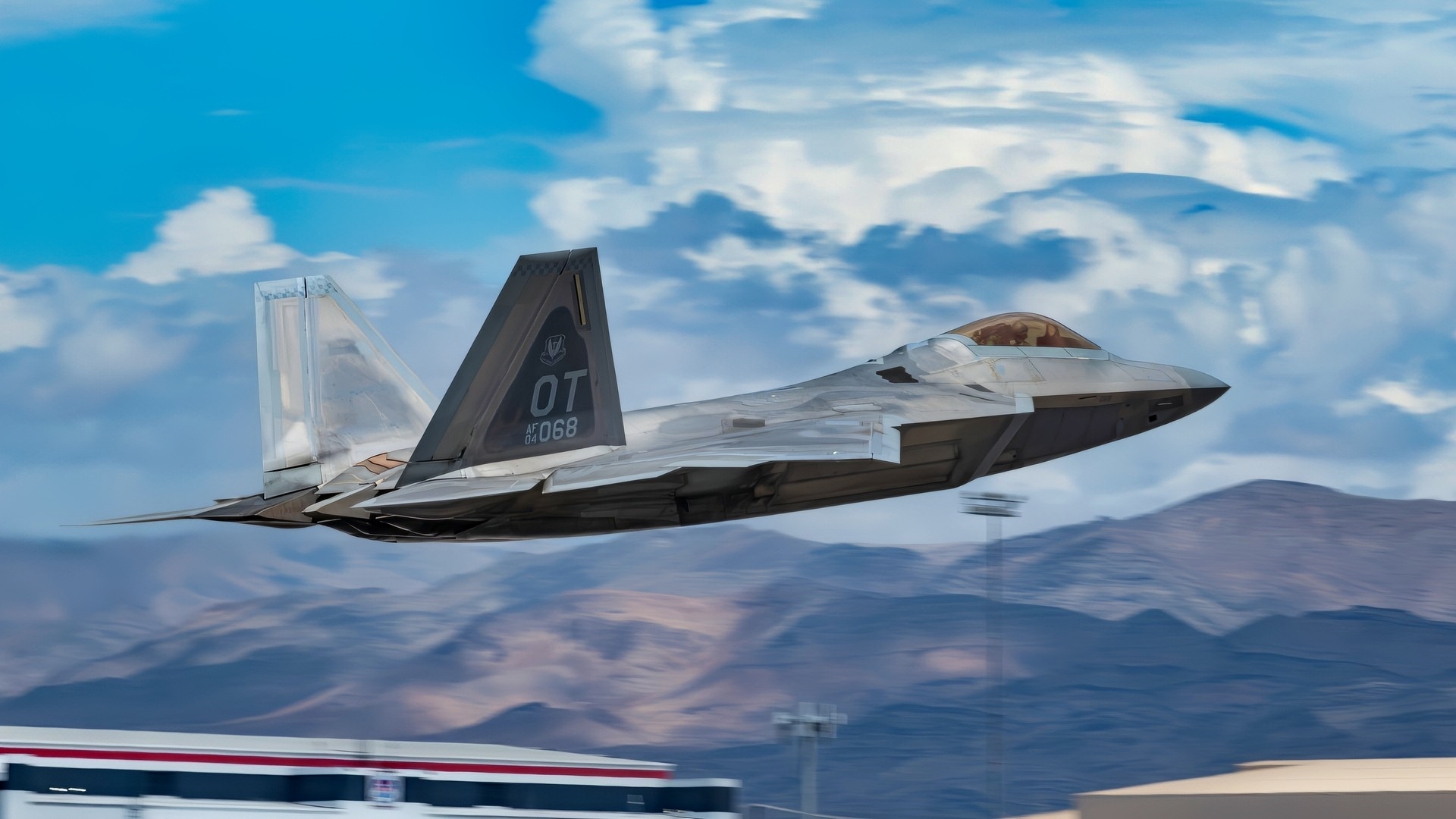
A U.S. Air Force F-22 Raptor fighter jet assigned to the 422nd Test and Evaluation Squadron (TES), takes off for a mission at Nellis Air Force Base, Nevada, Aug. 26, 2025. The 422nd TES is a geographically separated unit of the 53rd Test and Evaluation Group, Eglin AFB, Florida. (U.S. Air Force photo by William R. Lewis)
-The production line closed in 2011, taking with it the tooling, workforce expertise, and industrial capacity. The forthcoming F-47 NGAD will replace it.
The F-22 Raptor and the Numbers Challenge
One of the fiercest debates in modern aviation history is whether the US should have built more F-22 Raptors. The debate stems from the original plan to build 381 F-22s. But only 187 were actually built, of which only about 120 are combat-ready today.
The surface argument is that more F-22s would have delayed the need for the forthcoming F-47 NGAD fighter.
But the reality is more complicated: while a higher number of F-22s would have bought more time, deterrence, and strategic breathing room, it would not have bought technological permanence.
The F-22 would be outdated today, whether there were 200 or 400 units available, necessitating the F-47 regardless.
In Favor of the F-22
The F-22 remains attractive today and is perceived as enduringly relevant. Understandably so—the jet is fast, maneuverable, stealthy, and still dominant in air-to-air combat. The performance metrics are still deeply impressive, with a max speed of Mach 2-plus, supercruise of Mach 1.5-plus, and a service ceiling of 65,000 feet.
Accordingly, the F-22 has been viewed, for years, as essentially untouchable.
But the picture is changing, as China fields a large J-20 fleet, improved missile inventories, and improved sensor networks—all of which threaten to challenge the F-22’s dominance. The concern today is that the small F-22 fleet is stretched across the Pacific, Europe, and the Middle East, and that possibly a larger fleet could have dramatically improved US air-superiority depth.’

J-20 Fighter Weibo Screenshot.
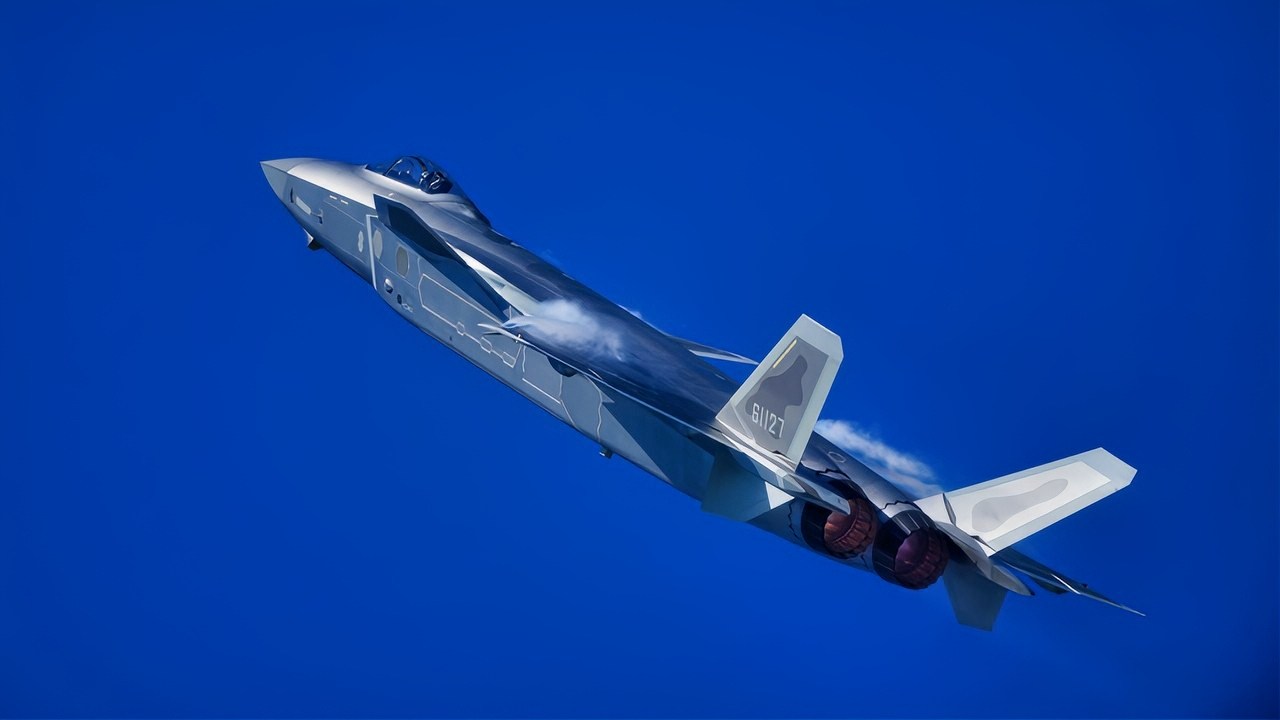
J-20 Stealth Fighter in 2024. Image Credit: Creative Commons.
Deeper than Aerodynamics
While the F-22 is still aerodynamically elite, the problem is increasingly about architecture.
The F-22 was designed in the late 1980s and early 1990s, meaning the jet was built for a different era, under the assumption that the objective was to defeat Soviet fighters, evade radar, and dominate dogfights.
Back then, there was less emphasis on AI integration, autonomous wingmen, massive sensor fusion, and machine-speed networking. In the case of the F-22, the jet became digitally outdated before it became physically outdated.
The Computer Problem
The F-22 was built around the Intel i960 processor architecture. This older design featured tight integration between hardware and software—essentially a closed system—meaning that adding upgrades often requires a major recoding effort of millions of code changes rather than a simple software patch.
Newer aircraft, however, such as the F-35, feature Open Mission Systems (OMS) that enable easy software patches. It’s kind of like new smartphones versus old desktop computers: on old computers, replacing components was difficult, but on new smartphones, modular upgrades are easy. And modern combat increasingly rewards software adaptability.
Alternative Force Structure
What if the US had fielded more F-22s? Several things would have been different. First, the US would have enjoyed a larger deterrent buffer: 300-plus operational F-22s could have maintained overwhelming Pacific air dominance throughout much of the 2010s and early 2020s, thereby reducing Chinese influence in the region.
Second, the F-22 fleet would have suffered from less structural fatigue; with such a small fleet, aircraft were repeatedly deployed and flight hours accumulated rapidly.

F-22. Image Credit: Creative Commons.
Individual aircraft reach their certified life duration of 8,000 hours more quickly. In a larger fleet, however, wear is distributed. Third, the industrial base would have been preserved longer; the F-22 line was closed in 2011, leaving the US without the tooling, workforce expertise, or production experience needed to build future aircraft. So, building more F-22s may have preserved overall manufacturing capability.
F-47 Still Necessary
Regardless, the F-47 would have been necessary. Future conflicts increasingly involve dense electronic warfare, AI-assisted targeting, collaborative combat aircraft, massive sensor networks, and long-range missile combat.
The F-47 fits that model; it will be built around software-defined systems, autonomous teammates, open architecture, and continuous upgrades. The result is that future fighters are increasingly becoming not just aircraft but network nodes. In this respect, the F-22 is inadequate and would need to be replaced with something more akin to a flying computer platform.
The Flaw Comes Down to 1 Word: Numbers
Building more F-22s would not have solved every problem.
It would have strengthened deterrence and reduced fleet strain while preserving industrial capacity and buying strategic time. But we’d still be in a place today where evolving threat environments forced the development of a next-generation aircraft.
But better numbers would surely take some of the pressure off.
About the Author: Harrison Kass
Harrison Kass is a writer and attorney focused on national security, technology, and political culture. His work has appeared in City Journal, The Hill, Quillette, The Spectator, and The Cipher Brief. He holds a JD from the University of Oregon and a master’s in Global & Joint Program Studies from NYU. More at harrisonkass.com.


