

Key Points and Summary – The U.S. Army abruptly canceled its M10 Booker light tank program in May 2025 due to excessive weight, rising costs, and maintenance woes, leaving a critical firepower gap for light infantry.
-The Booker was intended to be a rapidly deployable direct-fire support vehicle.
-With no immediate replacement announced, the Army is pivoting to other Next Generation Combat Vehicle programs like the XM30.
-The key lesson from this failure is that the Army’s next armored vehicle must be designed for the realities of the modern, drone-saturated battlefield, not just for doctrinal templates.
What Comes After the M10 Booker?
The M10 Booker was meant to be the U.S. Army’s answer to a decades-long gap in its arsenal: a mobile, protected direct-fire vehicle designed for infantry brigades that lacked the heavy firepower of tanks but still needed something strong enough to target bunkers, gun emplacements, and light armored threats.
Conceived under the Army’s Mobile Protected Firepower program and developed by General Dynamics Land Systems (GLDS), the M10 Booker emerged from years of research, design, and testing that began in the mid-2010s.
By 2023, the project showed promise and the Booker had entered low-rate production, with roughly 80 vehicles delivered and placed into field testing.
The idea was this: the Booker would give light infantry formations a weapon that could be flown rapidly into theater, and deployed in environments that the heavy Abrams tank could not navigate.
With modular armor, less bulk and weight, advanced optics, and a 105 mm cannon, the Booker was all set to fill that role.
But on May 2, 2025, the Army abruptly canceled the program. Officials cited weight creep that made the vehicle too heavy for its intended airlift role, as well as infrastructure problems and rising costs – on top of various maintenance woes.
But with the M10 Booker dead, analysts are warning that lessons must be learned – and that a new solution is still necessary.
So What Comes Next?
After the Booker project was canceled, no direct replacement platform was immediately announced or designated.
Instead, the Army appears to be pivoting toward broader modernization efforts within its Next Generation Combat Vehicle (NGCV) portfolio. The Booker, which was built off the GDLS Griffin II armored fighting vehicle platform, served as the Mobile Protected Firepower (MPF) element under NGVC.
With its cancellation, the Army is now focusing on the XM30 Mechanized Infantry Combat Vehicle (MICV), which was formerly known as the Optionally Manned Fighting Vehicle (OMFV).
The vehicle will replace the Bradley IFV, providing advanced, modular, and optionally unmanned capabilities.

A live fire demonstration of the Army’s newest and most modernized combat vehicle, the M10 Booker, marks the conclusion of the M10 Booker Dedication Ceremony at Aberdeen Proving Ground, in Aberdeen, Md., April 18, 2024. (U.S. Army photo by Cpl. Jonathon Downs)
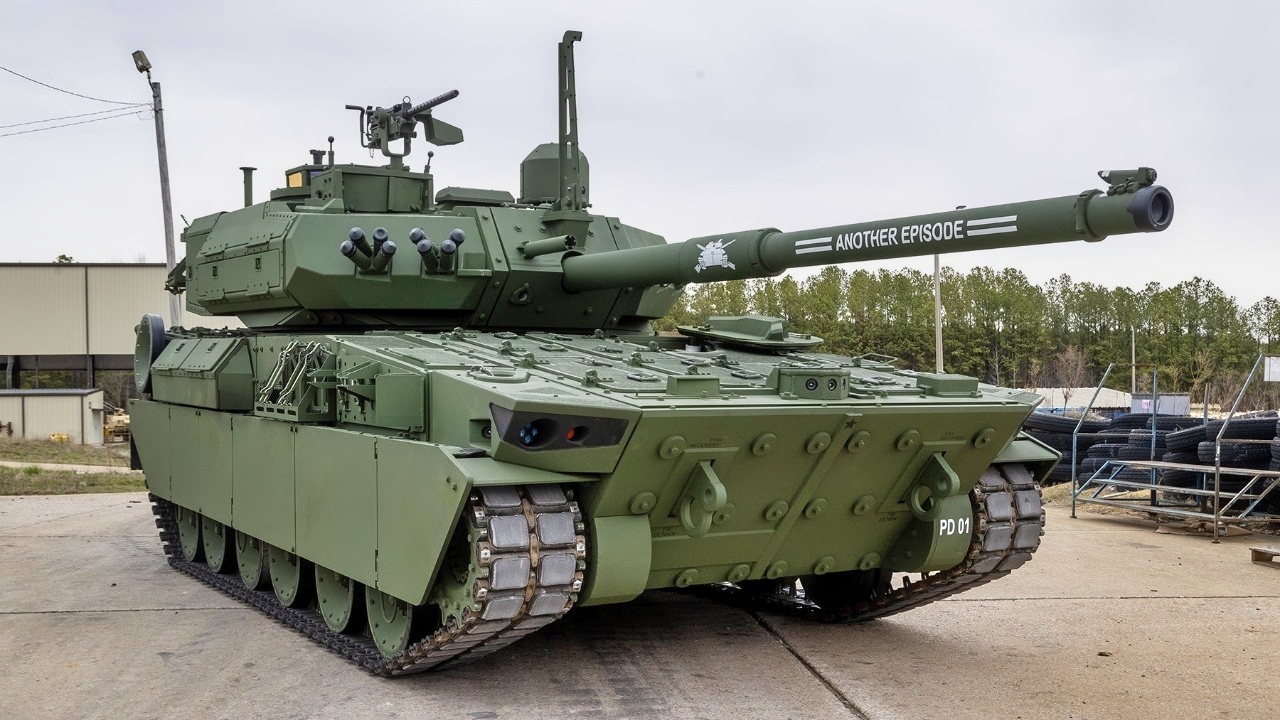
PD1 – Delivery of First Production Vehicle M10 Booker Combat Vehicle. Image Credit: U.S. Army.

The M10 Booker Combat Vehicle proudly displays its namesake on the gun tube during the Army Birthday Festival at the National Museum of the U.S. Army, June 10, 2023. The M10 Booker Combat Vehicle is named after two American service members: Pvt. Robert D. Booker, who posthumously received the Medal of Honor for actions in World War II, and Staff Sgt. Stevon A. Booker, who posthumously received the Distinguished Service Cross for actions during Operation Iraqi Freedom. Their stories and actions articulate the Army’s need for the M10 Booker Combat Vehicle, an infantry assault vehicle that will provide protection and lethality to destroy threats like the ones that took the lives of these two Soldiers. (U.S. Army photo by Bernardo Fuller)

M10 Booker. Image Credit: Creative Commons.
But whatever comes next must not only meet the needs of the U.S. Army in a way the Booker ultimately couldn’t, but should serve as a lesson not to repeat the mistakes of the past – and to account for the rapidly-changing nature of modern warfare.
Writing for the Association of the United States Army in August, retired U.S. Army Col. Thomas Balish summed up the problem well:
“The Army cannot afford another Crusader. It cannot survive another Booker. The next generation of light armor must be built not for an imagined doctrinal template, but for the drone-saturated, electronic warfare-contested modern battlefield.”
About the Author:
Jack Buckby is a British author, counter-extremism researcher, and journalist based in New York who writes frequently for National Security Journal. Reporting on the U.K., Europe, and the U.S., he works to analyze and understand left-wing and right-wing radicalization, and reports on Western governments’ approaches to the pressing issues of today. His books and research papers explore these themes and propose pragmatic solutions to our increasingly polarized society. His latest book is The Truth Teller: RFK Jr. and the Case for a Post-Partisan Presidency.
More Military
SR-72 Darkstar Might Never Fly
The U.S. Navy’s ‘Achilles Heel’: China’s Underwater Drones
The F-35 Has a ‘5-Year Late’ Problem


