

Key Points and Summary – Lockheed Martin’s SR-72 Son of Blackbird or “Darkstar” aims to replace the SR-71 with hypersonic ISR—and possibly strike—using a turbine-based combined cycle (TBCC) that blends a turbofan for takeoff/acceleration with a dual-mode ramjet/scramjet for Mach-5+ cruise.
-Skunk Works says subscale tests proved the TBCC handoff; a flight research vehicle was teased to validate the concept.
-The program draws heavily on DARPA’s HTV-2 data, but major challenges remain: extreme aero-heating, materials that survive thousands-degree skins, seamless turbofan-to-scramjet transition, and ruggedized embedded electronics for mission/flight control and real-time sensor processing.
-If realized, SR-72 could transform rapid ISR and standoff strike.
What Do We Know About The SR-72’s Engine?
The SR-72 Son of a Blackbird (SOB) is supposedly close to flying soon, if it hasn’t already. This airframe is just another incredible aircraft in Lockheed Martin’s Skunk Works’ portfolio. The much-anticipated aircraft, which is expected to travel at speeds of up to Mach 5+ (nearly 4,000 mph), will revolutionize the standards for stealth and speed among aircraft.
Designed to replace the SR-71 Blackbird, the potentially unmanned SR-72 will focus on intelligence, surveillance, and reconnaissance (ISR) missions. The jet will feature a turbine-based cycle propulsion system, combining a turbofan and scramjet for efficient hypersonic travel.
The SR-71 Blackbird was well ahead of its time. It could streak across the sky at Mach 3.2 (some claim even faster) and simply outrun enemy missiles. During its operational life, more than 4,000 missiles were fired at it, but none ever hit it. Now, its namesake will be flying even faster.

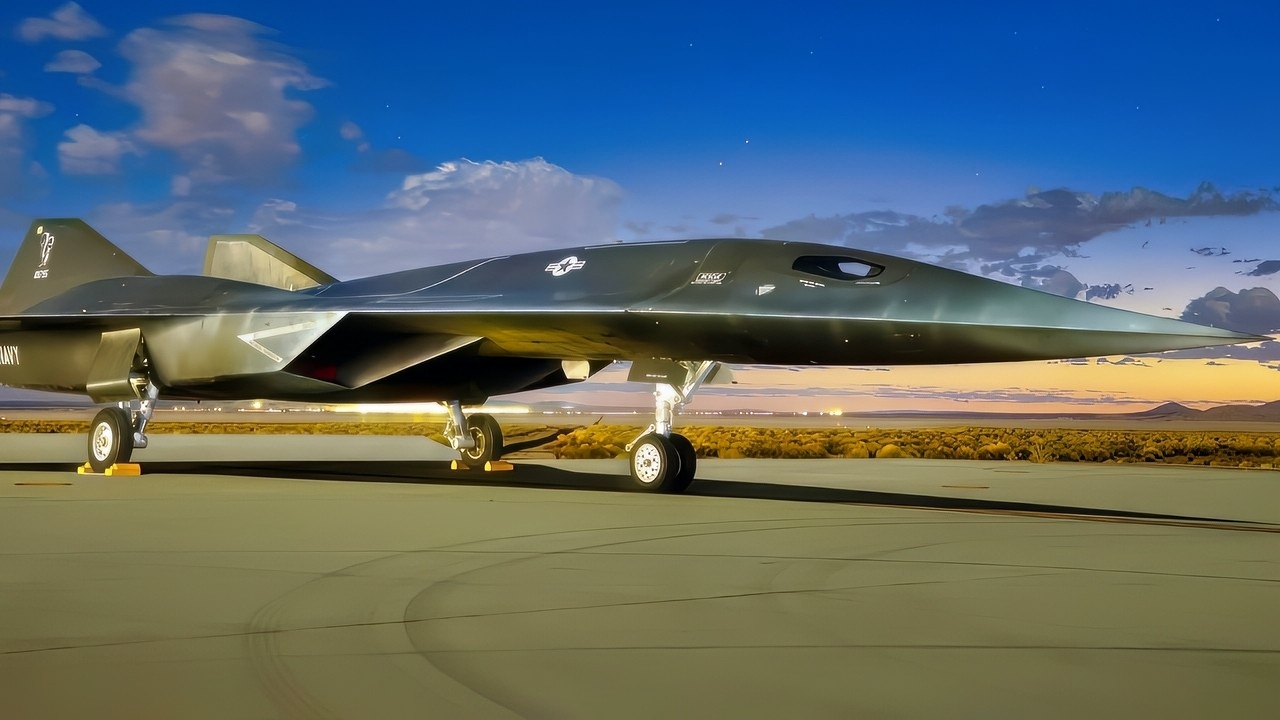
SR-72 Darkstar. Image Credit: Creative Commons.
The SR-72, also known as the Darkstar (from Top Gun fame), may have other hidden talents. The aircraft is envisioned to have reconnaissance and strike capabilities, making it a versatile platform for intelligence gathering and potentially standoff offensive operations.
But what kind of engine will power the Darkstar?
Was The Engine Riddle Solved?
In June 2017, Lockheed Martin’s executive vice president and general manager for Skunk Works, Rob Weiss, told the media that testing was complete on the turbine-based combined cycle hypersonic propulsion system for the SR-72 and that they were “getting close” to beginning work on what he described as an SR-72 Flight Research Vehicle (FRV).
This single-engine technology demonstrator was said to be “about the size of an F-22 Raptor” and was meant to demonstrate the platform’s ability to take off under conventional turbofan power, accelerate up to supersonic speeds, and then transition from turbofan power to a much more exotic dual-mode scramjet that would allow the aircraft to achieve maximum speeds well above Mach 6.

F-22 Raptor National Security Journal Image
How Does The Engine Work?
The SR-72 engine is a concept for a turbine-based combined cycle (TBCC) hypersonic engine. This hybrid system combines a conventional jet engine for lower speeds with a scramjet (supersonic combustion ramjet) for achieving speeds above Mach 5.
A turbofan accelerates the aircraft to speeds around Mach 3, at which point the scramjet engages and takes over to reach hypersonic velocities. This dual-mode system addresses the “propulsion gap” where traditional jet engines overheat at hypersonic speeds and scramjets cannot operate from a standstill.
“Hypersonic aircraft, coupled with hypersonic missiles, could penetrate denied airspace and strike at nearly any location across a continent in less than an hour,” Brad Leland, Lockheed Martin’s hypersonics manager, said in a Lockheed Martin press release that has since been taken down.
“Speed is the next aviation advancement to counter emerging threats in the next several decades. The technology would be a game-changer in theater, similar to how stealth is changing the battlespace today.”
The TBCC system’s subscale ground tests were conducted by integrating a small off-the-shelf turbine engine with a dual-mode ramjet/scramjet with an axisymmetric inlet and a nozzle.
The Skunk Works Based The SR-72 On The HTV-2 Program
Lockheed Martin’s ‘Skunk Works,’ developed the Hypersonic Technology Vehicle 2 (HTV-2), a rocket-launched aircraft, as part of the Defense Advanced Research Projects Agency (DARPA’s) “Falcon” project.
The HTV-2 project was created to gather data on aerodynamics, guidance, navigation, control, and aerothermal effects. The vehicle took its first flight in April 2010 and its second in August 2011. It achieved a maximum speed of Mach 20 (15,345.2 miles per hour). The knowledge and data obtained from the HTV-2 are now being used to develop designs for the SR-72.
The HTV-2 was an uncrewed aircraft designed to maneuver through the Earth’s atmosphere at a breakneck speed. It would take less than 12 minutes to fly from New York City to Los Angeles.
HTV-2 was to lead to the development of an HTV-3X vehicle, known as Blackswift, which would have formed the basis for deployment around 2015 of a reusable Hypersonic Cruise Vehicle, an unmanned aircraft capable of taking off from a conventional runway with a 5,400 kg (12,000 lb) payload to strike targets 16,650 km away in under 2 hours. The HCV would have required a lift-to-drag ratio of 6-7 at Mach 10 and 130,000 ft (40,000m)
But it hasn’t flown yet, or has it?
Lockheed Lets The Cat Out of the Bag … Sort of
In 2023, Lockheed posted on Twitter or “X” that set tongues to wagging.
The first, with an image of the SR-71, reads, “The SR-71 Blackbird is still the fastest acknowledged crewed air-breathing jet aircraft,” implying that there is an even faster aircraft out there.
Another tweet, posted to celebrate the success of the latest Top Gun film, featured an image of the high-speed aircraft that appeared in the film. Interestingly, Lockheed Martin said, “To celebrate, we are sharing some Maverick-worthy images of real aircraft.”
What Are The Challenges Of Flying the SR-72, Beyond The Engines?
Propulsion is a significant challenge, as engines must efficiently transition from turbine-powered flight at lower speeds to scramjet operation at hypersonic speeds. However, if the engines are working as the Skunk Works claim they will, that is just a part of the equation; if it is to be flown often, safely, and affordably.
An aircraft traveling at Mach 6, with friction with the atmosphere, causes the aircraft’s skin and airframe to reach thousands of degrees, a significant obstacle for material integrity that will melt steel.
The challenges of designing a Mach 6 aircraft include the need for specialized materials that can withstand these temperatures and stresses. The designers will have to create advanced composites and metal alloys, such as carbon-carbon composites and titanium-ceramics, to tolerate these extreme thermal loads and structural stresses.
Precision control systems, along with the design of sensors, payloads, and avionics, must also be developed to function in this harsh, high-load environment.
Lorne Graves, the chief technology officer of Abaco Systems, wrote in 2019 that when developing hypersonics, the three areas that need to be addressed are propulsion systems, airframe materials, and embedded electronics.
“While most research spending is targeting the first two areas, it is clear that innovative improvements in embedded electronics are key to creating fully functional hypersonic systems.”
Graves identified four primary functions embedded electronics that will need to perform for deployable hypersonic platforms:
Mission computing, focused on responding to commands, adjusting to changing conditions, and ensuring that all subsystems work in concert to accomplish a platform’s mission;
Flight computing, controlling the path of the platform, monitoring the outputs of sensors, and controlling the operational employment of sensors;
Real-time signal processing for radar, electro-optical sensors, and electronic warfare (EW), as well as flawless and secure communications with command and control networks.
“The electronics to perform these functions may exist in a single computing enclosure or be spread across several, Graves wrote.
Lastly, ensuring aircraft stability at such high speeds and altitudes requires overcoming complex aerodynamic and thermal management issues. Due to inherent instability, hypersonic vehicles require robust active control systems to maintain stability and control throughout the flight.
The SR-72 continues the SR-71’s speed strategy legacy instead of stealth. It will at least provide our designers with many more developments that will no doubt see it used in aircraft, weapons, and space vehicles in the future.
At best, it will provide the US with a vehicle that will revolutionize our intelligence, surveillance, and reconnaissance (ISR) capabilities.
Here’s to the SOB.
About the Author: Steve Balestrieri
Steve Balestrieri is a National Security Columnist. He served as a US Army Special Forces NCO and Warrant Officer. In addition to writing on defense, he covers the NFL for PatsFans.com and is a member of the Pro Football Writers of America (PFWA). His work was regularly featured in many military publications.
More Military
China’s J-20 Mighty Dragon Stealth Fighter Summed Up in 3 Words
The B-52J Bomber Program Might Be Over (Thanks to the B-21 Raider)
The F-22 Raptor’s Biggest Problem in 1 Word


