

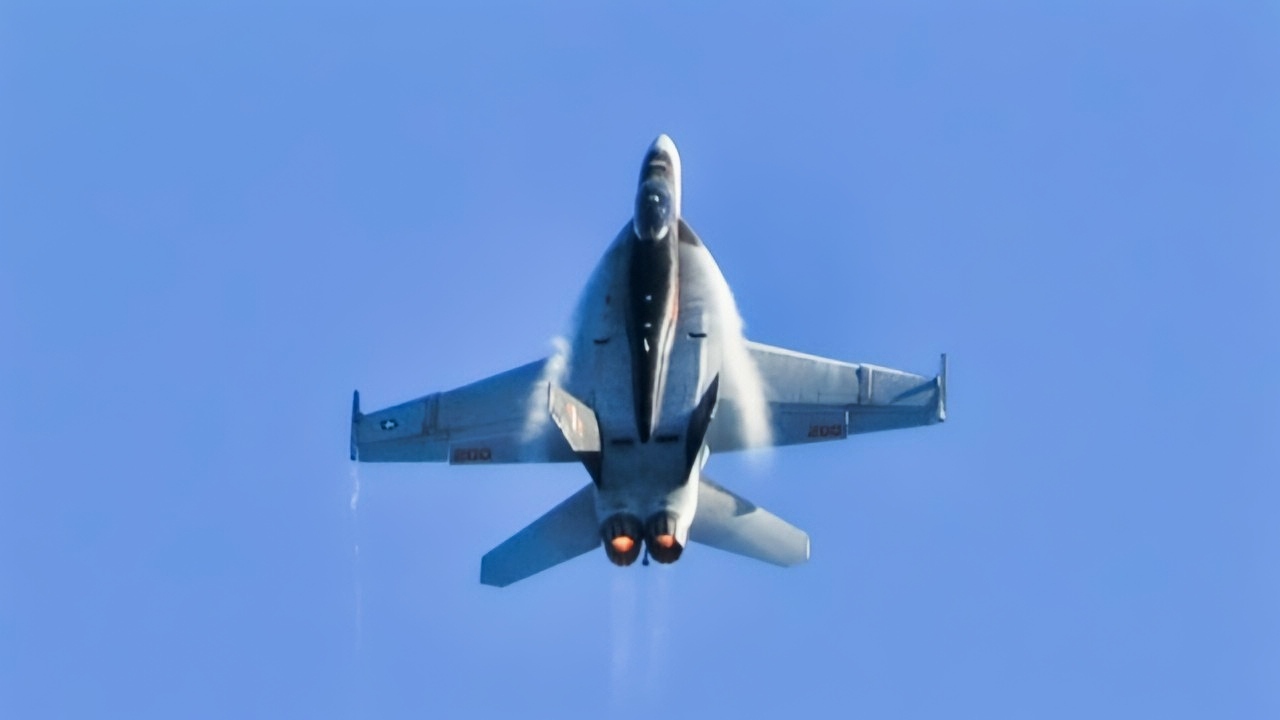
The U.S. Navy is preparing to use retired F/A-18E/F Super Hornets as adversary aircraft, replacing the 1960s-era Northrop F-5 Tigers that have served as aggressor jets for decades. The upgrade gives Navy pilots a far more realistic stand-in for China’s Chengdu J-20 stealth fighters and the long-range PL-15 air-to-air missile, which devastated Indian forces during last year’s Indo-Pakistani War. It’s a pragmatic move as Beijing’s air power continues to close the gap.
The Super Hornet Will Have a New Role in Retirement: J-20 Pretender
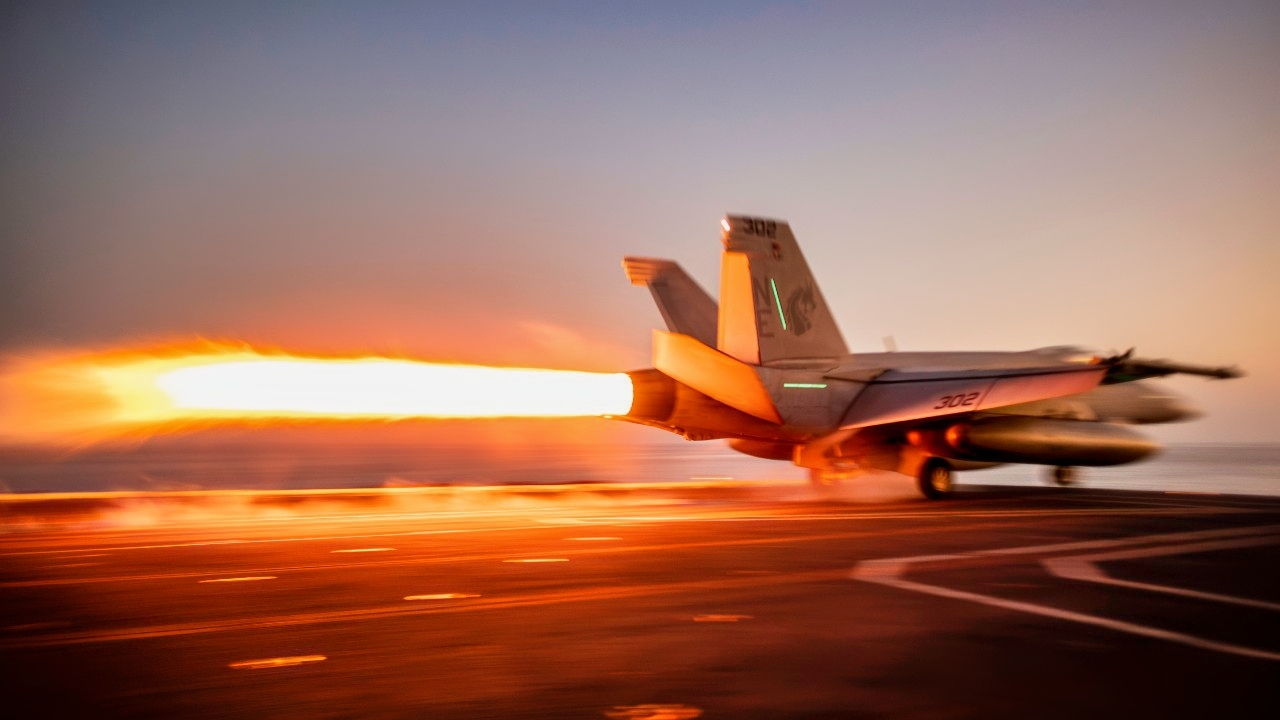
250429-N-FS097-1154 U.S. CENTRAL COMMAND AREA OF RESPONSIBILITY (April 28, 2025) An F/A-18E Super Hornet, attached to Strike Fighter Squadron (VFA) 192, launches from the flight deck of the Nimitz-class aircraft carrier USS Carl Vinson (CVN 70) in the U.S. Central Command area of responsibility. (Official U.S. Navy photo)
Part of military life is constant training. Not just for infantry. But for the expensive technical services, too. Pilots must practice their trade at all times to hone and maintain their skills. Mechanics must regularly maintain the warplanes, both to ensure their combat effectiveness and to refine their skills.
One of the most interesting aspects of combat training for aviators in the United States Navy is the use of “aggressor” planes to simulate real-world combat.
The Navy has for many years employed old Northrop F-5 Tigers as its primary “aggressor” birds. The only problem is that the F-5 is basically a lightweight Cold War-era jet. These planes, while very useful as aggressors in combat simulations, cannot emulate the performance, radar signature, speed, sensor fusion, and electronic warfare (EW) capability–or even missile employment profiles–of modern Chinese aircraft, such as the J-20 or even Russia’s upgraded Flanker derivatives.
That is why reports from The War Zone indicate that the Navy is considering using retired or excess Boeing F/A-18E/F Super Hornets aircraft as dedicated adversary platforms. Many Super Hornets are up for retirement. Rather than mothballing them, the Navy would prefer to refashion them for combat simulations against US Navy pilots who are in training, thereby replacing the aging F-5s.
As a premier fourth-generation warplane, even older Super Hornets are superior planes for US Navy aviators to train against than the old F-5s. An F/A-18E/F Super Hornet is equipped with modern AESA radars that enable it to see farther and fight better, with greater situational awareness. They’ve also got superior acceleration and range when compared to the F-5. What’s more, Super Hornets can carry a greater payload than the F-5 Tiger.
Essentially, this is a needed upgrade for Navy training. It allows Navy pilots to train against a system that is much more relevant to the modern battlefield. American fliers will face planes with similar–if not better–capabilities in the coming conflicts of this century. They need to have a feel for how to fight these systems, not just an academic understanding.

Aviation Boatswain’s Mate (Equipment) 3rd Class Mark Ruiz, assigned to Air Department aboard the world’s largest aircraft carrier, USS Gerald R. Ford (CVN 78), prepares a Carrier Air Wing 8 F/A-18E Super Hornet attached to Strike Fighter Squadron 37 for launch on the flight deck, Aug. 1, 2025. Gerald R. Ford, a first-in-class aircraft carrier and deployed flagship of Carrier Strike Group Twelve, is on a scheduled deployment in the U.S. 6th Fleet area of operations to support the warfighting effectiveness, lethality and readiness of U.S. Naval Forces Europe-Africa, and defend U.S., Allied and partner interests in the region. (U.S. Navy photo by Mass Communication Specialist 2nd Class Mariano Lopez)
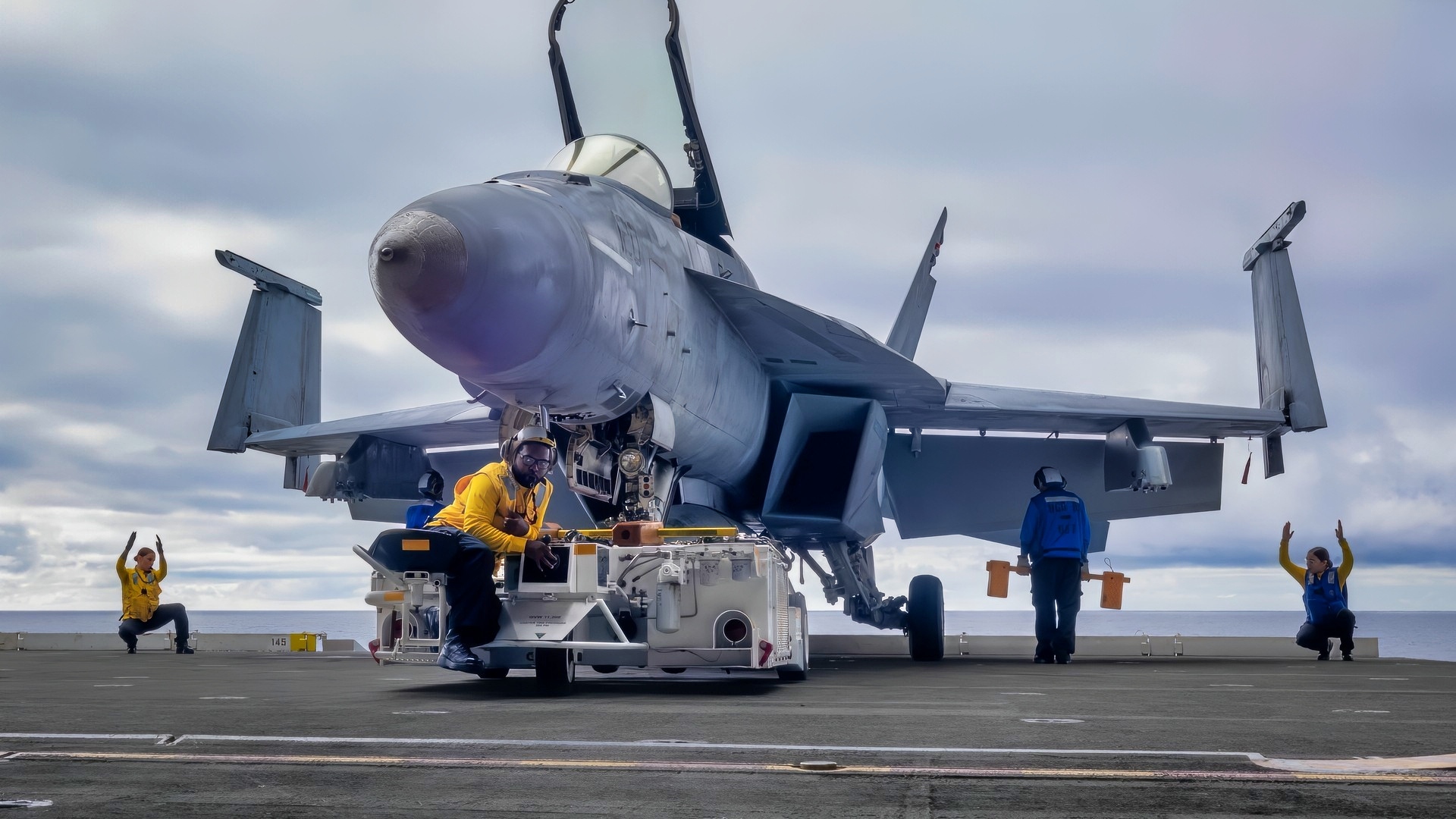
ATLANTIC OCEAN (Aug. 13, 2025) Sailors transport an F/A-18E Super Hornet attached to the “Gladiators” of Strike Fighter Squadron (VFA) 106 onto an aircraft elevator aboard the Nimitz-class aircraft carrier USS George H.W. Bush (CVN 77). George H.W. Bush is underway conducting carrier qualifications and routine operations in the Atlantic Ocean. (U.S. Navy photo by Mass Communication Specialist Seaman Apprentice Kayleigh Tucker)
The China Factor
At its core, the Navy’s desire to use older F/A-18E/F Super Hornets is driven by a potential war against China’s People’s Liberation Army Air Force (PLAAF) and the naval aviators of China’s People’s Liberation Army Navy (PLAN). Even if US Navy pilots don’t fight Chinese pilots, the rate at which Beijing is exporting its indigenously produced fourth-and-fifth-generation warplanes means that US pilots will likely be fighting Chinese birds in some ancillary conflict.
They need to be ready.
Chinese airpower has evolved dramatically in the last 20 years, too. They now have Chengdu J-20 “Mighty Dragon” fifth-generation warplanes that rival US fifth-generation jets such as the iconic F-22 Raptor. Meanwhile, Chinese weapons have progressed significantly. They were once the laughingstock of the world’s defense contractors.

J-20 on the Tarmac. Image Credit: Creative Commons.
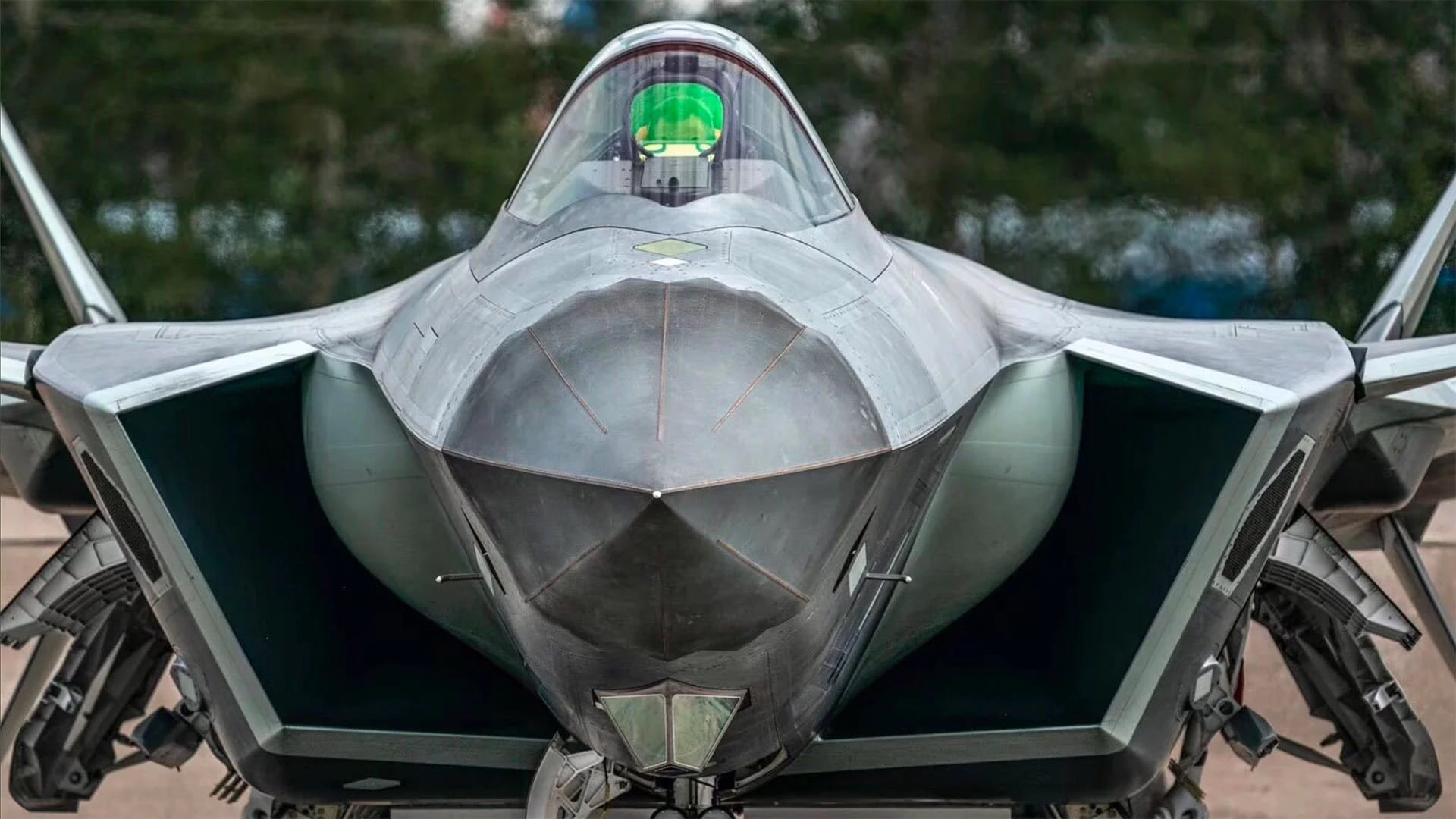
J-20 Fighter Image. Image Credit: Creative Commons.
After the Indo-Pakistan War of last year, though, specific Chinese military systems demonstrated a very robust capability that could stymie even the advanced Western and Russian systems that Indian forces used against Pakistan.
In that campaign, Pakistan defended its territory employing the long-range PL-15 air-to-air missiles from China. Those missiles did massive damage to the Indians. Beijing is exporting these missiles elsewhere today. And, Heaven forbid, if war between China and the US did erupt, US Navy pilots would face these weapons in combat.
Chinese planes further employ advanced integrated sensor networks, enjoy increasingly sophisticated carrier aviation capabilities, and have high-end EW capabilities. So, an F/A-18E/F is much more useful for training purposes than are 1960s-era F-5 Tigers that have been run ragged by serving as aggressor birds for years.
A Sign of Larger Problems for the US Navy
The maritime force’s need for F/A-18s as aggressor-training birds, though, highlights a deeper problem plaguing the United States Armed Forces. In the Navy, their legacy birds are aging out faster than they can replace them with the F-35C Lightning II. After all, the F-35C fleet has struggled since its inception.
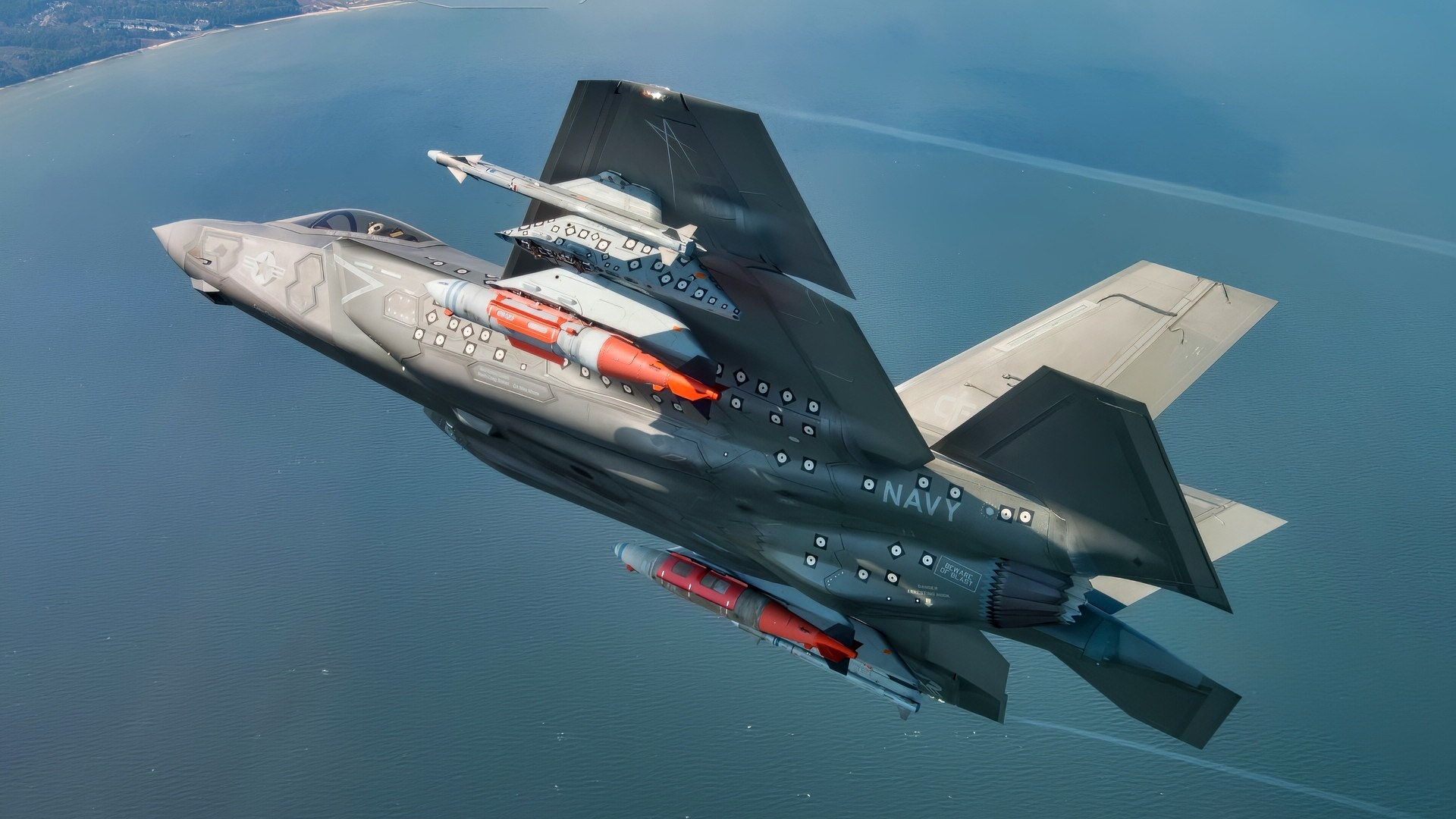
The final SDD Test flight CF-2 Flt 596 was piloted by BAE Test pilot Peter Wilson, April 11, 2018, from the F-35 Pax River Integrated Test Force. The F-35C completed a mission to collect loads data while carrying external 2,000-pound GBU-31 Joint Direct Attack Munitions (JDAM) and AIM-9X Sidewinder heat-seeking missiles. (Photo courtesy of Lockheed Martin)
Recent reports indicate a readiness rating of barely 50 percent for the entire US F-35 fleet, including the Navy’s F-35Cs. These planes were significantly delayed due to technical complications and budgetary problems throughout their development. Today, the Navy still lacks the fleet of F-35Cs it needs to reliably replace the retiring F/A-18E/F Super Hornets.
What’s more, the Navy’s fantastical plans for the dubious F/A-XX program remain years away, all while facing extreme budgetary uncertainty. Beyond that, carrier air wings are struggling with range and survivability concerns against China’s growing anti-access/area-denial (A2/AD) systems.
The Navy cannot build its own unique aggressor fleet for a variety of reasons, including failures in the defense industrial base, budgetary constraints, and timing (the Navy cannot wait for new planes to be built for essential training). They’re repurposing existing Super Hornets as a practical interim solution. Make no mistake: the Super Hornets, as aggressor birds, will not be just a temporary solution.
One Last Bit of Irony
If the Navy ever does get its F/A-XX sixth-generation warplane, the F/A-18E/Fs will spend their final years pretending to be Chinese fighters while training the pilots who will eventually fly their replacements. It’s a pragmatic, smart move by the Navy to use the Super Hornets, which absolutely require reliable aggressor aircraft relevant to the ever-changing modern battlefield.

Boeing NGAD F/A-XX Fighter Rendering. Image Credit: Boeing.

F/A-XX Handout Photo from Northrop Grumman.
Yet, it’s a band-aid over a larger wound created by America’s chronically failing industrial base. That’s because, at some point soon, training sixth-generation planes and pilots against aging fourth-generation birds, like the Super Hornets, will be as irrelevant–only sooner–as the F-5 Tigers are today.
The bottom line is that America’s military readiness is deteriorating even as it faces a serious military challenge from peer rivals. The F/A-18E/F being used as aggressor planes for training is a necessary move. But it doesn’t resolve the larger readiness and industrial woes the Navy faces today.
About the Author: Brandon J. Weichert
Brandon J. Weichert is Senior National Security Editor. Recently, Weichert became the editor of the “NatSec Guy” section at Emerald. TV. He was previously the senior national security editor at The National Interest. Weichert hosts The National Security Hour on iHeartRadio, where he discusses national security policy every Wednesday at 8 p.m. Eastern. He hosts a companion show on Rumble entitled “National Security Talk.” Weichert consults regularly with various government institutions and private organizations on geopolitical issues. His writings have appeared in numerous publications, among them Popular Mechanics, National Review, MSN, and The American Spectator. His books include Winning Space: How America Remains a Superpower, Biohacked: China’s Race to Control Life, and The Shadow War: Iran’s Quest for Supremacy. Weichert’s newest book, A Disaster of Our Own Making: How the West Lost Ukraine, is available for purchase at any bookstore. Follow him via Twitter/X @WeTheBrandon.


