

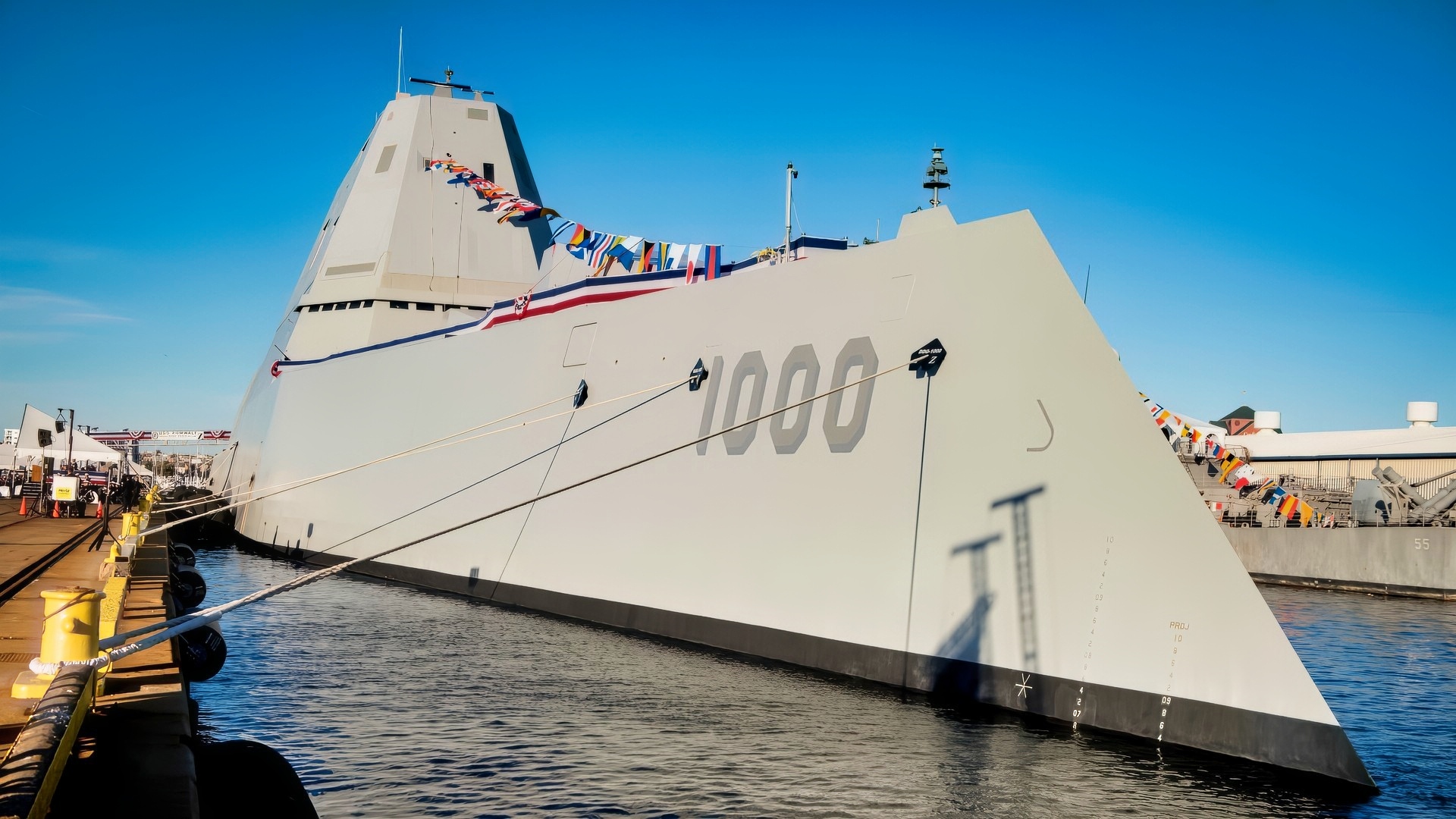
Summary and Key Points: As of February 2026, the USS Zumwalt (DDG-1000) has officially cleared builder’s sea trials following a three-year “rebirth” at HII’s Ingalls Shipbuilding.
-The destroyer’s failed 155mm gun systems have been replaced with four Advanced Payload Modules, housing 12 Conventional Prompt Strike (CPS) hypersonic missiles.
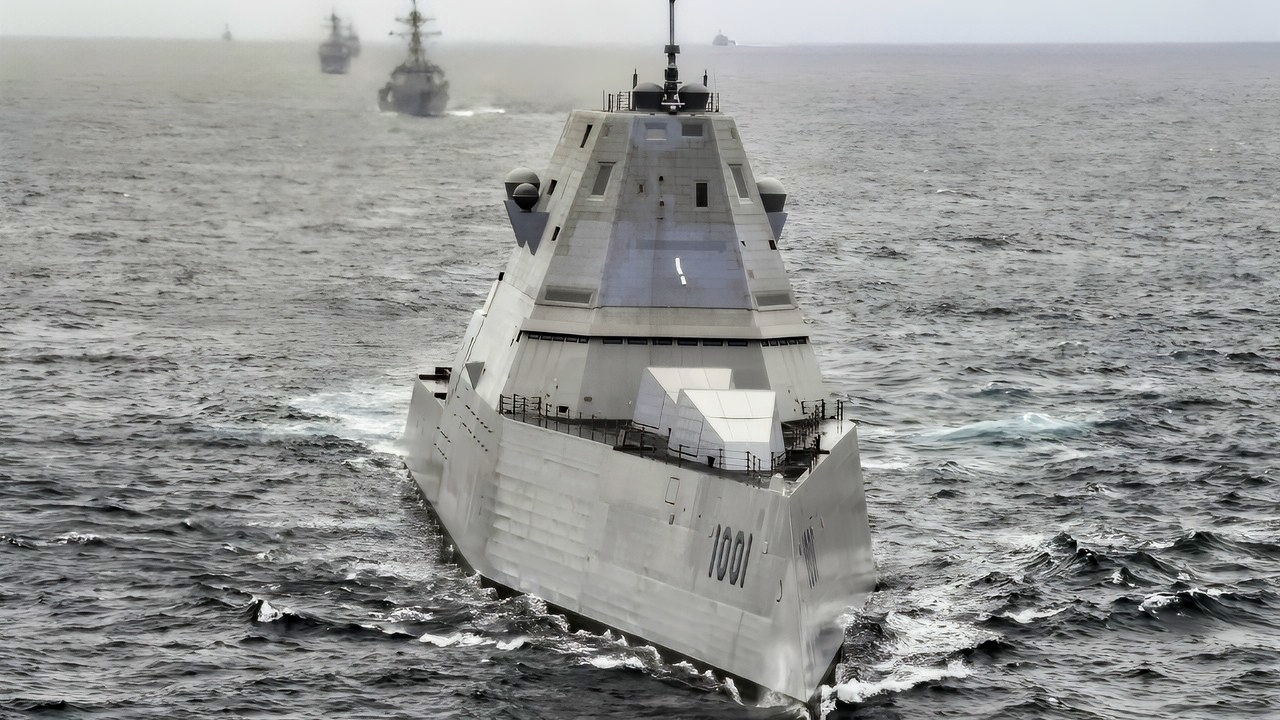
(April 21, 2021) The Zumwalt-class guided-missile destroyer USS Michael Monsoor (DDG 1001) leads a formation including the Arleigh Burke-class guided missile destroyers USS Fitzgerald (DDG 62), USS Spruance (DDG 111), USS Pinckney (91), and USS Kidd (DDG 100), and the Independence-variant littoral combat ship USS Coronado (LCS 4) during U.S. Pacific Fleet’s Unmanned Systems Integrated Battle Problem (UxS IBP) 21, April 21. UxS IBP 21 integrates manned and unmanned capabilities into challenging operational scenarios to generate warfighting advantages. (U.S. Navy photo by Chief Mass Communication Specialist Shannon Renfroe)
-This Mach 5+ weapon provides a non-nuclear, 1,700-mile strike radius, effectively transforming the “stealth bomber of the seas” into a strategic deterrent.
-While the Zumwalt leads the class into IOC this year, the Lyndon B. Johnson is currently undergoing similar modifications, with the Michael Monsoor slated for its refit in 2027.
How the USS Zumwalt’s 2026 Hypersonic Refit Finally “Saved” the $8 Billion Stealth Destroyer
USS Zumwalt (DDG-1000) took to sea for the first time since 2023 after the installation of large missile tubes capable of fielding hypersonic strike weapons was emplaced in the HII shipyard in Pascagoula, MS, back last month.
The Lyndon B. Johnson, second in class, is undergoing modifications to fire hypersonic missiles, promising global reach and offensive power.
Currently, Ingalls Shipbuilding, a Mississippi shipyard, is installing vertical hypersonic missile tubes on the Zumwalt-class destroyers, replacing twin turrets from a gun system that was never activated due to the high cost of the ammunition.
“We have achieved a pivotal milestone with our Navy and industry partners to advance this complex modernization work that will set a precedent for the Zumwalt class,” Brian Blanchette, Ingalls Shipbuilding president, said in a statement. “I’m very proud of the team effort and their critical role to advance the U.S. Navy’s first warship with hypersonic capabilities.”

(July 28, 2022) U.S. Navy Zumwalt-class guided-missile destroyer USS Michael Monsoor (DDG 1001) sails in formation during Rim of the Pacific (RIMPAC) 2022, July 28. Twenty-six nations, 38 ships, three submarines, more than 30 unmanned systems, approximately 170 aircraft and 25,000 personnel are participating in RIMPAC from June 29 to Aug. 4 in and around the Hawaiian Islands and Southern California. The world’s largest international maritime exercise, RIMPAC provides a unique training opportunity while fostering and sustaining cooperative relationships among participants critical to ensuring the safety of sea lanes and security on the world’s oceans. RIMPAC 2022 is the 28th exercise in the series that began in 1971. (U.S. Navy photo by Mass Communication Specialist 3rd Class Aleksandr Freutel)
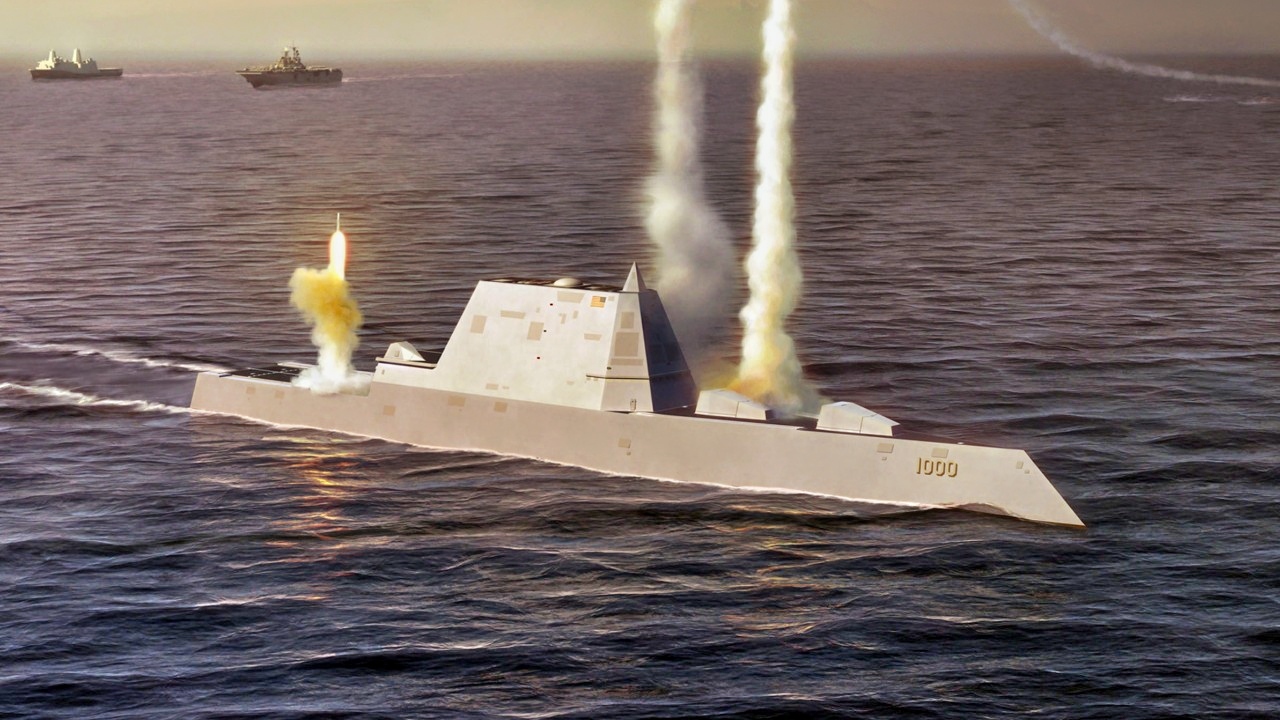
The US Navy’s troubled Zumwalt-class destroyers are being revitalized with the integration of Conventional Prompt Strike (CPS) hypersonic missiles, transforming them into powerful long-range strike platforms. The original class of 32 ships was cut to just three after its Advanced Gun System failed due to exorbitant costs. Now, these stealthy, $8 billion warships are having their defunct guns replaced with vertical launch tubes for hypersonic weapons. This upgrade will dramatically increase their strike range from a mere 63 miles to over 1,700 miles, making the Zumwalts relevant and formidable assets for deterring adversaries like China in the 21st century.
The U.S. Navy is refitting its three Zumwalt-class stealth destroyers with Conventional Prompt Strike (CPS) hypersonic missiles to provide a long-range, rapid-strike capability by 2026. These weapons, capable of traveling over Mach 5, will replace the ships’ main gun systems, with each vessel expected to carry up to 12 missiles.
What Is The Conventional Prompt Strike Weapon System?
The Zumwalt class will employ the Conventional Prompt Strike (CPS) system, a hypersonic boost-glide weapon capable of traveling over 1,700 miles.
CPS pairs advanced hypersonic missiles with submarines and surface ships to hit high-value targets anywhere in the world within minutes instead of hours.
CPS is a new class of non-nuclear, ultra-fast strike capability that can penetrate modern defenses and respond to emerging threats almost instantly.
Lockheed Martin is developing the CPS system for the Navy, the Long Range Hypersonic Weapon (LRHW) for the Army, and the Air-Launched Rapid Response Weapon (ARRW) air-to-ground missile for the Air Force.
The glide body is the same across the different missiles, which helps reduce costs, speed development, and ensure future upgrades are simplified.
Following the Zumwalts, the next vessels to carry CPS rounds will be the Block V Virginia-class submarines, with missile storage enabled by the addition of 4 extra missile silos in the Virginia Payload Module (VPM).
The Navy is removing the two 155mm Advanced Gun Systems (AGS) on each ship and replacing them with four large Advanced Payload Module (APM) tubes, with each tube capable of housing three missiles.

Zumwalt-Class U.S. Navy Image.
The USS Zumwalt (DDG-1000) is undergoing a refit, with testing expected to continue this year. The goal is to have all three ships in the class (including Michael Monsoor and Lyndon B. Johnson) upgraded.
This could transform the Zumwalt class from a troubled coastal support ship into a premier, stealthy, long-range strike platform, particularly critical for potential Pacific theater conflicts.
The missiles are designed to be non-nuclear, relying on extreme speed (over a mile per second) and maneuverability to strike targets, which makes them highly accurate but technically challenging to develop.
The Zumwalt destroyers are the first U.S. surface combatants to carry these weapons, with the capability expected to be fully integrated across the class to provide a significant, non-nuclear strategic, high-speed strike option.
Will It Be Enough To Save The Zumwalt-class?
The integration of hypersonic missiles on the Zumwalt-class destroyer is indeed a significant step that could potentially “save” the program by revitalizing its purpose and enhancing its relevance in a possible future conflict with China.
Initially designed with advanced features like stealth and electric propulsion, the Zumwalt class faced challenges, particularly with its expensive gun system.
The Navy had planned to order 32 Zumwalt destroyers, but now there are only three on active duty.
The two Advanced Gun Systems have failed, and schedule slips and cost overruns have plagued the program. The CPS missiles increase the range of the Zumwalt-class from 63 miles with the Advanced Gun System to 1,725 miles.
The Zumwalt-class ships cost the Navy around $8 billion each, and it is unclear whether the fitting of hypersonic missiles on the destroyers will lead to increased procurement.
Navy Captain Clint Lawler, program manager of the DDG 1000 destroyer program, said, “The plan is to get the ship available this year and then to support [initial operational capability] when the testing schedule supports that.
“We removed both guns from the ship. We’ve recovered some of the space under the second gun system for spaces that were previously used under the forward gun mount,” Lawler added. “We’ve essentially recaptured some of that space. Other space is a reservation for future capability.”
The Zumwalt Class Can (Finally) Be A Powerful Strike Platform
Adding hypersonic missiles, specifically the Conventional Prompt Strike (CPS) system, however, transforms the Zumwalt into a powerful strike platform, capable of delivering long-range, high-speed attacks. This makes it a much more valuable and versatile platform in the event of war.
Hypersonic missiles, capable of speeds exceeding Mach 5, offer a critical standoff strike capability against a wide range of targets, including those previously requiring naval gunfire support.
Each Zumwalt-class destroyer would be equipped with four missile tubes, each with three missiles, for a total of 12 hypersonic weapons per ship.
The Zumwalt’s stealthy design, advanced radar, and electric propulsion system, while not initially fully utilized, would now become valuable assets when paired with the hypersonic missile capability.
“I refer to all the ships that get hypersonics as the Larry Bird ships of the Navy,” Jerry Hendrix, a retired Navy captain and former Pentagon staff member who is now a senior fellow at the Sagamore Institute, said, referring to the legendary three-point shooter who played for the Boston Celtics.
“These ships, because of the ranges associated with hypersonics, will be able to do that pinpoint accuracy from way outside the shooting range for the rest of the fleet.”
Because the Zumwalts are designed with a low-radar cross-section, they’ll be able to operate “much more comfortably” in regions where adversaries are practicing area-denial strategies that might keep other platforms at bay, Hendrix added.
Adding the CPS hypersonic missile upgrade transforms the Zumwalt from a potentially obsolete warship into a potent and relevant platform, capable of projecting power and deterring potential adversaries of the United States in the 21st century.
However, with only three ships in the class and no plans to build more, this move, while important, may only serve to introduce hypersonics to more classes of Navy surface ships.
About the Author: Steve Balestrieri
Steve Balestrieri is a National Security Columnist. He served as a US Army Special Forces NCO and Warrant Officer. In addition to writing on defense, he covers the NFL for PatsFans.com and is a member of the Pro Football Writers of America (PFWA). His work was regularly featured in many military publications.


