

Key Points and Summary – A critical analysis concludes the U.S. Navy faces a dangerous shortage of attack submarines, leaving it stretched too thin to meet global demands.
-While the fleet is already below its 66-boat goal, the reality is worse: about one-third of subs are non-deployable at any time due to massive maintenance backlogs and crew shortages.

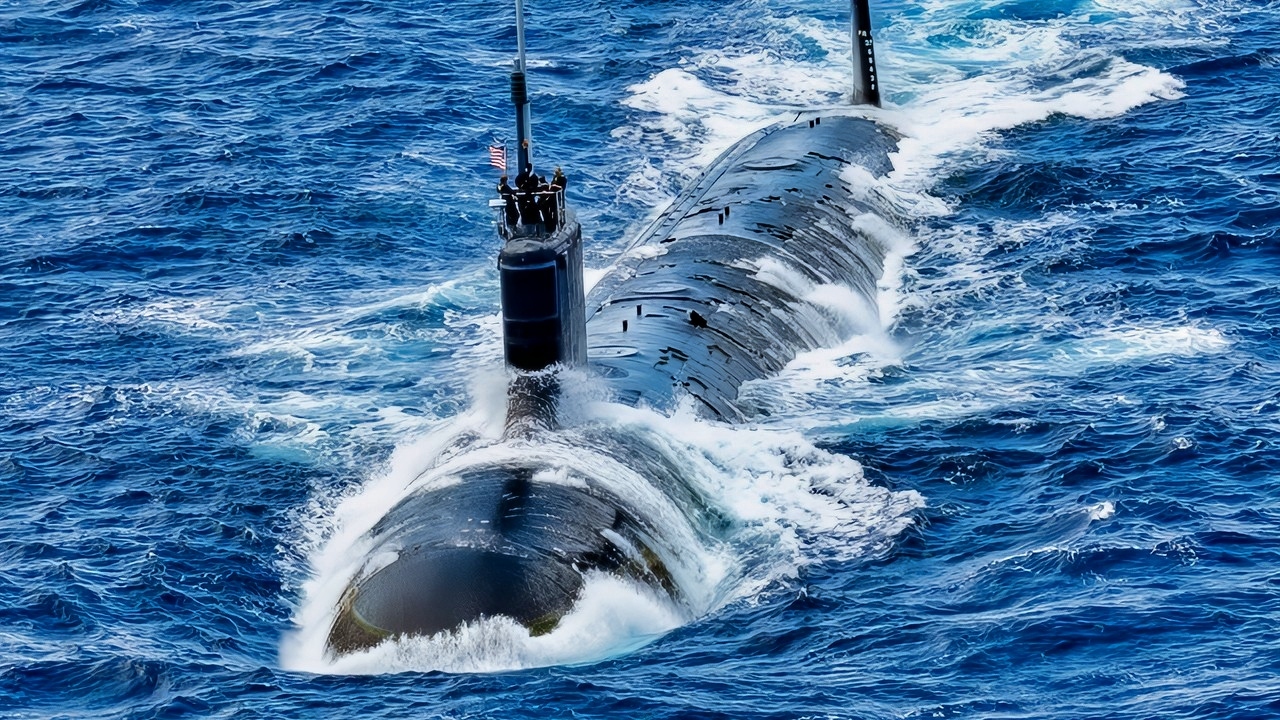
110630-N-ZZ999-002.ATLANTIC OCEAN (June 30, 2011) The Virginia-class attack submarine USS California (SSN 781) underway during sea trials. (U.S. Navy photo by Chris Oxley/Released).
-This readiness crisis is fueled by a struggling industrial base that cannot build new boats fast enough and a severe manning crisis.
-Though U.S. subs remain qualitatively superior, this widening numbers gap invites miscalculation from rivals and risks leaving the Navy “dominant in theory but impotent in practice.”
Does the U.S. Navy Have Enough Attack Submarines?
Does the United States Navy have enough attack submarines?
The question is disarmingly simple, but it goes to the heart of the American strategic position.
Attack submarines—SSNs—are nuclear-powered boats built to hunt enemy subs and surface ships, gather intelligence, hit targets on land with cruise missiles, and support special operations forces.
These boats are how America fights the quiet war for undersea dominance in an age when great powers are once again contesting control of the world’s oceans. Yet the fleet is being stretched thin. The number of subs is in decline.
The crews needed to man them are in short supply. Maintenance backlogs are increasing. Fleet commanders can muster only a fraction of the number of attack submarines they have on paper, meaning that they cannot do everything they are asked to do, everywhere they are needed to do it, at the same time. The bottom line: today, the United States does not have enough attack submarines to sustain even a grand strategy of restraint.
Readiness in the Water
On paper, the US Navy has about 53 fast-attack submarines of the Los Angeles, Seawolf, and Virginia classes.
That number is already well short of its goal of 66 boats—a number established to provide a global presence in the Indo-Pacific, Atlantic, and Arctic in the face of peer competitors. Worse, the number of subs is expected to dip further in the next few years, to as low as 47 by 2028, before it slowly builds back up to the mid-century. It is a worrisome trend in an era of intensifying maritime great power competition with China and Russia.

Type 093B Submarine from China. Image Credit: Screengrab.
But those numbers, too, are misleading. The real number of attack submarines is not the total on hand, but rather the number of boats that are available to deploy on any given day. Today, the Navy’s “surge readiness” for attack submarines is a little better than two-thirds, meaning that one-third of the fleet is not deployable because of maintenance, modernization, or crew shortages. Maintenance delays have been so severe that the available force has sunk to nearly 60 percent at times in recent years. The Navy has taken steps to reduce the time it takes to bring boats through inspections and refits, but the structural maintenance backlog remains an enormous challenge.
And the size of the gap between requirement and reality is the function of the answer to a further question: “Enough for what?” If the requirement is only to provide some kind of presence in the Pacific, Atlantic, and Mediterranean, the answer is “yes.” The Navy can just about scrape by.
Suppose, however, the requirement is to provide credible deterrence against China in the Western Pacific, cover for Russian subs in the North Atlantic, and be ready to project strike power globally. In that case, the number is simply too low. And the range of missions the Navy has asked of attack submarines is precisely that: all of the above, simultaneously. To do so, it needs both numbers and operable hulls.
Numbers Under the Surface
Numbers matter because presence matters. Rivals must know and be confident that American submarines are on patrol in chokepoints and hotspots, following their own boats, and able to strike at critical targets on land without warning or detection. A submarine force that is not numerous enough to provide such constant coverage invites miscalculation by opponents. But quality matters as well.
The Virginia-class attack submarine is a world-beating platform, particularly with the introduction of the Block V design and the Virginia Payload Module for increased strike capacity. They are stealthier, more versatile, and more lethal than any submarine China or Russia can field in any kind of quantity. But supremacy at the platform level is irrelevant if there are not enough of these boats on hand to meet the missions required of them. Worse, if the production line slows or stops for any reason, and new hulls cannot come online fast enough to replace older boats being decommissioned, the entire force starts to age as a unit.

Akula-Class. Image Credit: Creative Commons.
The most critical pressure point is industrial capacity. The Navy would like to be building two Virginia-class boats per year, but has so far been able to do no more than half that, on a good day. Skilled labor shortages, cost overruns, and delays cascade and feed on themselves in a kind of vicious cycle: fewer new boats coming off the assembly line, more pressure on older and more heavily deployed boats, and a maintenance backlog that only grows as a result.
The first commissioning in April 2025 of USS Iowa, after significant schedule pressure, demonstrates how systemic production delays impede the ability of new hulls to relieve the strain on the fleet. Shipyard capacity and a skilled workforce will both need to be dramatically increased if the Navy is to win the numbers game.
Staffing the Boat
Crews are a separate but equally serious problem. Attack submarines require skilled and highly trained crews, and the Navy’s recruiting and retention crisis has hit the submarine force especially hard. Despite recent modest gains in recruitment in 2025, the consensus among leaders is that it will take years of consistent recruiting success to return to healthy staffing levels. Incentives have been expanded and tour spans lengthened simply to keep existing boats crewed.
A high-tech submarine platform is not useful without a full, competent crew, and manning shortfalls are one of the top risks to the undersea readiness of the entire force.
For now, American undersea power still represents qualitative superiority under the waves: its submarines are quieter, its crews more experienced, and its technology more advanced. But quantitative superiority has a quality of its own, and on that metric, the balance is shifting.
A force that is too small overall and which has a limited number of hulls ready for deployment at any given time risks losing the initiative to rivals prepared to fight and ready to exploit gaps in American coverage and presence. The risk is not so much that the US Navy would lose a fair fight against the Chinese or Russian navies, but that it would not be in the fight at all.
American undersea power has long been a great strategic insurance policy, hidden, unpredictable, and shockingly lethal. But insurance only pays if it is kept up to date and paid in full. Suppose Washington cannot close the growing gap between the number of attack submarines on paper and the number of attack submarines at sea.
In that case, the US will find itself with the worst of both worlds—dominant in theory but impotent in practice. In the unforgiving strategic environment of multipolarity and great power competition, that is not just a bet. It is an invitation to defeat.
About the Author: Dr. Andrew Latham
Andrew Latham is a Senior Washington Fellow with the Institute for Peace and Diplomacy, a non-resident fellow at Defense Priorities, and a professor of international relations and political theory at Macalester College in Saint Paul, MN. You can follow him on X: @aakatham. He writes a daily column for National Security Journal.
More Military
Mach 6 SR-72 Darkstar: Russia or China Can’t Shoot It Down?
J-20 vs. F-47: Which Stealth Fighter Wins?
F-14 Tomcat: We Got As Close To This Fighter as the Law Allowed Us (Full Tour/Pictures and Video)


Jim
September 9, 2025 at 12:47 pm
In the new world of war, dispersal of forces is key (pinpoint and unstoppable striking power suggests not putting all your eggs in one basket).
Could this submarine gap be turned into a positive?
Possibly, but it takes a dramatic shift to a different strategic idea, not an easy thing in the world of naval strategy and procurement.
Large numbers of sufficient, inexpensive vessels with smaller crews whether underwater or on the surface to disperse forces over a broad area.
Diesel-electric submarines in large numbers (numbers matter), each with a battery of offensive pinpoint missiles or other offensive & defensive systems, which can be targeted and coordinated to bring concentration of fire.
(There are only limited instances for the need to concentrate forces, the name of the game is “Concentrated Fire” and a requirement for the ability of pinpoint accuracy from a set of dispersed forces.)
My suspicion… and only that, is that the United States could setup a crash building program of producing diesel/electric submarines much faster and cheaper than the current nuclear submarine program is able to do.
Numbers matter in a dispersion of forces strategy, and the offensive/defensive capability of each vessel is crucial as well.
By, by, nuclear submarine?
Not quite, but we can’t get stuck where we are right now; way behind scheduled delivery of nuclear powered subs with seemingly little prospect to catch up.
The tech behind today’s diesel-electric is not your grandad’s tech of WWII.
The range is acceptable, the capacity is acceptable, the ability to build in numbers and for a fair price is likely fantastic.
That’s what we need: numbers… not a few, gold-plated Cadillacs… delivered twenty years from now.
That just won’ cut it.
We need a new strategy in today’s modern warfare.