

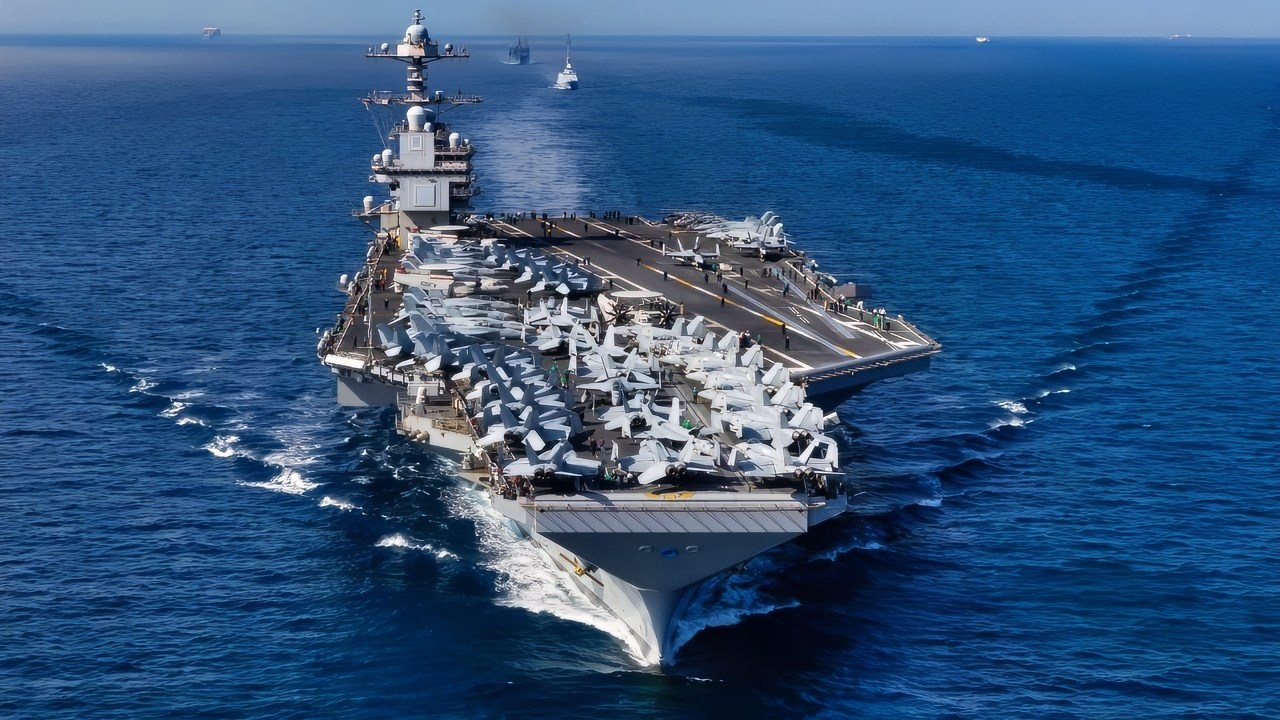
Summary and Key Points: USS Gerald R. Ford supercarrier is operating in the Middle East during rising U.S.-Iran tensions, with its deployment extended twice and nearing a post-Vietnam carrier endurance record.
-Yet the ship still lacks the modifications required to operate the Navy’s F-35C, a capability only a handful of Nimitz-class carriers currently have.
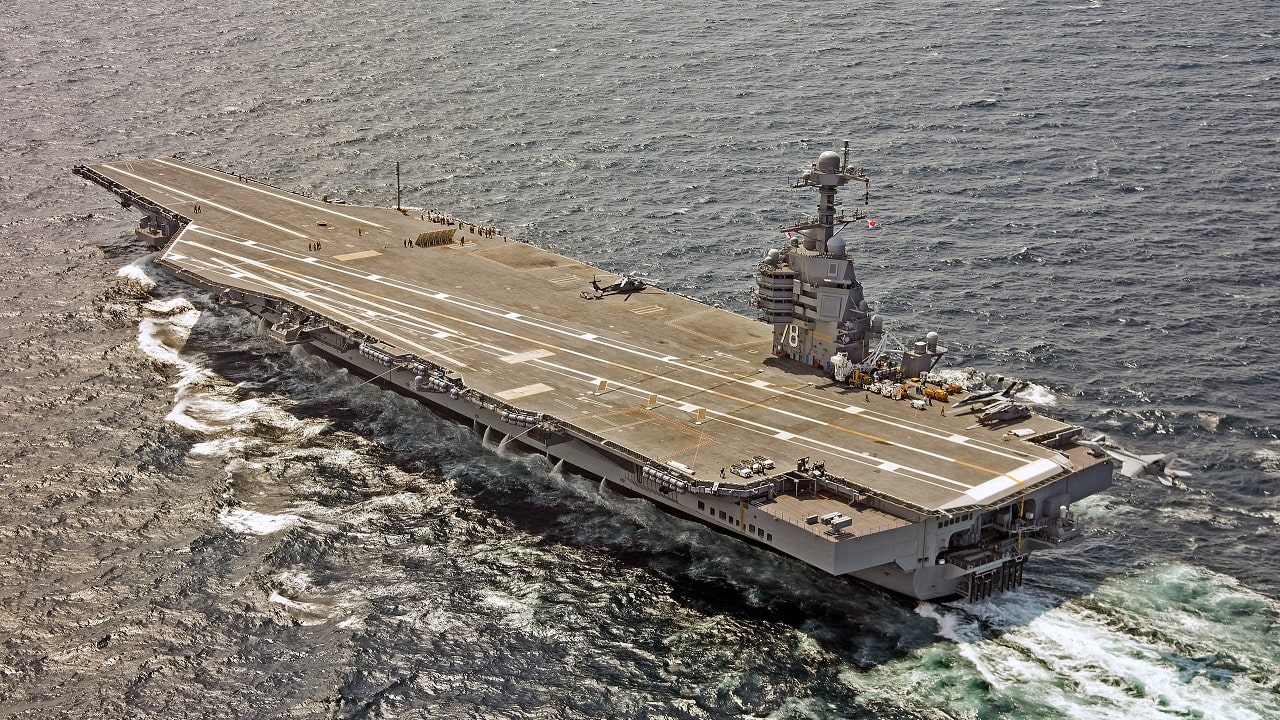
Ford-Class Aircraft Carrier in Test Run. Image Credit: Creative Commons.

ATLANTIC OCEAN (Sept. 21, 2024) The world’s largest aircraft carrier, USS Gerald R. Ford (CVN 78), sails in formation with the Japan Maritime Self Defense Force (JMSDF) Kashima-class training ship, JS Kashima (TV-3508), middle, and Hatakaze-class guided missile destroyer JS Shimakaze (TV-3521) while conducting routine operations in the Atlantic Ocean, September 23, 2024. The U.S. Navy and JMSDF continue to train together to improve interoperability and strengthen joint capabilities. For more than 60 years, the U.S.-Japan Alliance has been the corner stone of stability and security and is crucial to the mutual capability of responding to contingencies at a moment’s notice. (U.S. Navy photo by Mass Communication Specialist 2nd Class Jacob Mattingly)
-That doesn’t remove F-35s from the picture: F-35Cs are aboard USS Abraham Lincoln, and Air Force F-35As and F-22s are positioned at regional bases.
-Meanwhile, the Navy is publicly emphasizing crew readiness, morale, and routine maintenance amid renewed attention to the ship’s sanitary systems.
USS Gerald R. Ford Summed Up in 1 Problem: It Still Can’t Launch the F-35C
The USS Gerald R. Ford, the U.S. Navy’s largest and newest aircraft carrier, is currently in the Middle East, amid the possibility of a U.S. attack on Iran. Reuters published a video on Friday of the carrier group approaching the port in Haifa.
The carrier, which has been at sea since last June, has had its deployment extended twice, and may set the record for the longest deployment by an aircraft carrier in the post-Vietnam era.
But even in a potential war situation, one of America’s iconic jets is not able to take off from that carrier or some others like it.
According to a new report by Forbes, the USS Gerald R. Ford supercarrier “has yet to receive the upgrades necessary to operate with the carrier-based variant of the fifth-generation stealth fighter,” referring to the F-35 Lightning II.
“Among the aircraft that could be employed in airstrikes against the Islamic Republic if a ‘deal’ can’t be reached over the state of the Middle Eastern nation’s nuclear program will be the Lockheed Martin F-35 Lightning II,” Forbes reports. “Yet none will be operating from the United States Navy’s newest and arguably most capable nuclear-powered supercarrier.”
That isn’t to say it will never have that capability, as, per Forbes, upgrades to enable such takeoffs would come during “a future refit,” which would have to occur once the carrier’s current long deployment is over.
However, other carriers are also in need of that same upgrade.
“As of last year, only the Nimitz-class supercarriers USS Carl Vinson (CVN-70), USS Theodore Roosevelt (CVN-71), USS Abraham Lincoln (CVN-72), and USS George Washington (CVN-73) had completed the necessary modifications, including jet blast deflectors and secure maintenance areas, to embark the F-35C,” Forbes reported.
Another Upgrade for USS Gerald R. Ford Supercarrier
Meanwhile, Forbes also reported that the USS Iwo Jima, the assault ship that was involved in the January mission to arrest Venezuelan leader Nicolas Maduro and bring him to the United States, is headed to Norfolk for an upgrade.
“This week, BAE Systems’ Norfolk shipyard received a $204.1 million U.S. Navy contract to provide maintenance services for LHD-7,” Forbes reported. “During the upcoming ‘elected restricted availability,’ the warship’s shipboard systems will be updated to further accommodate the F-35B, which is fitted with a Rolls-Royce Liftsystem for operations from small ships and austere bases.”
“The USS Iwo Jima availability is welcomed work for our Norfolk shipyard team,” David M. Thomas, Jr., vice president and general manager of BAE Systems Maritime Solutions Norfolk, said in a statement upon the announcement of the contract.
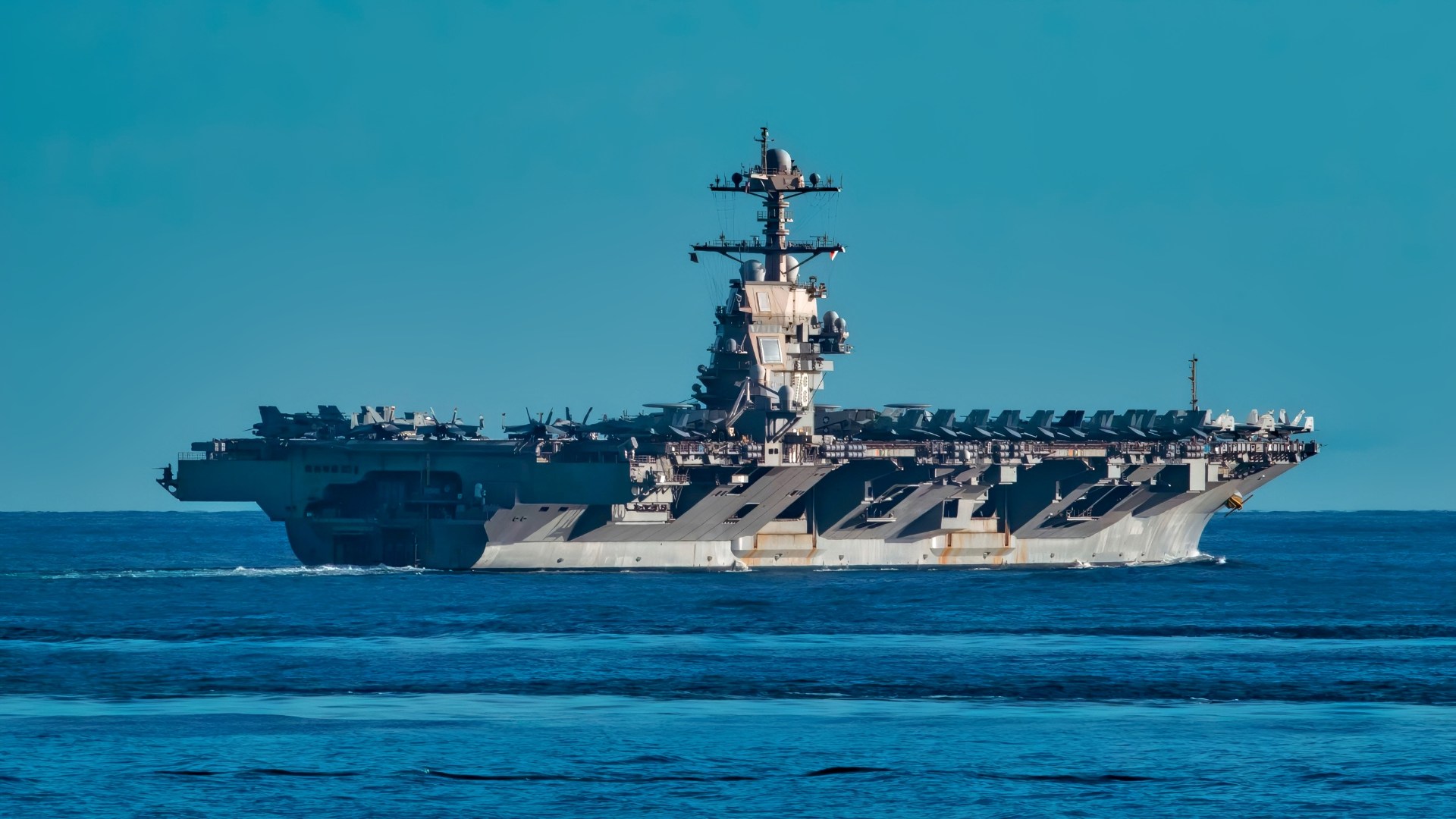
The Arleigh Burke-class guided-missile destroyer USS Winston S. Churchill (DDG 81) sails alongside the world’s largest aircraft carrier the USS Gerald R. Ford (CVN 78), Sep. 24, 2025. Winston S. Churchill, as part of Carrier Strike Group 12, is on a scheduled deployment in the U.S. 6th Fleet area of operation to support the warfighting effectiveness, lethality and readiness of U.S. Naval Forces, Europe-Africa, and defend U.S. Allied and partner interest in the region. (U.S. Navy photo by Mass Communication Specialist Seaman Hector Rodriguez)
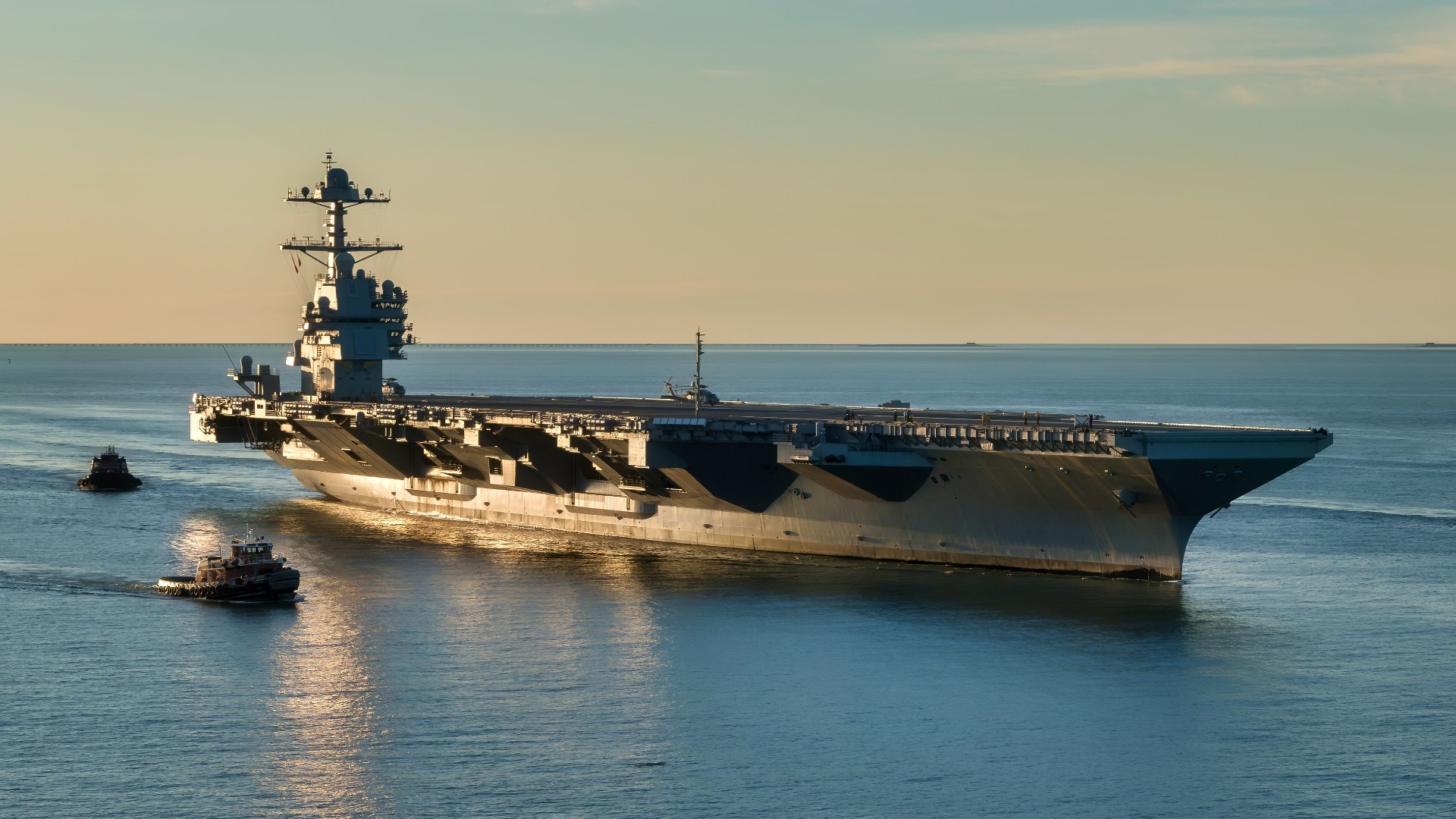
(April 14, 2017) The aircraft carrier Pre-Commissioning Unit (PCU) USS Gerald R. Ford (CVN 78) pulls into Naval Station Norfolk for the first time. The first-of-class ship – the first new U.S. aircraft carrier design in 40 years – spent several days conducting builder’s sea trails, a comprehensive test of many of the ship’s key systems and technologies. (U.S. Navy photo by Matt Hildreth courtesy of Huntington Ingalls Industries/Released)
“We are very familiar with performing modernization work aboard this class of ship. We will apply the lessons learned from current and past LHD-class work done within our shipyard.”
Work on that will begin in August and be completed by February of 2028, Forbes said.
How Will F-35s Strike?
Despite those carriers not having the capabilities, it doesn’t mean F-35s won’t participate in a potential Iran mission.
“Even as the F-35C doesn’t operate from the U.S. Navy’s largest supercarrier, F-35C fighters are embarked on the USS Abraham Lincoln, which arrived in the region in January,” Forbes reported. “In addition, the U.S. Air Force has deployed an undisclosed number of F-35As, the conventional takeoff and landing variants, to bases in the Middle East, along with approximately a dozen Lockheed Martin F-22 Raptor fifth-generation air superiority fighters.”
A Naval Defense
Amid recent media reports about conditions aboard the USS Gerald R. Ford supercarrier, the Navy issued a statement on Thursday, praising the “resilience” and “readiness” of the crew.
“More than eight months into an extended deployment, the Sailors of USS Gerald R. Ford (CVN 78) continue to demonstrate resilience, professionalism, and sustained morale while serving far from home,” the Navy statement said. They added that “the ship and Carrier Strike Group 12 have continued to operate at a high state of readiness.”
“Extended deployments demand endurance,” Adm. Daryl Caudle, Chief of Naval Operations, said in the Navy’s statement.

Nimitz-class carrier USS George H.W. Bush (CVN 77) transits the Atlantic Ocean while offloading munitions via helicopter to the world’s largest aircraft carrier, USS Gerald R. Ford (CVN 78), June 27, 2025. Gerald R. Ford, a first-in- class nuclear aircraft carrier and deployed flagship of Carrier Strike Group Twelve, incorporates modern technology, innovative shipbuilding designs, and best practices from legacy aircraft carriers to increase the U.S. Navy’s capacity to underpin American security and economic prosperity, deter adversaries, and project power on a global scale through sustained operations at sea. (U.S. Navy photo by Mass Communication Specialist Seaman Jarrod Bury)

Ford-Class Aircraft Carrier. Image Credit: Creative Commons.
“They ask Sailors to miss births, anniversaries, and everyday moments at home. They ask families to shoulder additional responsibility. That sacrifice is real, and we do not take it lightly. The nation relies on these Sailors to remain forward and ready, and they continue to meet that responsibility with professionalism and pride.”
Admiral Caudle went on to praise morale aboard the Gerald R. Ford.
“The morale aboard Gerald R. Ford remains strong because leadership is engaged, systems are operating, and Sailors understand the importance of their mission,” the admiral said. “This crew is experienced, disciplined, and committed to one another. That cohesion matters during long deployments.”
Toilet Talk
The Navy, in its statement, also pushed back against media reports about backed-up toilets on the carrier. The Navy’s statement stated that the toilets are “operating within expected parameters for a Ford-class aircraft carrier with more than 4,000 personnel embarked” and that the Ford’s vacuum collection, holding, and transfer (VCHT) system “has processed more than six million toilet flushes” since the start of the deployment.
“On a ship this size, with this many Sailors, clogs will occur,” Capt. David Skarosi, commanding officer of USS Gerald R. Ford, said in the Navy’s statement. “What matters is how quickly they are resolved. Our maintenance teams respond immediately, and the system continues to function as designed with no impact to operational readiness or our ability to meet our mission. I am engaged daily with any concerns regarding the health, well-being, and morale of the crew.”
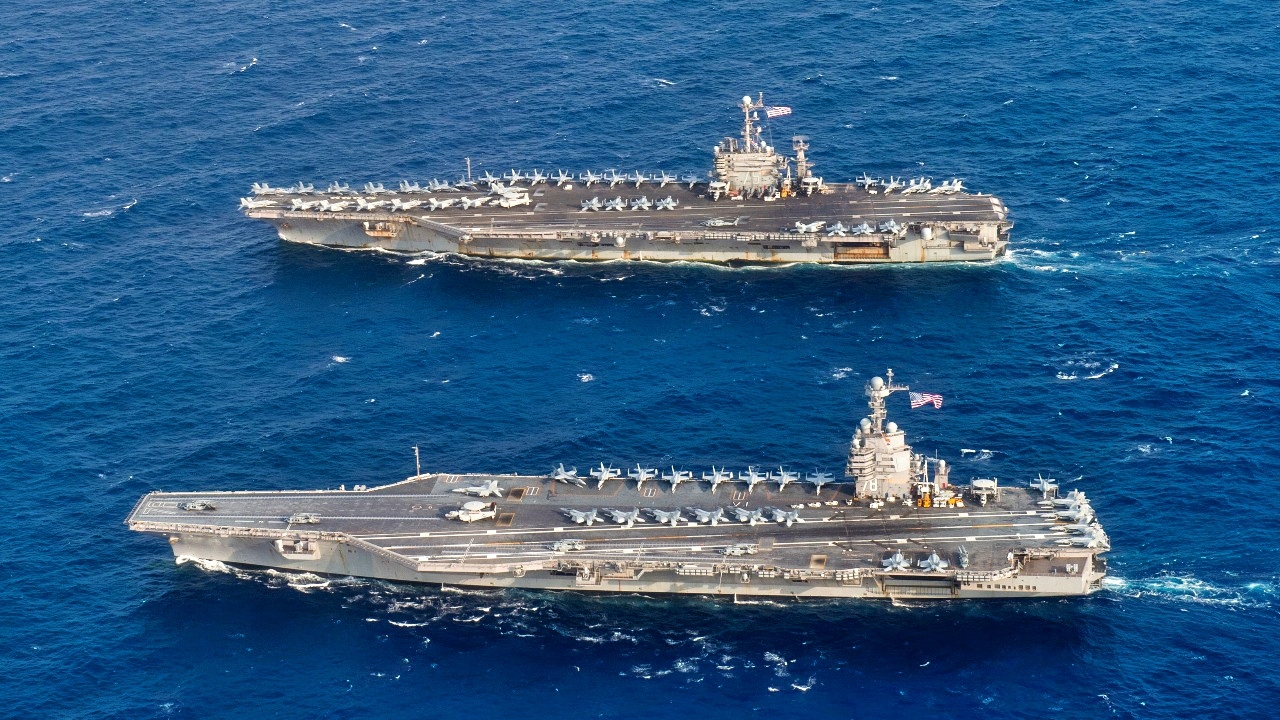
The U.S. Navy Gerald R. Ford–class aircraft carrier USS Gerald R. Ford (CVN-78) and the Nimitz-class aircraft carrier USS Harry S. Truman (CVN-75) underway in the Atlantic Ocean on 4 June 2020, marking the first time a Gerald R. Ford–class and a Nimitz-class aircraft carrier operated together underway.
Skarosi added that in the majority of instances, “clogs are the result of items being flushed that should not be introduced into the system.”
In a piece for National Review earlier this week, Luther Ray Abel claimed that the toilet reports had been pushed by “accounts linked to China,” and added that issues with toilets had been a fact of life to deal with during his own past deployments.
“After all, the idea that sailors, who have been at sea for the better part of a year, have to queue to use heads (bathrooms), fight regurgitating toilets, and mop up human waste is a particularly noisome mental image,” he wrote. “But that’s life at sea.”
About the Author: Stephen Silver
Stephen Silver is an award-winning journalist, essayist, and film critic, and contributor to the Philadelphia Inquirer, the Jewish Telegraphic Agency, Broad Street Review, and Splice Today. The co-founder of the Philadelphia Film Critics Circle, Stephen lives in suburban Philadelphia with his wife and two sons. For over a decade, Stephen has authored thousands of articles that focus on politics, national security, technology, and the economy. Follow him on X (formerly Twitter) at @StephenSilver, and subscribe to his Substack newsletter.


Robert Bagnell
February 27, 2026 at 7:26 pm
This article is a little confusing as the F-35’s can take off and land vertically. They don’t require a catapult launch (matter of fact that is exactly how they land and take off from Amphibious Ships)
I understand that the F-35 may have to take off vertically with less fuel than from a “Cat Shot” but that is easily rectified by having a tanker top them off with fuel prior to commencing the mission – actually many missions require in flight refueling.