

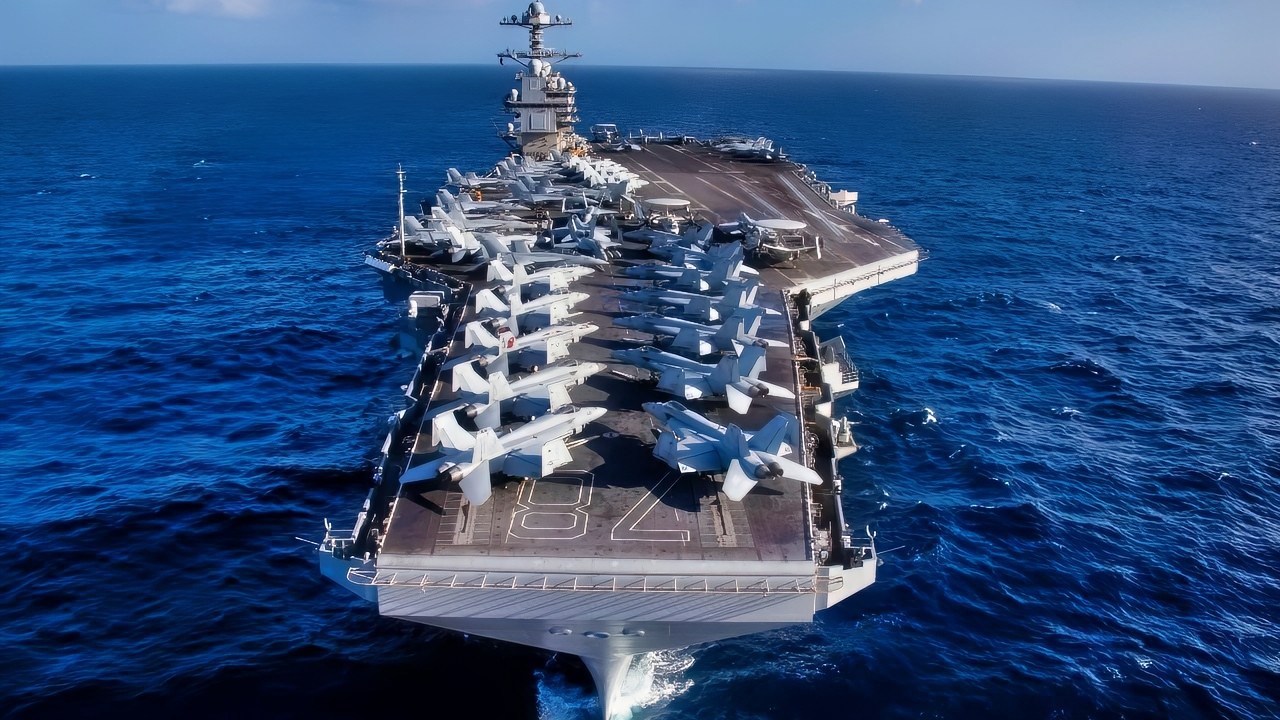
Key Points and Summary –The USS Gerald R. Ford (CVN-78), a $13.3 billion supercarrier, is labeled a “defense acquisition horror show” due to “critical failures” in its core technologies.
-The carrier was delivered $2.5 billion over budget and years late, plagued by a faulty propulsion system, non-functional weapons elevators (9 of 11 were broken at delivery), and unreliable EMALS catapults (failing 1 in 75 launches) and AAG arresting gear.

The world’s largest aircraft carrier USS Gerald R. Ford (CVN) 78 and the USNS Laramie (T-AO-203) conduct a refueling-at-sea in the Eastern Mediterranean Sea, Oct. 11, 2023. USS Gerald R. Ford is the Navy’s newest and most advanced aircraft carrier, representing a generational leap in the U.S. Navy’s capacity to project power on a global scale. The Gerald R. Ford Carrier Strike Group is currently operating in the Eastern Mediterranean Sea, at direction of the Secretary of Defense. The U.S. maintains forward deployed ready and postured forces to deter aggression and support security and stability around the world.(U.S. Navy photo by Mass Communication Specialist 2nd Class Jackson Adkins)
-A faulty Dual-Band Radar also needed replacement in 2025. The cascading failures have delayed the next carrier, USS Kennedy, to 2027 and reportedly prompted President Trump to order a return to steam catapults.
BONUS: We have included a big photo montage at the end of this article to give you an idea of the scale and scope of this massive Ford-class aircraft carrier.
The USS Gerald R. Ford Supercarrier Is Not That Super
The USS Gerald R. Ford supercarrier is now headed to the Caribbean after serving a deployment in the Mediterranean.
The Ford will help the U.S. Southern Command with counter-narcotics interdiction in Latin America.
The United States has decided to take the fight directly to the narco-terrorists with precise military strikes instead of simply using law enforcement or the U.S. Coast Guard to board the ships and apprehend their operators.
It’s good to see the Gerald R. Ford steaming around the world for multiple-mission sets. The Ford had an inauspicious beginning with technological issues that were expensive and time-consuming to fix.
The Ford endured a history that included periods where it was over budget and behind schedule, with some wondering if this $13.3 billion ship was a boondoggle and a clear waste of taxpayer money.
It Started With the Propulsion System
In 2019, the Ford had tricky engine problems. The propulsion plant had a manufacturing defect that created issues with efficiency and power. The Ford had to return home from a shakedown cruise in April of that year after three days of testing and evaluation.
While in port, the workers noticed that the nuclear power plant was on the fritz and that the elevators were not working properly.
The Navy later said the nuclear system wasn’t the entire problem, “rather the issues resided in the mechanical components associated in turning steam created by the nuclear plant into spinning screws that propel the ship through the water,” according to Business Insider.
Then the Weapons Elevators Did Not Work Correctly
While working on the propulsion issues, the technicians also found that the advanced weapons elevators were not functioning correctly.
These modern marvels were supposed to increase loading efficiency and increase sortie rates.
Only a few elevators were working properly, and the Navy decided to send the carrier out to sea anyway to test other systems and the propulsion plant.
Congress Was Hopping Mad
Legislators on Capitol Hill were frustrated five years ago when these problems cropped up. “The ship was accepted by the Navy incomplete, nearly two years late, two and a half billion dollars over budget, and nine of eleven weapons still don’t work with costs continuing to grow,” said Senator Jim Inhofe, who then chaired the Senate Armed Services Committee.
Inhofe wondered whether the new radar, catapult, arresting gear, and weapons elevators would ever work as designed.
The workers and sailors on the Ford tried to address these issues before its first deployment, which itself was four years late.
Launch Systems and Arresting Gear Became the Next Trouble Spots
“The advanced new Electromagnetic Aircraft Launch System (EMALS) and Advanced Arresting Gear (AAG), both absolutely fundamental to its successful operation, have also had repeated issues,” The War Zone said in 2021.
There were also problems with its radar and the ability to collect flight data from aircraft launched on the Ford.
The EMALS and AAG faced mechanical issues for years.
The carrier was given poor grades during testing and evaluation cruises. EMALS “suffered 10 ‘critical failures’ across 747 aircraft launches in at-sea trials since delivery in 2017,” according to an Office of the Director of Operational Test and Evaluation report obtained by Bloomberg.
The EMALS and AAG were always bragging points the Navy used to explain the extra expense of the Ford. T
his was supposed to create advantages that would deploy more aircraft to complete valuable missions in future war scenarios. “The Navy’s goals were to launch and recover 84 aircraft in a 24-hour period, the War Zone wrote.
But EMALS just didn’t work right and even had numerous failures that hampered the air wing’s performance.
The catapults were unsuccessful once every 75 launches. Troubleshooting EMALS was difficult and time-consuming. Meanwhile, the AAG failed once every 76 recovery attempts, the test and evaluation office revealed.
After much work and maintenance, the EMALS and AAG were finally working better. But the fixes took years to complete. To add to the confusion and lack of clarity, President Donald Trump has just announced an executive order for the Navy to return to steam catapults and hydraulic elevators. This is another head-scratcher because the years of work on the EMALS and AAG now appear to be a complete waste.
Dual-Band Radar Is Faulty
At the beginning of 2025, Ford faced more problems. The carrier’s critical sensor system, comprised of a dual-band radar (DBR), was not functioning correctly. These issues began in February, and the dual-band radar had to be totally replaced. It is not clear how this problem affected its first deployment. It seems the ship may have been steaming blin,d depending on how bad the dual-band radar actually was.
“DBR availability declined during the FY23 [composite training unit exercise] with the continuous demand for radar coverage and an intermittent failure observed during operations,” the test and evaluation report referenced above said.
The Great Ford-Class Aircraft Carrier Comeback
With all of these maladies, it is incredible that the Ford is on deployment now. Most of the problems have been fixed with numerous hours in port, keeping the hulking carrier stateside. It is difficult to assign blame or determine whether we need to reward the steadfast work technicians have exhibited over the last several years.
Does that mean the other Ford-class carrier – the USS John F. Kennedy will have similar problems? The delivery of the Kennedy has been delayed to 2027. Again, the culprits are EMALS and AAG. This likely prompted Trump to act and eliminate these systems.
The lesson here is that if it is not broke, don’t fix it. Steam catapults had been serving the Navy on carriers for decades. Innovation is sometimes needed to modernize new ships, but the EMALS and AAG have been terrible. The Navy has invested so much time and money into the systems, it is a shame that the newfangled contraptions will likely be cancelled. The Navy is in for a penny and in for a pound, though.
Meanwhile, the Ford keeps cruising along toward the Caribbean. It will likely continue the policy of blasting drug boats with no let-up. That’s not exactly the prime mission the Ford was designed for, but so be it.
Now, attention turns to John F. Kennedy to see whether it can meet deadlines and milestones. The Ford-class is off to a questionable start for such an expensive group of carriers, and the program has become a defense acquisition horror show. We’ll have to wait for the next two years to see if the Kennedy can hit the water on time and under budget.
USS Gerald R. Ford Aircraft Carrier Photo Essay

The world’s largest aircraft carrier USS Gerald R. Ford (CVN 78) steams in the Adriatic Sea, June 23, 2023. Gerald R. Ford is the U.S. Navy’s newest and most advanced aircraft carrier, representing a generational leap in the U.S. Navy’s capacity to project power on a global scale. The Gerald R. Ford Carrier Strike Group is on a scheduled deployment in the U.S. Naval Forces Europe area of operations, employed by U.S. Sixth Fleet to defend U.S., allied, and partner interests. (U.S. Navy photo by Mass Communication Specialist 2nd Class Jackson Adkins)

The world’s largest aircraft carrier, USS Gerald R. Ford (CVN 78), conducts flight operations in the North Sea, Aug. 23, 2025. Gerald R. Ford, a first-in-class aircraft carrier and deployed flagship of Carrier Strike Group Twelve, is on a scheduled deployment in the U.S. 6th Fleet area of operations to support the warfighting effectiveness, lethality, and readiness of U.S. Naval Forces Europe-Africa, and defend U.S., Allied and partner interests in the region. (U.S. Navy photo by Mass Communication Specialist 2nd Class Maxwell Orlosky)
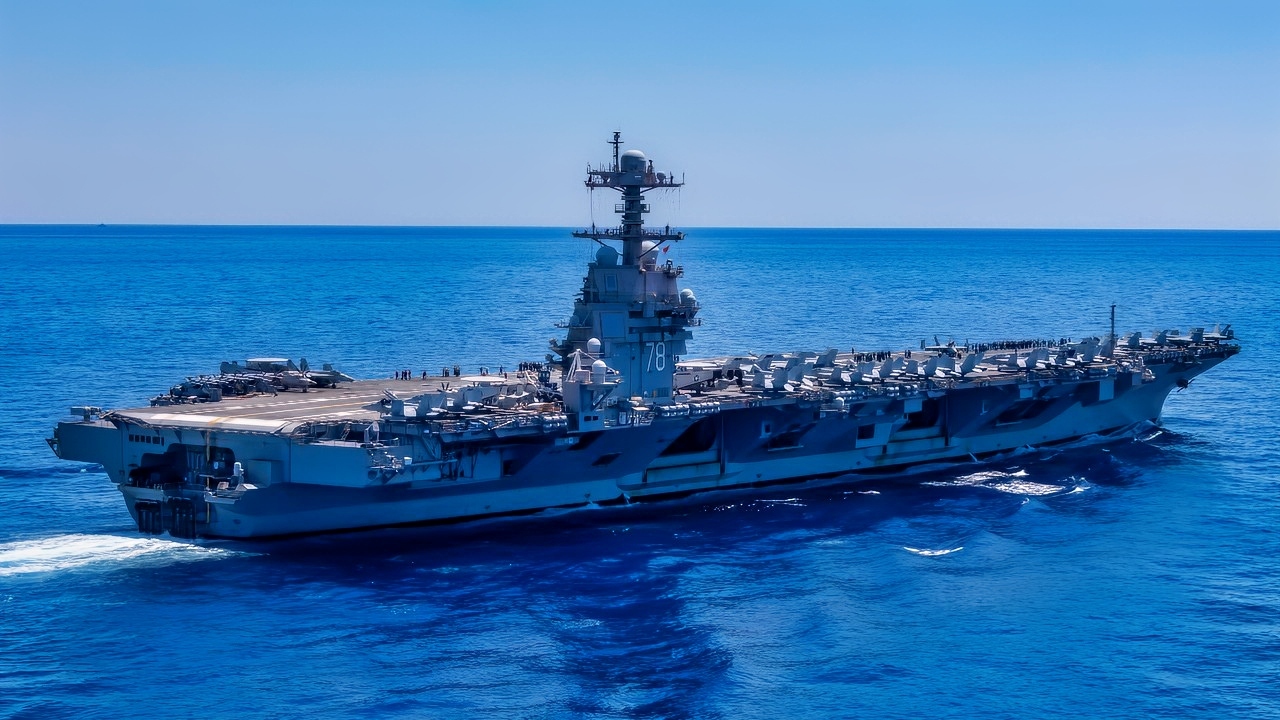
The world’s largest aircraft carrier, USS Gerald R. Ford (CVN 78) transits the Mediterranean Sea, August 1, 2025. Gerald R. Ford, a first-in-class nuclear aircraft carrier and deployed flagship of Carrier Strike Group Twelve, is on a scheduled deployment in the U.S. 6th Fleet area of operations to support the warfighting effectiveness, lethality, and readiness of U.S. Naval Forces Europe-Africa, and defend U.S., Allied, and partner interests in the region. (U.S. Navy photo by Mass Communication Specialist Seaman Brianna Barnett)

(July 28, 2017) An F/A-18F Super Hornet assigned to Air Test and Evaluation Squadron (VX) 23 approaches the aircraft carrier USS Gerald R. Ford (CVN 78) for an arrested landing. The aircraft carrier is underway conducting test and evaluation operations.(U.S. Navy photo by Erik Hildebrandt/Released) 170728-N-UZ648-161

The world’s largest aircraft carrier, USS Gerald R. Ford (CVN 78), sails in the Atlantic Ocean, July 4, 2025. Gerald R. Ford, a first-in-class aircraft carrier and deployed flagship of Carrier Strike Group Twelve, incorporates modern technology, innovative shipbuilding designs, and best practices from legacy aircraft
carriers to increase the U.S. Navy’s capacity to underpin American security and economic prosperity, deter adversaries, and project power on a global scale through sustained operations at sea. (U.S. Navy photo by Mass Communication Specialist 2nd Class Tajh Payne)

Ford-Class Aircraft Carrier. Image Credit: Creative Commons.
About the Author: Brent M. Eastwood
Brent M. Eastwood, PhD is the author of Don’t Turn Your Back On the World: a Conservative Foreign Policy and Humans, Machines, and Data: Future Trends in Warfare plus two other books. Brent was the founder and CEO of a tech firm that predicted world events using artificial intelligence. He served as a legislative fellow for US Senator Tim Scott and advised the senator on defense and foreign policy issues. He has taught at American University, George Washington University, and George Mason University. Brent is a former US Army Infantry officer. He can be followed on X @BMEastwood.
More Military
Northrop Grumman Is Likely Winner of F/A-XX, But Big Questions Remain
USS United States: The Aircraft Carrier Designed to Launch Bombers
The U.S. Air Force’s B-21 Raider Bomber Nightmare Has Just Begun
How Long Can a Nuclear U.S. Navy Aircraft Carrier Stay in Service?
The Air Force’s B-52 Stratofortress Bomber ‘Nightmare’ Is Real


Daniel C Lind
November 6, 2025 at 3:48 am
And for the fact the weapons elevator issue was north fork itself.
When building it, let it sit in the rain.
Way they build in sections and data square. Won’t run. It wasn’t the company’s fault.He built them.It was more the fault of thereafter.My net is personally because I built at lest half off them