

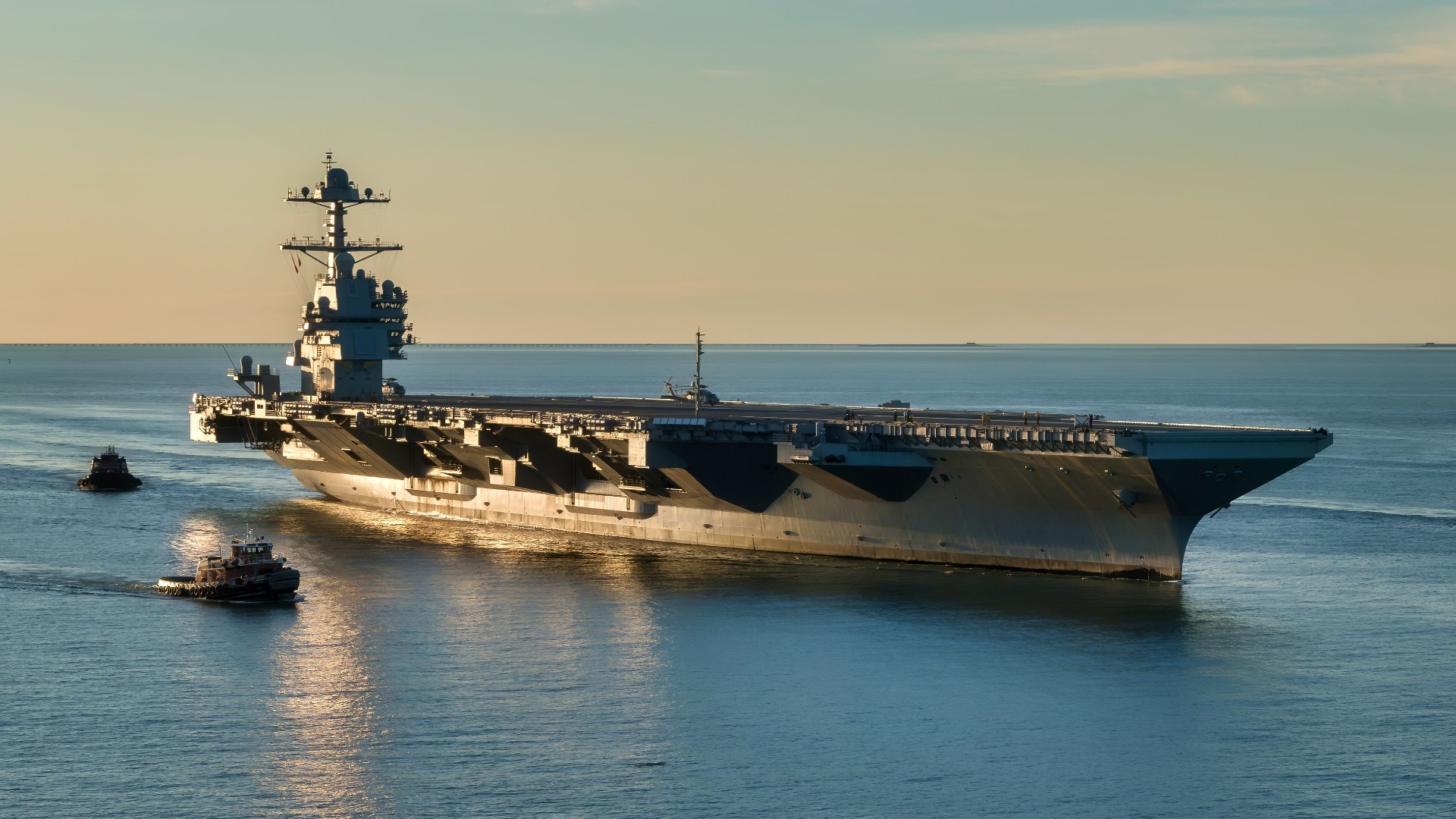
Key Points and Summary – The Navy’s newest aircraft carrier, USS Gerald R. Ford, is sailing to Latin America with capabilities no rival can match. The aircraft carrier is likely being sent to waters around Venezuela as a warning.
-Its next-gen nuclear reactors produce enormous electrical power, enabling electromagnetic catapults, advanced arresting gear, and a flight deck redesigned to move more jets, faster, with fewer people.

Ford-Class. Image Credit: Creative Commons

The Ford-class aircraft carrier USS Gerald R. Ford (CVN 78) and the Italian aircraft carrier ITS Cavour (CVH 550) transit the Atlantic Ocean March 20, 2021, marking the first time a Ford-class and Italian carrier have operated together underway. As part of the Italian Navy’s Ready for Operations (RFO) campaign for its flagship, Cavour is conducting sea trials in coordination with the F-35 Lightning II Joint Program Office’s Patuxent River Integrated Test Force to obtain official certification to safely operate the F-35B. Gerald R. Ford is conducting integrated carrier strike group operations during independent steaming event 17 as part of her post-delivery test and trials phase of operations. (U.S. Navy photo by Mass Communication Specialist 3rd Class Riley McDowell)
-New weapons elevators speed bombs from magazine to wing, while a tighter island and smarter deck choreography boost sortie rates.
-USS Gerald R. Ford carries today’s mix of strike fighters, electronic-attack jets, airborne command-and-control, helicopters, and drones—and leaves headroom for tomorrow’s lasers and sensors.
-Despite growing-pains, it’s the strongest single symbol of American sea-based airpower.
USS Gerald R. Ford Aircraft Carrier Is Close to Unstoppable
When the Pentagon sends USS Gerald R. Ford to Latin America, it isn’t just moving a ship—it’s moving a floating airfield, command center, and logistics hub that can stay on station for months, generate continuous air presence, and pivot across missions in a day.
And that should make Venezuela, the most likely reason the aircraft carrier is moving to the region, pretty nervous, to say the least.
That flexibility is what separates a true supercarrier from everything else at sea. The message is both practical and political: the United States can place a large, credible air wing—fighters, surveillance aircraft, helicopters, and soon unmanned tankers—within reach of almost any crisis, and keep it there without asking anyone’s permission or relying on land bases.
Power You Can’t See: New Reactors, New Margin
Under Ford’s skin are two brand-new nuclear reactors designed from the keel up for an all-electric ship. That matters because modern carriers aren’t just about pushing propellers; they are power plants feeding radars, networks, jammers, catapults, and (in the near future) directed-energy weapons.

A joint team consisting of F-35 Patuxent River Integrated Test Force flight test members, U.S. Sailors and Marines, and the crew of the Japan Maritime Self-Defense Force Izumo-class multi-functional destroyer JS Kaga (DDH-184) are executing developmental sea trials in the eastern Pacific Ocean to gather the necessary data to certify F-35B Lightning II short takeoff and vertical landing aircraft operations. While aboard the MSDF’s largest ship, the Pax ITF flight test team has been gathering compatibility data for analysis in order to make recommendations for future F-35B operational envelopes, further enhancing the Japanese navy’s capabilities. The results of the testing will contribute to improved interoperability between Japan and the United States, strengthening the deterrence and response capabilities of the Japan-U.S. alliance and contributing to peace and stability in the Indo-Pacific region. Japan is an F-35 Joint Program Office foreign military sales customer planning to purchase 42 F-35Bs. The F-35 Joint Program Office continues to develop, produce, and sustain the F-35 Air System to fulfill its mandate to deliver a capable, available, and affordable air system with fifth-generation capabilities.
Ford’s reactors produce substantially more electrical power than the previous generation, with enough margin to absorb energy-hungry systems that haven’t even left the lab yet. In a world where sensors and weapons are becoming electron-thirsty, power margin is combat power—and Ford has it.
Launching And Recovering, Reimagined
Ford replaces 1950s-era steam catapults with the Electromagnetic Aircraft Launch System (EMALS). Think high-speed roller coaster, but straight and far more precise. EMALS lets the ship tailor the “push” to the aircraft, which reduces stress on jets and opens the door to launching lighter platforms like drones right alongside heavy strike aircraft.
On the landing side, Advanced Arresting Gear uses electric machines instead of big hydraulic rams, giving finer control and less wear on both gear and airframes. Together, launch and recovery are smoother, safer, and friendlier to today’s mixed air wings.
A Flight Deck That Works Smarter
Aircraft carrier decks are controlled chaos. Ford’s design shifts the island (that tall, command superstructure) and re-routes the flow of aircraft, fuel, and weapons to reduce choke points. The result is more efficient deck choreography—less time taxiing, fewer cross-traffic delays, and faster “turns” between sorties.
The goal is simple: generate more combat power per hour. Even when the ship is not running flat-out, small efficiencies in how airplanes park, refuel, rearm, and launch compound into a bigger punch.
Bombs To Wings, Fast: The New Weapons Elevators
Twelve Advanced Weapons Elevators use magnetic motors to move ordnance quickly and safely from deep magazines to a centralized arming spot just off the flight deck. Because these elevators avoid crowded aircraft lanes, the ship can rearm more jets without tripping over itself.

Maj. Kristin Wolfe, F-35A Lightning II Demonstration Team pilot and commander, performs the “high speed pass” maneuver at the California International Air Show, Salinas, Calif., Oct. 30, 2021. The F-35A Demo Team performed alongside the U.S. Navy’s F-35C Demonstration Team, showcasing two different variants of the 5th-generation fighter aircraft. (U.S. Air Force photo by Capt. Kip Sumner)
That’s not just convenience; in combat, minutes matter. The faster a carrier turns aircraft, the more pressure it can apply—and the harder it is for an adversary to reset.
Fewer Sailors, More Ship
Automation and smarter layouts cut Ford’s crew size by hundreds compared with older carriers. Fewer sailors does not mean fewer capabilities; it means the same (or better) output with lower cost and less strain on the people aboard. Smaller berthing areas, modern work centers, and simplified maintenance lines also improve quality of life—no small thing on a ship designed to serve for half a century.
The Air Wing, Upgraded
Ford isn’t just a better ship; it’s a better host for a 21st-century air wing. It supports stealthy F-35C strike fighters alongside F/A-18E/F Super Hornets, EA-18G Growlers for electronic attack, E-2D Hawkeyes for airborne command-and-control, and MH-60 helicopters.
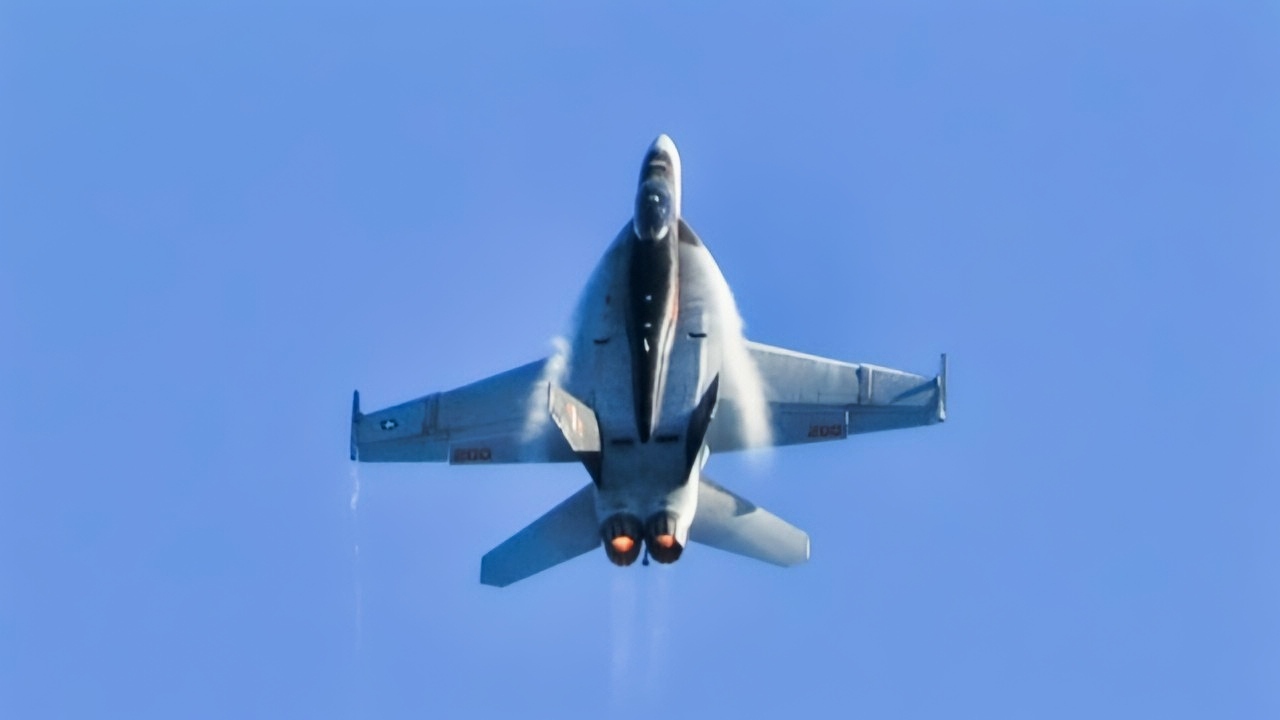
A U.S. Navy F/A-18E Super Hornet aircraft assigned to Strike Fighter Squadron (VFA) 147 performs maneuvers above the aircraft carrier USS Nimitz (CVN 68) during the departure of Carrier Air Wing (CVW) 11 Dec. 10, 2013, in the Pacific Ocean. CVW-11 fixed wing aircraft flew off the Nimitz to return home after being deployed to the U.S. 5th, 6th and 7th Fleet areas of responsibility. (U.S. Navy photo by Mass Communication Specialist Seaman Apprentice Kelly M. Agee/Released)
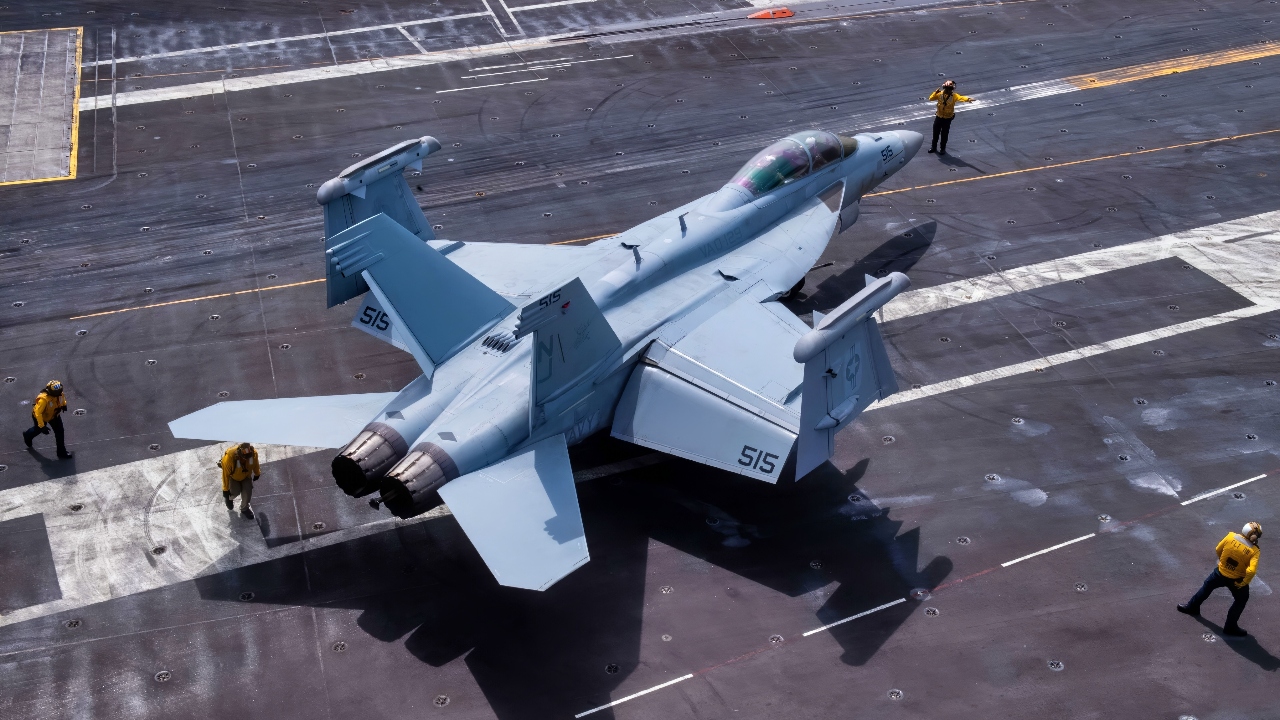
PACIFIC OCEAN (Aug. 11, 2025) – U.S. Navy Sailors direct an E/A-18G Growler, assigned to the “Vikings” of Electronic Attack Squadron (VAQ) 129, on the flight deck of the Nimitz-class aircraft carrier USS Theodore Roosevelt (CVN 71), Aug. 11, 2025. Theodore Roosevelt, flagship of Carrier Strike Group (CSG) 9, is underway conducting exercises to bolster strike group readiness and capability in the U.S. 3rd Fleet area of operations. (U.S. Navy photo by Mass Communication Specialist Seaman Apprentice Cesar Nungaray)
It is also built to integrate the MQ-25 unmanned tanker to push fighters deeper without guzzling precious deck space. EMALS and the new arresting gear are kinder to this diverse lineup, which ultimately means more sorties, longer aircraft life, and easier integration of future drones.
Survivability In The Missile Age
Critics argue that large carriers are obsolete in a world of long-range missiles and drones.
The better way to think about it: survivability is a system, not a single hull.
A carrier strike group layers early warning aircraft, escorting destroyers with powerful missile defenses, submarines screening ahead, and aircraft suppressing launchers before they can shoot.
Ford’s power margin, modern sensors, and digital backbone make it easier to plug into—and benefit from—that layered defense, while her air wing projects power far outside the most dangerous zones. No ship is unsinkable, but none brings a broader toolkit for surviving and winning in contested seas.
USS Gerald R. Ford: What No Rival Can Match
Other navies field capable carriers, but no nation can match the combination of Ford’s air wing size, endurance, sortie generation, and global sustainment. China’s carriers are improving quickly, yet they still rely on ski-jump ramps (for now) and are just starting to master catapult operations.
Britain’s carriers are flexible but smaller and rely on short-takeoff jets. France’s current carrier is a proven workhorse, yet fields a smaller air wing. Ford’s uniqueness isn’t one gadget; it’s the aggregate—power, deck flow, launch/recover systems, and the world’s deepest logistics bench.
The Reality Check: Cost And Growing Pains
Being first of class is hard. Ford has wrestled with reliability data collection and maturing brand-new systems at sea, and she’s been through the full gauntlet of explosive shock trials and post-deployment tune-ups.
That’s normal for a lead ship that rewires how carriers work. The important part is trajectory: launch and recovery counts have climbed, weapons elevators are online, and the program is folding lessons into the next hulls. In the meantime, the ship has already completed extended deployments and is now heading south—not as a test bed, but as the fleet’s flagship.
Bottom Line on the USS Gerald R. Ford
USS Gerald R. Ford is powerful not because of any single headline feature but because all the pieces reinforce one another: big power feeding smarter systems; a deck that moves airplanes like clockwork; crews focused on output rather than workarounds; and an air wing tailored for the long reach of modern warfare.
Sending her to Latin America underscores a simple fact: when the United States wants decisive, sustained airpower at sea, nothing else on Earth does the job as well.
About the Author: Harry J. Kazianis
Harry J. Kazianis (@Grecianformula) is Editor-In-Chief and President of National Security Journal. He was the former Senior Director of National Security Affairs at the Center for the National Interest (CFTNI), a foreign policy think tank founded by Richard Nixon based in Washington, DC. Harry has over a decade of experience in think tanks and national security publishing. His ideas have been published in the NY Times, The Washington Post, The Wall Street Journal, CNN, and many other outlets worldwide. He has held positions at CSIS, the Heritage Foundation, the University of Nottingham, and several other institutions related to national security research and studies. He is the former Executive Editor of the National Interest and the Diplomat. He holds a Master’s degree focusing on international affairs from Harvard University.
More Military
The Army’s AbramsX Tank Boils Down to 1 Word
China’s Big Plan To Sink U.S. Navy Aircraft Carriers Comes Down to 4 Words
The New Air Force B-21 Raider Isn’t Just a Stealth Bomber
The F-22 ‘Super’ Stealth Fighter Is Coming
The Real Reason U.S. Air Force Recruiting Numbers Are Surging


Krystal cane
October 25, 2025 at 11:30 pm
Is the message Trump’s a fat phuch?