
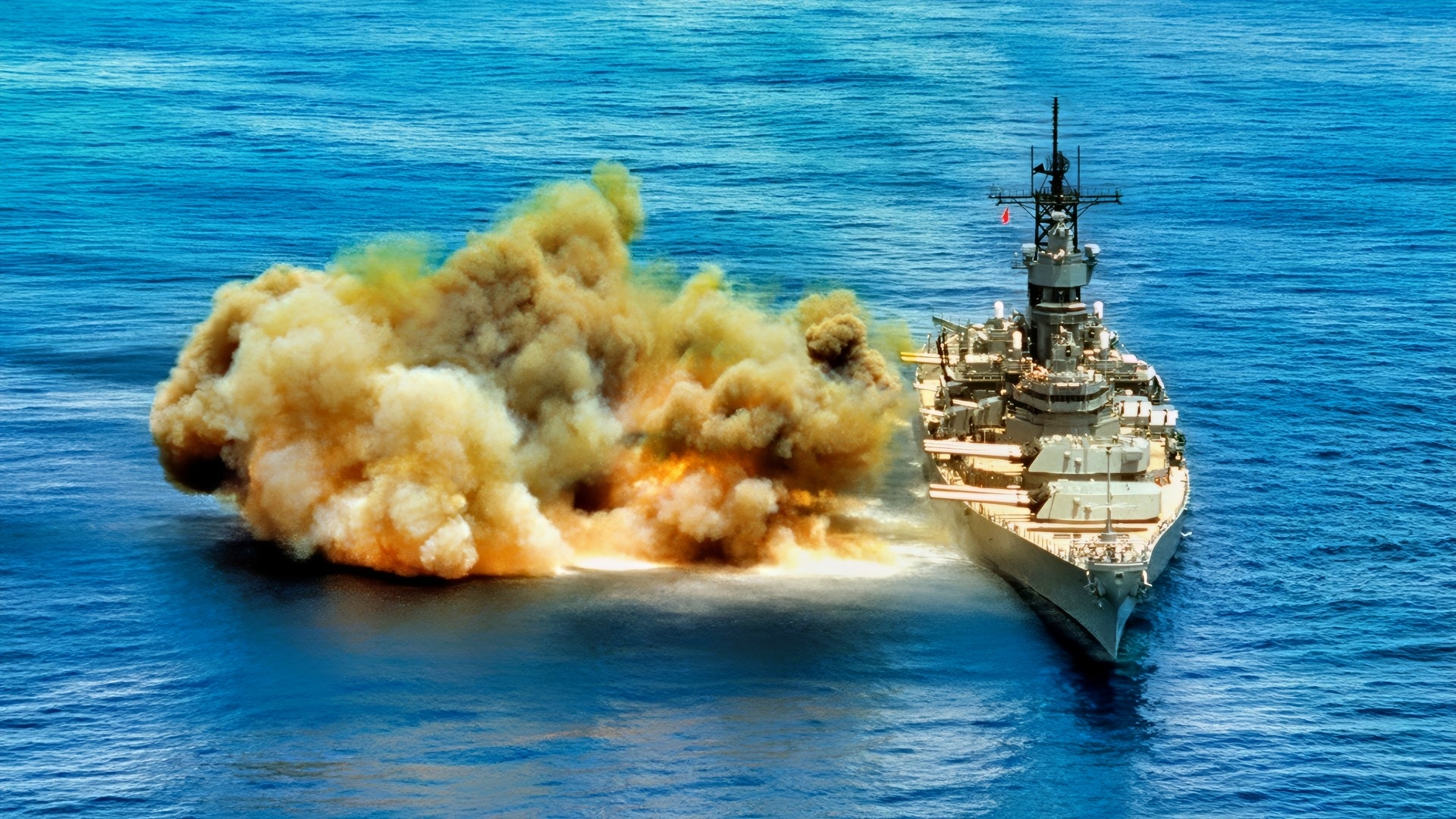
U.S. Navy officials just provided the clearest look yet at the Trump-class battleship, how much it might cost, and how quickly the controversial program could come to fruition. At separate roundtables during the Navy League’s Sea-Air-Space 2026 exposition, Chief of Naval Operations Adm. Daryl Caudle and outgoing Navy Secretary John Phelan said the service sees the ship – formally designated BBG(X) – as a necessary answer to modern naval warfare, particularly amid rising competition with China and growing pressure on U.S. forces across multiple theaters.
The officials’ remarks offer new insight into a program first unveiled by President Donald Trump in December, when he announced a new “Golden Fleet” naval expansion centered on the first Trump-class ship, USS Defiant.

Trump-Class Battleship. Image Credit: White House.

Trump-Class Battleship. Image Credit: White House.
The Navy Wants to Lock in the Design First
Comments made by Caudle during the exposition indicate that the Navy is seeking to avoid past mistakes and will lock in the design before construction begins.
Caudle noted that one of the mistakes previously made was when the Navy “started to build before the design is mature enough.”
“And we want to make sure that we’re at least a very, very high level – I won’t try to give a percentage, but you can think like 80% or more design – before the first weld is done,” he said.
The comments appear to reference past problems with the Ford-class carrier, the Littoral Combat Ship, and the canceled Constellation-class frigate, all of which experienced cost growth and redesign pressures mid-construction. In a separate discussion, Phelan also announced that the Navy is already in discussions with two potential builders and wants to lay the keel in fiscal year 2028.

Littoral Combat Ship USS Cooperstown NSJ Photo Taken On October 14, 2025.
What the Trump-Class Will Be
The proposed Trump-class battleships will be among the largest surface combatants in the modern U.S. fleet. According to Navy materials, the Trump-class will displace roughly 35,000 tons, measure between 840 and 880 feet long, and have a top speed of more than 30 knots.
That would make it dramatically larger than an Arleigh Burke-class destroyer, which displaces around 9,000 to 10,000 tons, depending on variant.
The planned weapons suite is also far more significant than the size alone. The ship is expected to feature 128 Mk 41 vertical launch cells, two 5-inch guns, close-in defense systems, and larger launchers for hypersonic missiles.
It may also be equipped with directed-energy weapons – or, at least, the capacity to install them – as well as an electromagnetic railgun, assuming that the technology is mature by then.
In its official December 22, 2025 announcement, the U.S. Navy described the future USS Defiant, the lead Trump-class battleship, as “an unambiguous statement of American commitment to maritime superiority,” adding that the new class would be able to “distribute more firepower across the fleet than any other class of ship, for any Navy, in history.”
The ship is considered less a traditional battleship revival than a heavily armed ship designed to concentrate missile firepower and deterrence in contested waters.
Why Washington Is Pushing It Now
The Trump administration is becoming increasingly ambitious, having already announced the Trump-class battleships and, more recently, announced a historic $1.5 trillion 2027 defense budget request.
It is one of the largest Pentagon requests ever proposed and includes major increases in shipbuilding and initial funding for the Trump-class program.
The Navy is seeking about $1 billion in advance procurement funding and roughly $837 million in research and development funds for the ship in FY2027.
The first hull is currently projected to cost about $17 billion, but Navy Secretary John Phelan said during a roundtable at the Navy League’s Sea-Air-Space 2026 exposition that the figure remains preliminary. “The $17 billion figure is the early initial estimate,” Phelan said. “We’ll see where we really settle down as we get through that and start to rationalize some of the costs.”
Phelan also made it clear that the administration wants to move quickly.
The Race Against China
Even with current headlines focusing on Iran, China is the central long-term naval challenge – and the Trump-class proposal reflects that.
The People’s Liberation Army Navy is already the world’s largest navy by hull count and continues expanding with new destroyers, submarines, amphibious ships, and aircraft carriers.
U.S. officials and lawmakers have repeatedly warned that American shipbuilding capacity trails China’s industrial output.
That helps explain why Phelan also emphasized during the roundtable that modular and distributed shipbuilding methods, including ideas drawn from leading Asian commercial shipyards, should be used to accelerate production and reduce risk.
The Trump-class battleship, should it survive the political process, will be a test of whether the United States can still design and build expensive, high-end warships at speed while rivals expand their fleets.
If the Navy can control costs and lock in the design early, BBG(X) could become the centerpiece of a powerful new surface fleet. If not, it risks becoming another ambitious program bogged down by delays and budget overruns.
About the Author: Jack Buckby
Jack Buckby is a British researcher and analyst specializing in defense and national security, based in New York. His work focuses on military capability, procurement, and strategic competition, producing and editing analysis for policy and defense audiences. He brings extensive editorial experience, with a career output spanning over 1,000 articles at 19FortyFive and National Security Journal, and has previously authored books and papers on extremism and deradicalization.


