
Summary and Key Points: A Congressional Budget Office analysis warns President Trump’s proposed BBG(X) “Golden Fleet” battleships could cost $15 billion to $22 billion for the lead ship, with later hulls still running $10 billion to $15 billion once production stabilizes.
-The concept envisions 20 to 25 35,000-ton guided-missile battleships starting in the early 2030s, beginning with USS Defiant (BBG-1).

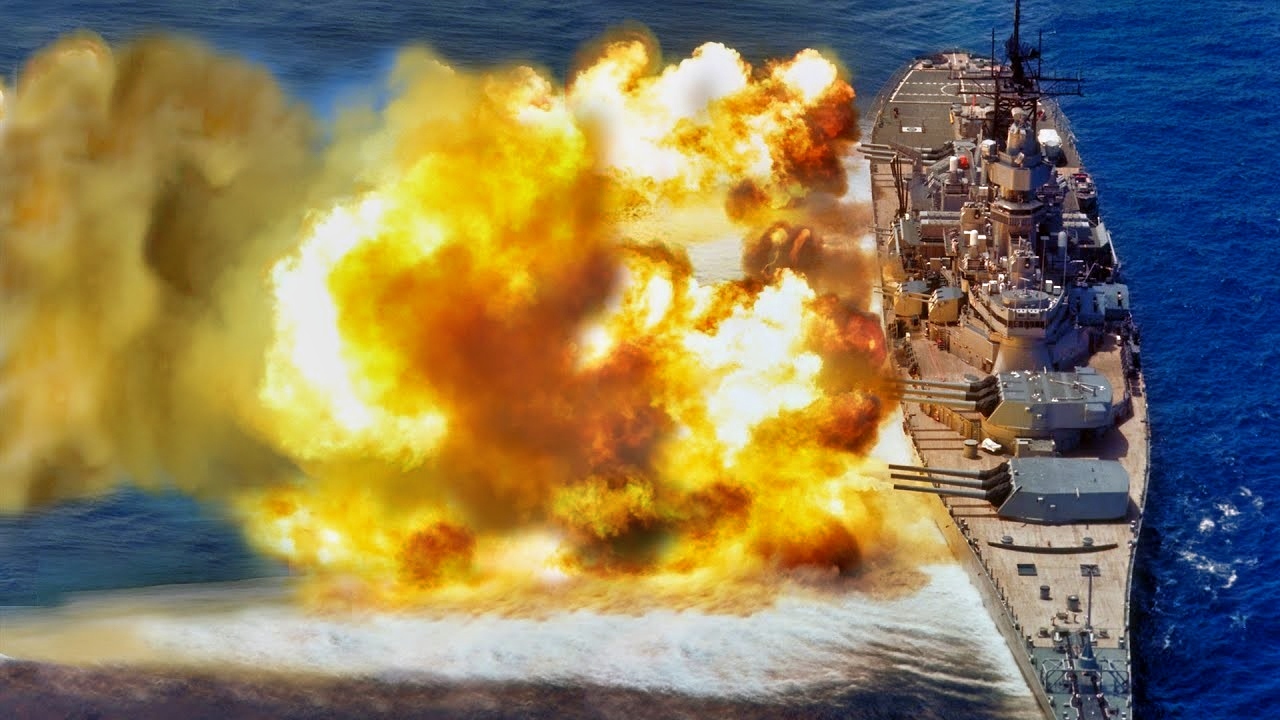
Indiana leading Massachusetts and the heavy cruisers Chicago and Quincy shortly before the bombardment of Kamaishi on 14 July 1945. This photo was taken from South Dakota.
-Skeptics argue the price tag, workforce shortages, and shipyard capacity limits could squeeze DDG(X), the next-generation destroyer meant to anchor future surface combat power.
DDG(X) “On Steroids”? Why BBG(X) Could Upend Navy Shipbuilding Plans
President Donald Trump’s proposed “Golden Fleet” of Trump-class battleships could be the most expensive series of warships in American history, if the plan goes ahead as planned, an early analysis from the Congressional Budget Office has revealed.
The proposed fleet of vessels, designed to aid the U.S. Navy with global patrol and presence missions, could also eat into an already tight budget for the Navy’s next-generation destroyers.
According to Congressional researchers, Trump’s BBG(X) proposal could cost anywhere between $15 billion and $22 billion, depending on the final design of the vessel. CBO analyst Eric Labs explained at the Surface Navy Association symposium that the ship, with a 35,000-ton displacement, would cost “north of $20 billion if the displacement ends up being higher.”
Labs also speculated that subsequent warships built after the first could end up costing anywhere between $10 and $15 billion once the infrastructure and production line have been fully established, but noted that those cost estimates assume that labor conditions improve. Labs also warned that the current workforce is still too small to handle the Navy’s current projects – and that without action soon, both the cost of the Trump-class ships and indeed the viability remain uncertain.

USS New Jersey Broadside Battleship. Image Credit: Creative Commons.

Iowa-Class Battleship National Security Journal Visit from August 2025. Image Credit: Harry J. Kazianis.
“There’s a lot of reasons to think that those numbers are not going to be correct,” Labs said. “I think it’s a starting point.”
“There are a number of factors that are going to play in that lead me to conclude that the ship might be more expensive than what I’ve said so far…and there’s reasons to think why they could be less expensive.”
A Threat to the DDG(X) Program?
Should Trump’s proposed “Golden Fleet” come to fruition, there are also concerns that the cost could impact the development of crucial future-proofing programs like the Navy’s next-generation guided missile destroyer DDG(X) program.
The program is intended to replace the aging Arleigh Burke-class destroyers beginning in the 2030s and is widely seen as the backbone of the future surface fleet.
DDG(X) is designed to provide integrated air and missile defense, long-range strike, and command-and-control capabilities at a crucial time when adversaries are rapidly building their own arsenals of hypersonic weapons and ballistic missiles.

USS New Jersey Iowa-Class Battleship. Image Taken on 8/2/2025 by National Security Journal/Stephen Silver.

Iowa-Class Battleship Coming Home. Image Credit: Creative Commons.
Unlike the existing Burke fleet, DDG(X) is expected to feature a significantly larger power generation capability, intended to support future directed-energy weapons and advanced radar systems. In effect, it is meant to be fllexible platform that can grow as new technologies arrive and adapt to new threats over decades of service.
The concern raised by congressional researchers here is not just about cost, though: Navy officials have suggested that the Trump-class battleship could absorb or even replace some elements of the DDG(X) concept, with Chief of Naval Operations Adm. Daryl Caudle describing the battleship as “DDG(X) on steroids.”
And here lies a problem: if a future administration cancels or scales back the battleship plan after several years – something that is perfectly likely given how closely tied the proposal is to President Trump’s personal brand and ambitions – the Navy could find itself having lost critical development time on DDG(X). Delaying or even subordinating the destroyer program in favor of Trump’s plans, therefore, risks creating a capability gap at the worst possible time.
Trump’s Golden Fleet Plan
President Trump’s proposed BBG(X) “Golden Fleet” is expected to be a new class of guided-missile battleships. The president publicly announced the plans from Mar-a-Lago on December 22, 2025, alongside senior administration officials and described it as the next great step in revitalizing American seapower and shipbuilding capacity.
The first ship, to be named USS Defiant (BBG-1), is currently in the design phase, with construction targeted for the early 2030s and an eventual fleet of 20 to 25 hulls.

Iowa-Class Battleship Looking Really Old. Image Credit: Harry J. Kazianis/National Security Journal.
According to official statements from the Navy, the Trump-class design is intended to exceed existing U.S. surface combatants in size and firepower, with a displacement of more than 35,000 tons and the capacity for advanced weapons such as hypersonic missiles, deep-strike systems, and possibly directed-energy weapons.
The vessels will, of course, also be equipped with enhanced command-and-control capabilities and networking technologies.
If all goes to plan, the new fleet will involve more than 1,000 suppliers across nearly every U.S. state, according to the Navy. That broad base of suppliers is intentional, too; the plan is to bolster the domestic shipbuilding base and spread the benefits of the new program as far and wide as possible.
The Trump-Class Might Never Sail and Hurt the Navy
Despite the ambitious rhetoric, the project’s future remains uncertain: Trump is determined to proceed with the fleet, but by the time he leaves office, little more than designs will remain. It remains to be seen how these new battleships will integrate with or alter existing fleet plans, including DDG(X), and there is a significant chance that a Democratic administration, which could well be in the White House by 2029, will cancel those plans in favor of something less ambitious.
About the Author:
Jack Buckby is a British researcher and analyst specialising in defence and national security, based in New York. His work focuses on military capability, procurement, and strategic competition, producing and editing analysis for policy and defence audiences. He brings extensive editorial experience, with a career output spanning over 1,000 articles at 19FortyFive and National Security Journal, and has previously authored books and papers on extremism and deradicalisation.


