


Key Points and Summary – The U.S. Navy’s Virginia-class is the world’s best attack submarine. It blends the lethality of the Seawolf with revolutionary adaptability.
-Its five key advantages are: versatility in both deep oceans and coastal waters; unparalleled quietness from its pump-jet propulsion; 360-degree situational awareness from advanced sonar and photonic masts; massive strike capability via the Virginia Payload Module; and a future-proof modular design.
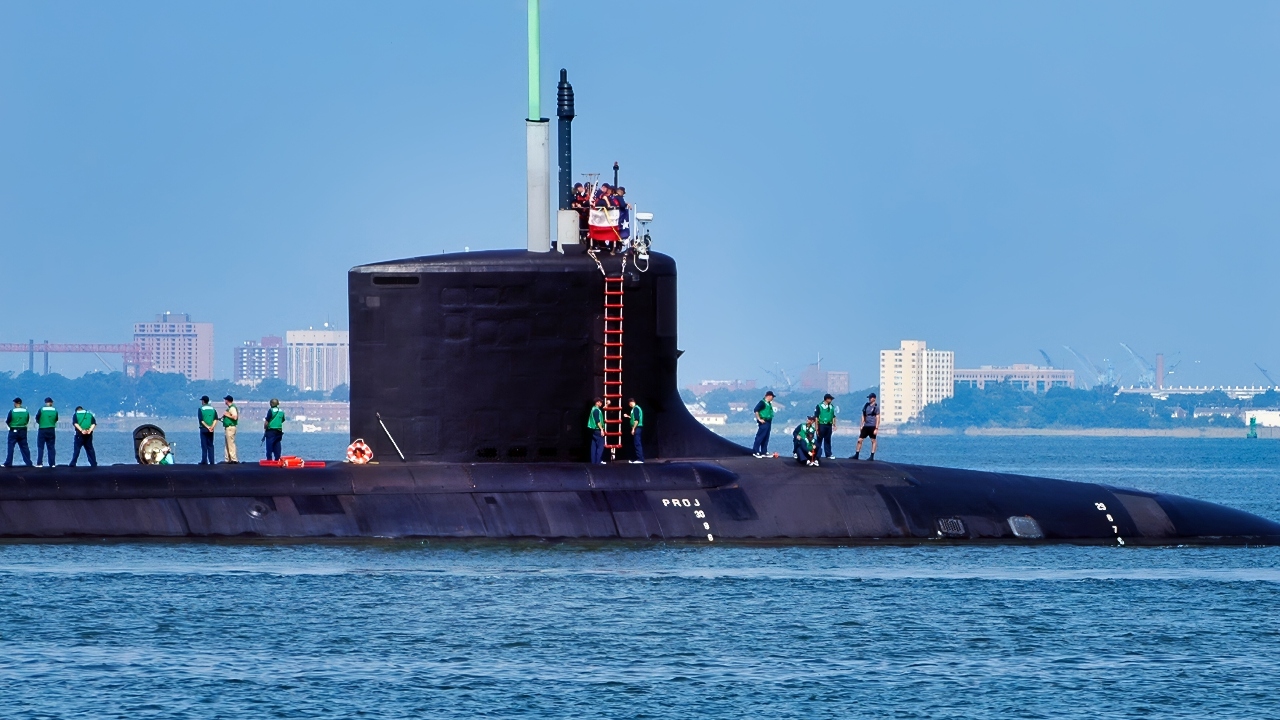
Norfolk, Va. (Aug. 22, 2006) – Sailors stationed aboard the Pre Commissioning Unit (PCU) Texas (SSN 775) stand topside as she gets underway from Naval Station Norfolk.
-However, its one flaw is a crisis: the U.S. is not building them fast enough to replace retiring boats, creating a dangerous “submarine gap” as threats from China and Russia grow.
The Virginia-Class Submarine Dominates, But One Problem Remains
In the silent, three-dimensional battlefield beneath the ocean’s surface, there is only one rule: the quietest boat wins.
This is not a gentleman’s game of moves and countermoves; it is a primal contest between unseen predators, where the first sign of your enemy is often the sound of their torpedo hitting your hull.
For decades, the United States Navy dominated this domain. Our fleet of Los Angeles-class nuclear-powered attack submarines, or SSNs, was the workhorse of the Cold War, the silent pack that would have hunted the Soviet Navy to the brink of extinction in a war.
When the Soviet Union collapsed, we built the ultimate “silver bullet,” a submarine so powerful, so quiet, and so terrifyingly advanced that it was practically a mythical beast. This was the Seawolf-class. It was, and arguably still is, the greatest hunter-killer ever built. It was also an exquisite, gold-plated relic of a bygone era, so astronomically expensive that we only ever built three of them—a “boutique fleet” of ghosts that could never be built in the numbers we needed.
This left America with a serious problem. Our old Los Angeles boats were aging, and our Seawolf was a technological dead end. We needed a new submarine. We needed a boat that could be produced in absolute numbers but would still carry the lethal DNA of the Seawolf.
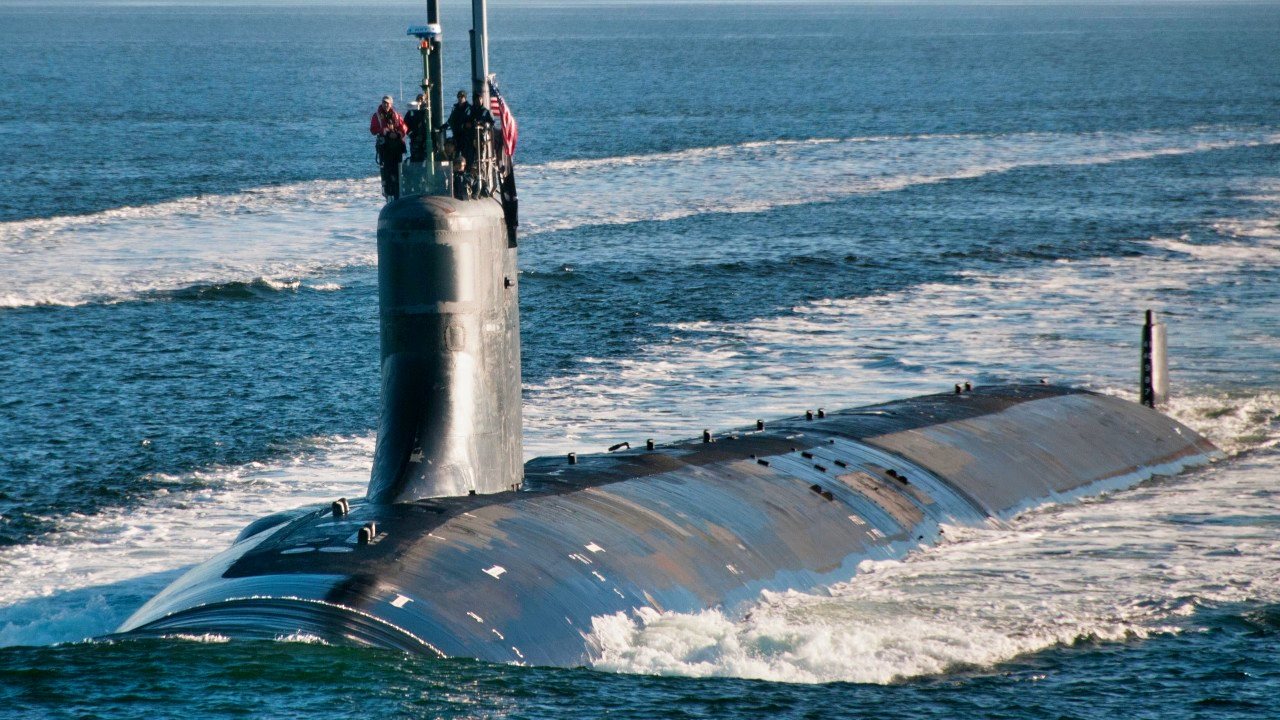
PUGET SOUND, Wash. (Sept. 11, 2017) The Seawolf-class fast-attack submarine USS Jimmy Carter (SSN 23) transits the Hood Canal as the boat returns home to Naval Base Kitsap-Bangor. Jimmy Carter is the last and most advanced of the Seawolf-class attack submarines, which are all homeported at Naval Base Kitsap. (U.S. Navy photo by Lt. Cmdr. Michael Smith/Released)

The U.S. Navy’s newest attack submarine, USS Seawolf (SSN 21), conducts Bravo sea trials off the coast of Connecticut in preparation for its scheduled commissioning in July 1997. The aerial image shows the sail from a starboard angle, looking forward, 9/16/1996. Jim Brennan. This image is public domain/U.S. Government photo.
The answer is the Virginia-class, and let’s be clear: it is the single most effective, versatile, and deadly attack submarine on the planet. It is not just a submarine; it is a fully networked, underwater battlespace manager. It is a stealthy intelligence-gathering hub, a covert special-operations platform, a deep-strike missile arsenal, and a peerless hunter-killer, all fused into one. It is, quite simply, the perfect predator.
It is also the subject of a looming, self-inflicted catastrophe. For all its brilliance, the Virginia-class has one, terrible, almost unforgivable flaw that has nothing to do with its design: we are not building them fast enough.
As our old submarines retire, a dangerous capability gap is opening, a wound that our adversaries, China and Russia, are watching with keen interest. The story of the Virginia-class is one of breathtaking technological triumph and a catastrophic failure of industrial foresight.
A New Philosophy: Master of All Waters
The first thing you have to understand about the Virginia-class is that it was designed for a different world. The Seawolf and Los Angeles-class boats were blue-water brawlers, designed to hunt Soviet “boomers”—ballistic missile submarines—in the deep, open stretches of the North Atlantic. But the post-Cold War world presented a new, far messier challenge: the “littorals.”
These are the shallow, noisy, cluttered coastal waters where the new threats—like China, North Korea, and Iran—live. For a submarine, this is a nightmare. It’s like trying to find a whisper in the middle of a rock concert. The water is full of sediment, shifting temperature layers, and the deafening noise of commercial shipping. A large, deep-diving submarine is clumsy and half-blind in this environment.
The Virginia-class was the first American submarine built from the keel up to dominate this coastal battleground and the deep ocean. It does this with a revolutionary set of controls. It does not have a traditional cross-shaped tail fin. It has an “X-shaped” stern, which, when combined with its advanced “fly-by-wire” control system, makes it astonishingly agile. A Virginia-class boat can do things a Los Angeles-class would never dream of. It can hover in place. It can pivot on a dime. It can maneuver in shallow channels with the precision of a helicopter.
This agility makes it the perfect tool for the shadowy missions that define 21st-century warfare. It can silently creep up to an enemy’s coastline, remaining motionless in the shallows to conduct intelligence, surveillance, and reconnaissance (ISR) for weeks. It is designed to deploy Navy SEALs from a built-in lock-out trunk, sending them ashore in secret and picking them up, all while remaining completely submerged and undetected. It is a spy, a transport, and a killer, all in one platform.
The Soul of the Seawolf: Becoming a Black Hole
For all its new missions, the primary job of an attack submarine is still to find other submarines and sink them. And the Virginia-class is almost supernaturally good at this. It inherited the acoustic DNA of the Seawolf, making it one of the quietest man-made objects on Earth.
Submarine quieting is a dark art. The Virginia employs every trick in the book. Its entire hull is coated in “anechoic tiles”—special rubberized blocks that absorb an enemy’s active sonar pings, making the submarine a “black hole” on a sonar screen. More importantly, these tiles dampen the sounds from inside the sub, preventing them from escaping into the water. All the noisy internal machinery—the pumps, the generators, the air scrubbers—are not bolted to the hull. They are mounted on massive “rafts,” complex platforms suspended on sound-dampening cushions, which isolate their vibrations from the water.
But the real magic is its propulsion. The Virginia-class does not use a traditional, multi-bladed propeller. A spinning propeller, no matter how well-designed, creates “cavitation”—a fizz of tiny, collapsing bubbles that creates a distinct and easily trackable sound. Instead, the Virginia uses a “pump-jet propulsor.” This is a technology it shares with the Seawolf. The propeller blades are enclosed inside a complex shroud, or duct, which smooths the flow of water, eliminates cavitation, and muffles the sound.
The result is a submarine that, when cruising at a patrol speed, is quieter than the background noise of the ocean itself. It is a phantom. An enemy sonar operator isn’t listening for a submarine; they are listening for a tiny patch of ocean that has gone too quiet. This level of stealth, once the exclusive domain of the hyper-expensive Seawolf, is now the fleet standard.
The All-Seeing Hunter: A Revolution in Senses
The Virginia-class is not just quiet; it is a shark that can “smell” a drop of blood from miles away. Its sensor suite is a complete departure from any submarine that came before it.
The biggest leap is the sonar. Older submarines, like the Los Angeles-class, had one primary sonar: a large, spherical array in the nose. This meant that to “hear” what was behind them, they literally had to turn the entire submarine. The Virginia-class has no such limitation. It has a massive, “chin-mounted” Large Aperture Bow (LAB) array, which is far more sensitive than the old spherical ones. But critically, it also has “flank arrays”—listening devices built into the entire length of its hull on both sides.

101210-N-5538K-056 PHILIPPINE SEA (Dec. 10, 2010) The Los Angeles-class attack submarine USS Houston (SSN 713) takes part in a photo exercise as part of Keen Sword 2011. Keen Sword is a joint, bilateral exercise designed to strengthen Japan-U.S. military operations. (U.S. Navy photo by Mass Communication Specialist 3rd Class Casey H. Kyhl)
This gives the Virginia’s commander a complete, 360-degree, passive listening picture of the battlespace, all at once. He can track targets in every direction without ever having to move his own boat an inch, allowing him to remain perfectly silent while building a complete tactical plot.
And then there’s the periscope. The Virginia-class doesn’t have one. The traditional, hull-penetrating, eye-in-the-sky periscope—a staple of submarine movies—is gone. It has been replaced by a “photonic mast.” This is a high-tech sensor boom that doesn’t require a massive hole through the pressure hull, a traditional point of weakness. Instead, it just pokes a small mast above the waves, equipped with high-definition cameras, thermal imagers, and electronic sensors.
The signal is sent via fiber-optic cable to a command center deep inside the sub, where the feed is displayed on large-screen monitors. The captain no longer has to be the only one with his eye to the scope. The entire command team, the pilot, and the sonar operators can all see the same picture, fusing it with the sonar data. This makes the Virginia-Class a “networked” hunter. It’s not just a submarine; it’s an underwater quarterback, able to see the entire field and direct other assets.
A Future-Proof Design: The Submarine as a Smartphone
Perhaps the most brilliant aspect of the Virginia-class is that it was designed to never become obsolete. The Seawolf was a technological marvel, but it was a closed system, a piece of 1980s hardware that is now incredibly difficult to upgrade. The Virginia-class, by contrast, was built from the ground up with an “open architecture.”
Think of it this way: the Seawolf is a mainframe computer. The Virginia is a smartphone. Its systems are designed to be upgraded not by rebuilding the submarine, but by simply installing new software or sliding new hardware blades into existing racks. A boat launched in 2005 can receive a software patch in 2025 and gain entirely new capabilities, new weapon systems, and new sensor processing. This design philosophy is why the class is built in “Blocks.” Each new block of submarines integrates the latest technology, making the fleet more lethal every year.
This modularity, building the sub in large, pre-fabricated sections, also made it far cheaper and faster to build than the Seawolf. It was the perfect balance: a platform that had the lethality of a purpose-built killer but the affordability and adaptability of a workhorse. It was the submarine that was supposed to secure America’s undersea dominance for the 21st century.
The Tomahawk Truck: From Stealth Hunter to Arsenal Ship
The final, and most devastating, evolution of the Virginia-class is happening right now.
The original mission of the attack submarine was to hunt other ships and submarines. But the U.S. Navy is about to retire its four specialized Ohio-class guided missile submarines (SSGNs). These were massive ballistic missile subs, converted to hold a staggering 154 Tomahawk land-attack cruise missiles. They gave the U.S. an unmatched, secret ability to strike targets 1,000 miles inland from a hidden, underwater platform.
The loss of these “arsenal ships” would create a massive firepower gap. The solution? The Virginia Block V.
Starting with the Block V boats, the Navy is inserting a new, 88-foot-long section into the middle of the submarine’s hull. This section, known as the “Virginia Payload Module” (VPM), is essentially a bank of four massive vertical launch tubes. These tubes add 28 more Tomahawk missiles to the boat’s existing 12, bringing its total strike capability to 40 cruise missiles.
This transforms the Virginia-class from a hunter-killer into a stealthy, deep-strike battleship. A single Virginia can now sneak up to an adversary’s coast, completely undetected, and unleash a saturation barrage of precision-guided missiles that can take out air defenses, command centers, and key infrastructure, all before the enemy even knows they are under attack. This capability, combined with its ability to hunt the enemy’s own fleet, makes the Virginia-class the most strategically potent and complete warship on Earth.
The Perfect Weapon We Don’t Have Enough Of: Meet the Asterisk for Virginia-Class Subs
So, the Virginia-class is a masterpiece of design. It is quieter, more versatile, more lethal, and more adaptable than any other submarine in production. It is the perfect weapon for a new era of great power competition with China and Russia. It has no equal.
And yet, we are in the midst of a full-blown strategic crisis. Because for all its brilliance, the Virginia’s greatest flaw is one we created ourselves: we are not building them fast enough.
Here is the brutal, terrifying math. Our fleet of Los Angeles-class submarines, the Cold War workhorses, are reaching the end of their 40-year service lives. They are being decommissioned at a steady, relentless pace.

APRA HARBOR, Guam (Jan. 17, 2023) – The Los Angeles-class fast-attack submarine USS Key West (SSN 722) departs Apra Harbor, Guam, Jan. 17. Key West is one of five submarines assigned to Commander, Submarine Squadron 15. Commander, Submarine Squadron 15 is responsible for providing training, material and personnel readiness support to multiple Los Angeles-class fast attack submarines and is located at Polaris Point, Naval Base Guam. (U.S. Navy photo by Lt. Eric Uhden)
At the same time, our shipbuilding industry is struggling to produce just two Virginia-class submarines per year, and often, it fails even to meet that meager target.
The result is a “submarine gap.” The U.S. Navy’s own analysis shows that its attack submarine fleet is on a path to shrink from over 50 boats today to just 46 in the 2030s, at the very moment when China’s naval power is exploding. The Navy states it needs a minimum of 66 of these boats. We are facing a 20-boat deficit.
And into this production crisis, we have introduced a new, enormous complication: AUKUS. We have, quite rightly, made a historic pact with Australia and the United Kingdom to counter Chinese aggression. A key pillar of that pact is our promise to sell Australia between three and five brand-new Virginia-class submarines in the 2030s.
Let that sink in. We are already failing to build enough submarines to maintain our own fleet, and we have now promised to sell boats from that same, over-stressed production line to an ally. This is a strategic nightmare. Our two primary shipyards that build these boats are already straining under a mountain of labor shortages, supply chain issues, and a lack of skilled welders.
The Virginia-class proves that we have the technological genius to build the perfect hunter-killer. But it also exposes our industrial atrophy. We have the world’s best submarine, but we are facing a future where we simply won’t have enough of them. An unrivaled weapon that exists only on a spreadsheet is not a deterrent; it is a fantasy.
This is the great paradox of the Virginia-class, and it is a self-inflicted wound we must heal, or we will find ourselves losing the undersea war before a single shot is ever fired.
About the Author: Harry J. Kazianis
Harry J. Kazianis (@Grecianformula) is Editor-In-Chief and President of National Security Journal. He was the former Senior Director of National Security Affairs at the Center for the National Interest (CFTNI), a foreign policy think tank founded by Richard Nixon based in Washington, DC. Harry has over a decade of experience in think tanks and national security publishing. His ideas have been published in the NY Times, The Washington Post, The Wall Street Journal, CNN, and many other outlets worldwide. He has held positions at CSIS, the Heritage Foundation, the University of Nottingham, and several other institutions related to national security research and studies. He is the former Executive Editor of the National Interest and the Diplomat. He holds a Master’s degree focusing on international affairs from Harvard University. Email Harry: [email protected].
More Military
China’s H-20 Stealth Bomber Has a Message for the U.S. Air Force
China’s New J-35 Stealth Fighter Has a Message for the U.S. Air Force
China Is Studying the Ukraine War to Become a Drone Superpower
The Road to a China-America Nuclear War
China Could Fire Mach 6 Hypersonic Missiles from Bombers to Sink Navy Aircraft Carriers


