


Key Points and Summary – Northrop Grumman’s YF-23 “Black Widow II” famously lost the Advanced Tactical Fighter contest to Lockheed’s F-22, but the story may not be over.
-Northrop’s emerging F/A-XX carrier fighter concept appears to borrow the YF-23’s blended, low-profile lines while pushing stealth into a new, bomber-like, tailless realm.

YF-23 Back. Image Credit: National Security Journal.
-Backed by decades of work on the B-2 and B-21, Northrop is expected to deliver a far more advanced design than its 1990s prototype, with deeper low-observable shaping and next-gen avionics.
-The YF-23 may have gone to the museum—but its DNA could yet define the Navy’s 6th-generation air superiority jet.
-BONUS – National Security Journal has visited both YF-23 fighters over the past year. We have included photos from those visits.
From YF-23 to F/A-XX: Northrop’s Surprise Comeback in the 6th-Gen Fighter Race
Northrop Grumman’s YF-23 prototype was, by all accounts, an impressive machine with speeds of Mach 2.25 and a high 1.36 thrust-to-weight ratio, yet the stealth fighter jet wound up “losing” an intense competition with the F-22.
However, it seems entirely possible that the YF-23, or some variation thereof, will re-emerge in the form of Northrop’s F/A-XX design.
Northrop’s F/A-XX design might indicate that the defense giant is bringing back or “re-introducing” a stealth jet configuration similar to its YF-23 Black Widow II offering submitted years ago during the previous competition for the “F-22.”

F/A-XX Handout Photo from Northrop Grumman.
While Lockheed was, of course, ultimately chosen to become the F-22, Northrop’s YF-23 did present an extremely “stealthy” looking jet.
Northrop is likely offering a 6th-generation aircraft far more advanced than its previous YF-23 offering for several key reasons.
First, the back end of Northrop’s F/A-XX image is not visible, and while the YF-23 includes vertical “fins,” it seems entirely possible that Northrop’s new aircraft is entirely horizontal.
Northrop F/A-XX Stealthier than YF-23?
This design would mean that, like the F-47, the F/A-XX would be a “stealthier,” more horizontal kind of blended wing-body without vertical “tails.”
Part of the rationale for why Northrop’s F/A-XX rendering might feature breakthroughs in stealth technology lies in Northrop’s reputation as a leader in technological advancement and sophistication in this field.
Not only did Northrop design and build the B-2, but the firm is also now building a new generation of stealth with its emerging B-21 Raider.
It seems entirely realistic that Northrop could engineer an extremely stealthy, fully horizontal “bomber-like” configuration with the speed and agility of a next-generation fighter aircraft.
Therefore, examining the available image of Northrop’s F/A-XX, it would seem that Northrop engineers are more likely to be producing an entirely new generation of stealth fighter technology that exceeds the capabilities woven into its YF-23 years ago.
While Northrop’s work on its YF-23 is likely to have influenced its F/A-XX design, it seems far more likely that the defense giant has now taken new, paradigm-changing leaps forward in the realm of stealth fighter technology, which far surpasses any innovations woven into its YF-23 years ago.
In a simple sense, it seems unlikely that Northrop would offer 1990s-era stealth technology.

Boeing NGAD F/A-XX Fighter Rendering. Image Credit: Boeing.
Nonetheless, there are likely many ways in which innovations pioneered for the YF-23 may inform or be woven into the F/A-XX.
YF-23 vs F-22
Some observers, experts, military weapons developers, and air war enthusiasts might be inclined to time-travel back to analyze the Air Force’s decision to choose the F-22.
Why was the F-22 considered superior to the very capable, stealthy YF-23?
Exact answers are unlikely to be found, as many variables likely informed this kind of decision, yet a retrospective look at it raises relevant questions.
The YF-23 now sits in a museum, and some have questioned whether it was stealthier than an F-22. The YF-23 has a flattened wing-body blended fuselage and a smooth exterior, yet it does not necessarily appear stealthier than an F-22 to the naked eye.
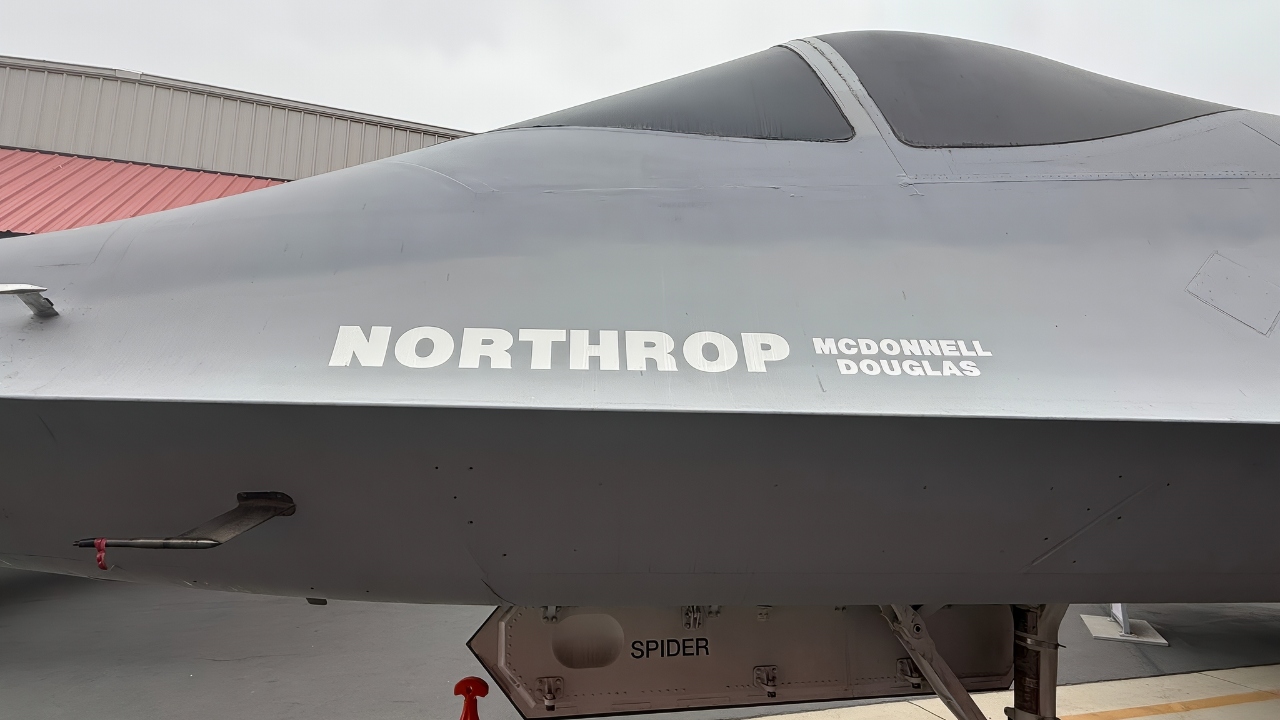
Sideview of YF-23A Black Widow II. Image Credit: Harry J. Kazianis/National Security Journal.
The YF-23 has jagged, angular structures at the rear, fins, and sharp, protruding wing-like points, likely to generate a strong, clear radar return signal. Radar works by bouncing electromagnetic “pings” off an object while traveling at the speed of light.
Sharp angles and protruding structures provide more areas, contours, and shapes for an electromagnetic return signal to generate a rendering or image.
About the Author: Kris Osborn
Kris Osborn is the President of Warrior Maven – Center for Military Modernization. Osborn previously served at the Pentagon as a highly qualified expert in the Office of the Assistant Secretary of the Army—Acquisition, Logistics & Technology. Osborn has also worked as an anchor and on-air military specialist at national TV networks. He has appeared as a guest military expert on Fox News, MSNBC, The Military Channel, and The History Channel.
More Military
JASSM: The ‘Stealth’ Cruise Missile That Keeps Russian Generals Up at Night
The Day a B-2 Stealth Bomber Disintegrated on Takeoff
The U.S. Military’s Superpower Muscles Are Getting Old
The Mach 6.7 X-15 ‘Hypersonic Rocket Plane’ Has a Message for the U.S. Air Force


