


Key Points and Summary – Despite continual F-35C upgrades (Block 4 weapons, better coatings, AI-ready computing), a new F/A-XX is operationally justified.
-However, at present, significant challenges remain regarding funding and White House support.
-Drivers: step-change stealth (blended wing-body cues for bomber-like signatures without tails), much greater unrefueled range to fight outside China’s A2/AD envelope (DF-26 reach), and next-gen sensing/AI that may exceed the F-35’s hardware headroom.
-MQ-25 refueling helps, but a carrier air wing still needs a fighter with longer legs, deeper magazines, and superior passive/active sensing to survive and persist at standoff.
-Net: F-35C remains vital, but a true 6th-gen, carrier-launched platform could restore margin against long-range threats and extend carrier relevance.
The F/A-XX: Why the U.S. Navy Needs It
The emerging yet mysterious and still uncertain F/A-XX carrier-launched stealth fighter continues to inspire the imagination, as it may introduce the stealthiest, fastest, and most capable maritime fighter the world has ever seen.
Indeed, there have been many technological breakthroughs since the dawn of the now cutting-edge stealthy, carrier-launched F-35C. Yet, some might be inclined to wonder if there are capability advances sufficient to justify a new F/A-XX platform. This seems to be a fair question, given the Navy’s ability to continuously upgrade the F-35C to a significant extent.
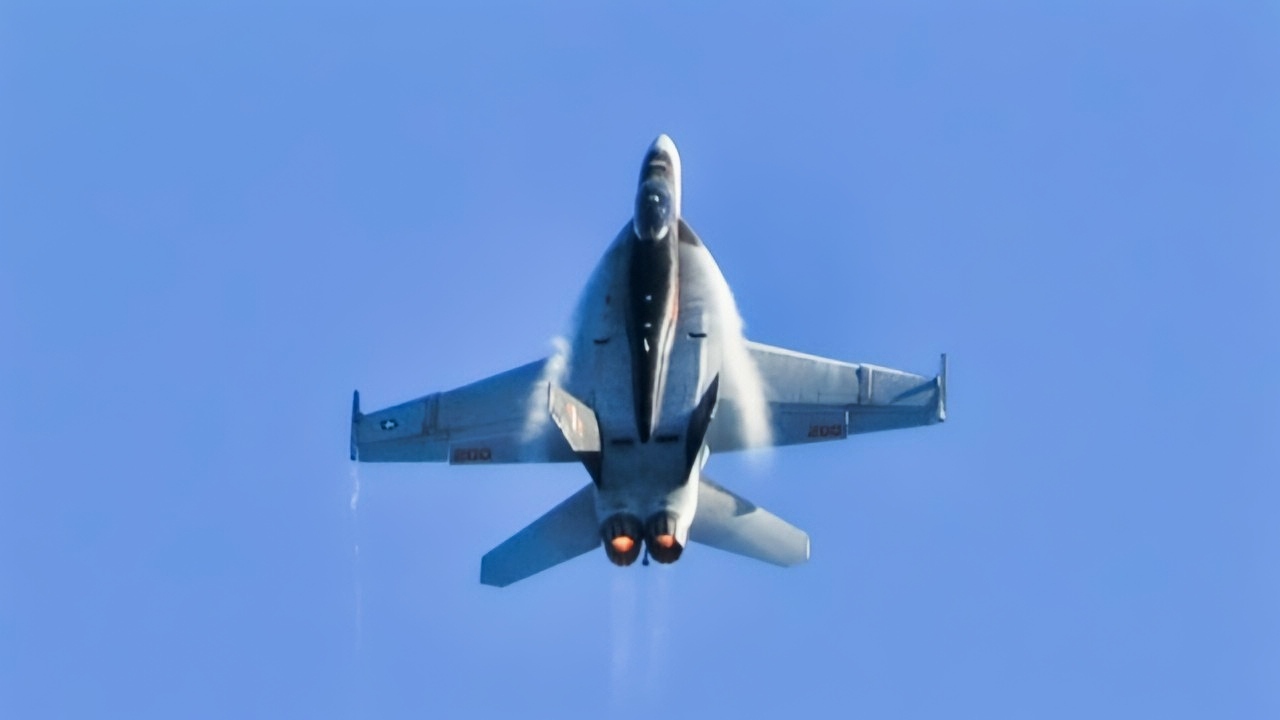
A U.S. Navy F/A-18E Super Hornet aircraft assigned to Strike Fighter Squadron (VFA) 147 performs maneuvers above the aircraft carrier USS Nimitz (CVN 68) during the departure of Carrier Air Wing (CVW) 11 Dec. 10, 2013, in the Pacific Ocean. CVW-11 fixed wing aircraft flew off the Nimitz to return home after being deployed to the U.S. 5th, 6th and 7th Fleet areas of responsibility. (U.S. Navy photo by Mass Communication Specialist Seaman Apprentice Kelly M. Agee/Released)
Block 4 software upgrades, for example, will introduce the next-generation Stormbreaker and AARGM-ER weapons.
Additionally, computing can be continuously upgraded with AI-capable systems, and stealth coating and radar absorbent materials can also be improved in the coming years. Therefore, is there truly an operational need for an F/A-XX in light of the continued promise of the highly capable F-35C?
While there are sure to be many unknowns when it comes to this question, there appear to be some potentially paradigm-changing technological advances in recent years that strongly support the argument for an F/A-XX.
There continue to be defining advances in the realm of stealth technology, fighter jet range capability, sensing and targeting fidelity, and AI-enabled computing and data processing.
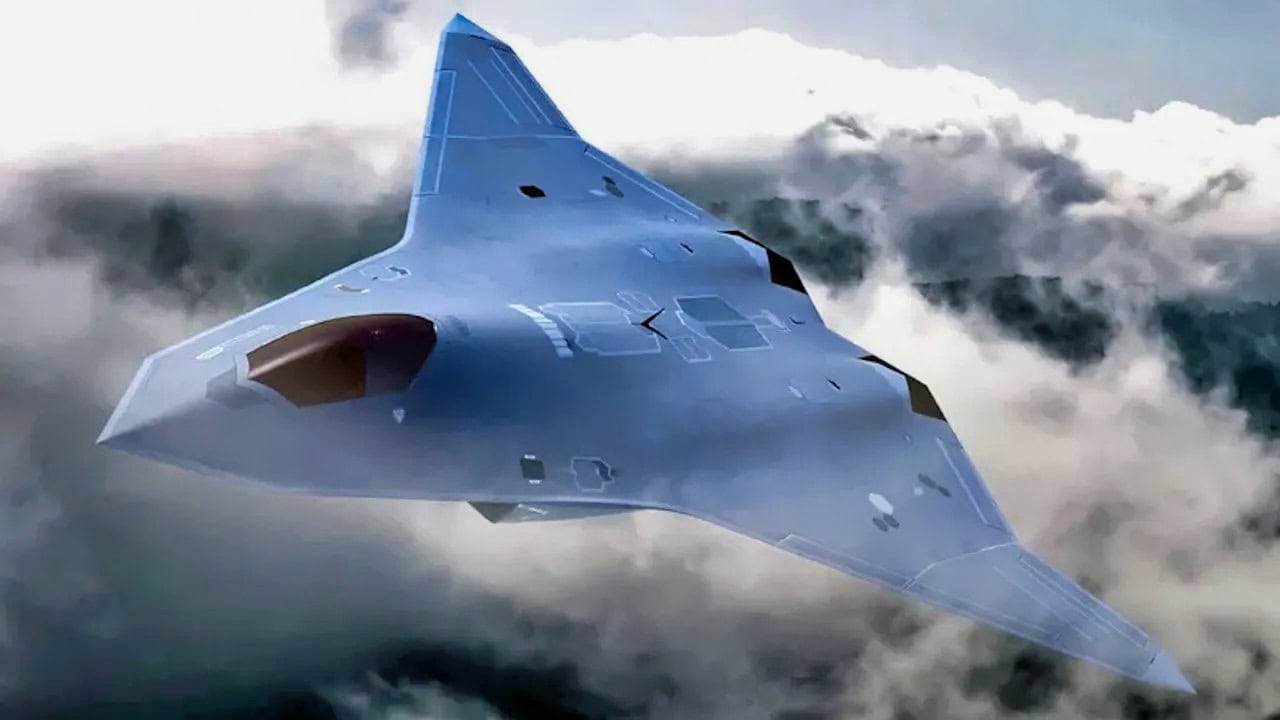
F/A-XX Fighter Mockup. Image Credit: Creative Commons.
Stealth Breakthroughs
In terms of pure stealth, the available renderings of F/A-XX configurations seem to indicate that there have been substantial breakthroughs with efforts to reduce the radar signature of a fighter jet.
An F/A-XX jet could possibly be built to achieve fighter jet-like agility, speed, and performance parameters with a fully horizontal, ultra-stealthy bomber-like blended wing-body fuselage configuration.
Stealth bombers such as the B-2 and B-21 are regarded as being the stealthiest in existence, given their purely horizontal, smooth, and rounded exterior. The absence of protruding structures, tails, and vertical shapes offers ground-based enemy radar “pings” very few contours off of which to “bounce” and generate a return rendering. A B-21, for instance, is expected to appear like a small bird to enemy radar systems.
Fighter jets, while still stealthy, are considered less stealthy than high altitude bombers because they have historically needed fins, tails, sharp angles, and other protruding structures to vector and aerodynamically achieve air combat agility.
However, it appears technological breakthroughs in aerial maneuverability may enable a purely horizontal stealth fighter such as the F-47 or F/A-XX to achieve F-22 and F-35-like air dominance with a much stealthier, bomber-like airframe.
In essence, the F/A-XX could possess B-21-like stealth capabilities, combined with the speed and aerial maneuverability of the F-22.
This possibility alone, it seems, could be sufficient to justify the need to build an entirely new aircraft.
AI, Sensing, Range
The F-35 was deliberately engineered to accommodate sensing, computing, and weapons upgrades with technical standards designed to integrate new technologies as they emerge. This will serve the aircraft well into the future and helps explain why the Pentagon plans to fly the F-35 into the 2070s.
However, advances in AI, sensing, targeting, and range could be sufficient to necessitate a new jet, which would represent yet another generation beyond the F-35.
Despite the F-35’s upgrade potential, it is possible there are limitations on the extent of new mission systems, sensing, and AI-enabled computing that its hardware could accommodate.
It might be necessary to engineer an entirely new aircraft to best leverage an entirely new generation of AI, long-range sensing, and weaponry.
F/A-XX Range?
For example, the F-35 arguably suffers from a range challenge in the Pacific. Parts of Southern Japan are a few hundred miles from Taiwan, and Manila in the Philippines is about 925km from Taiwan, distances potentially within reach of an F-35A should it be stationed there.
The F-35C has a range of roughly 1,300 miles, which means it would need to operate roughly 500 miles from the coast of mainland China to be able to project power with some dwell time and return to its carrier.
However, China’s famous DF-26 “carrier killer” missile can travel ranges out to 2,000 miles, so it is unclear if US Navy carriers could risk projecting power from only 500 miles offshore. This is why the US Navy will deploy its MQ-25 Stingray carrier-launched refueler drone, as it could potentially double the strike range of an ocean-launched F-35C.
A new F/A-XX, however, might be engineered to travel much longer distances.
Therefore, with a massively more extended attack range, longer-range sensors, and next-generation weapons, a new 6th-generation F/A-XX might have more success operating at greater distances offshore and be more survivable for carriers.
About the Author: Kris Osborn, Defense Expert
Kris Osborn is the President of Warrior Maven – Center for Military Modernization. Osborn previously served at the Pentagon as a highly qualified expert in the Office of the Assistant Secretary of the Army—Acquisition, Logistics & Technology. Osborn has also worked as an anchor and on-air military specialist at national TV networks. He has appeared as a guest military expert on Fox News, MSNBC, The Military Channel, and The History Channel. He also has a Masters Degree in Comparative Literature from Columbia University.
More Military
SEPv4: The M1 Abrams ‘Super’ Tank The Army Didn’t Need
SR-72 Son of Blackbird: The Mach 6 Mystery
F-15EX Eagle II vs. Russia’s Su-35: Who Wins?
Why China’s J-20 and J-35 Can’t Be the F-22 or F-35
The B-1B Lancer Bomber Can Come Back ‘From the Dead’ Thanks to the Boneyard


