


There’s a new sheriff in town. At least that’s what Tehran is signaling to the world about the Strait of Hormuz (SoH). The Strait was an open international waterway; the Islamic Republic of Iran is no longer content with that arrangement. In their minds, the Americans and Israelis launched an unprovoked war upon the Islamic Republic.
The Americans and Israelis killed many of their top leaders.

(July 28, 2017) An F/A-18F Super Hornet assigned to Air Test and Evaluation Squadron (VX) 23 approaches the aircraft carrier USS Gerald R. Ford (CVN 78) for an arrested landing. The aircraft carrier is underway conducting test and evaluation operations.(U.S. Navy photo by Erik Hildebrandt/Released) 170728-N-UZ648-161
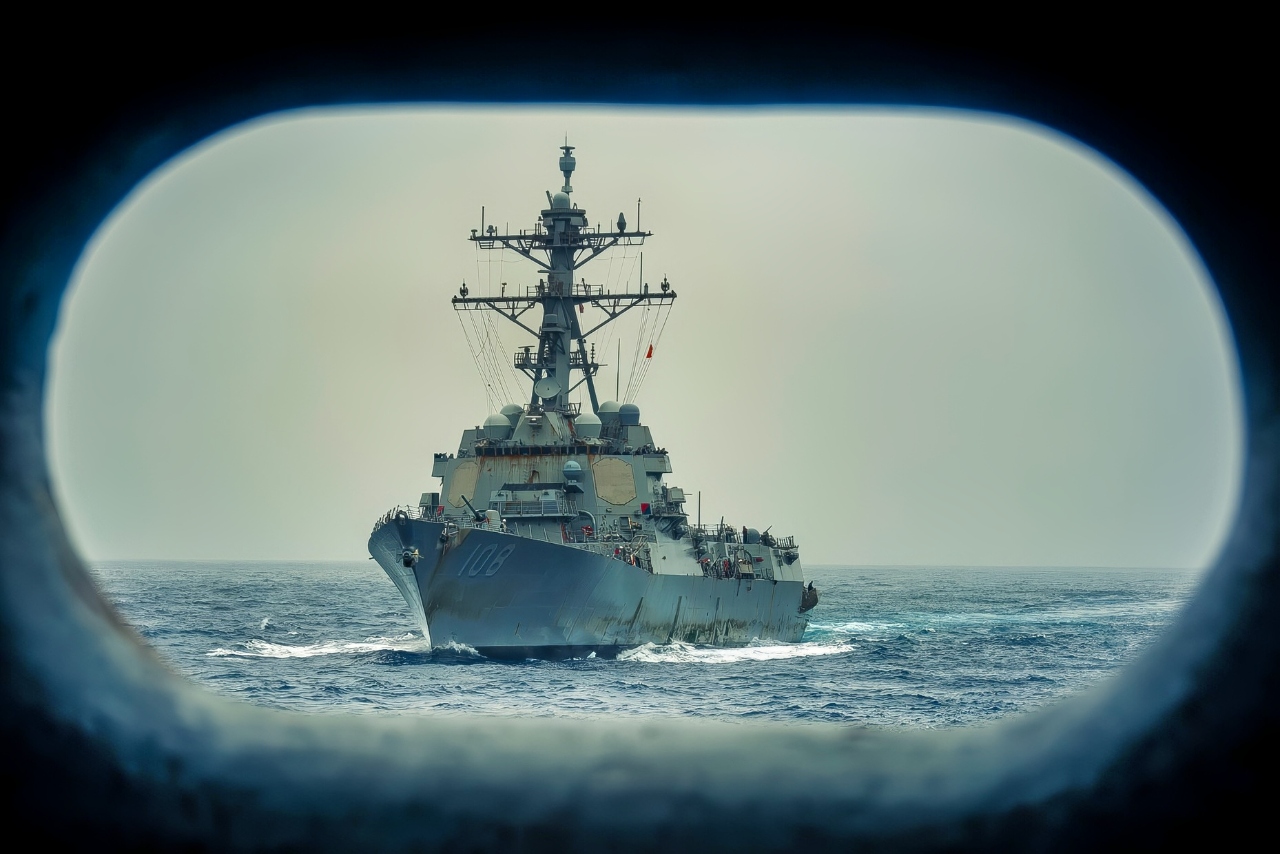
(August 1, 2025) The Arleigh Burke-class guided-missile destroyer USS Wayne E. Meyer (DDG 108) approaches the Nimitz-class aircraft carrier USS Nimitz (CVN 68) for a replenishment-at-sea in the U.S. Central Command area of responsibility. (Official U.S. Navy photo)
Their economy, already stunted by decades of American sanctions, has been crippled by the war. So, Tehran wants to exact some form of recompense from the West–especially since, thus far, the West is not winning the war.
The Ceasefire Collapses–and Shipping Comes Under Fire
Recently, the so-called “Memorandum of Understanding” (MoU) that had created a 60-day ceasefire between the Islamic Republic and the United States collapsed.
Shooting has restarted between the two warring parties, all because the Americans insisted that ships passing through the Strait of Hormuz employ the trade route through Oman’s waters.
At the same time, the Iranians urge ships to rely exclusively (for now) on their preplanned route, using Tehran’s new Traffic Separation Scheme (TSS).
In the 18 days since the MoU was signed, the Iranians have allowed 513 ships through the Strait. That’s an average of 28 ships per day.
Before the war began and the Strait of Hormuz was shut down, first by the Iranians and then by the United States Navy’s counter-blockade, an average of 140 ships passed through the Strait daily.
And the main reason those 513 ships passed through the Strait was that they used the Iranian route. The moment that the Omanis attempted to direct ships through their route, not using the Iranian TSS, Iran’s military attacked.
Washington’s Strategy Is Failing in the Strait of Hormuz
Oman, which generally has decent relations with Iran, the country that shares a coastline (opposite Oman’s) in the Strait of Hormuz, is being pressured by Washington to open the rival route in the SoH.
That’s because the Trump administration refuses to acknowledge that Iran will implement some form of control over the SoH once the war ends.
Washington is understandably worried about the precedent allowing Iran to exercise control–notably imposing tolls–over the SoH set for other important strategic waterways globally.
So, Washington is trying to use the Omanis to undermine the Iranian position. Iran knows this. That’s why Tehran started shooting at ships that weren’t following their preordained protocols in the Strait.
The World Economy Is Running Out of Time
Here’s the thing, though: the entire world is teetering on the brink of economic collapse because no one has access to their regular energy flows from the Middle East and through the Strait.
Yes, some flows continued through the SoH. But they are well below their prewar averages.
Because of those blockades and the shuttering of much of the Middle East’s energy production, the world faces shortages.
The greater the shortage, the higher prices will go across the board, and the more likely the world is to enter either a severe recession or, more likely, a depression. Few seem to comprehend this in Washington.
But the Iranians understand what’s happening and are more than happy to impose pressures and undue burdens upon the global trading system by attacking ships that do not adhere to their preferred route through the SoH.
Trump’s Escalation Trap
After all, Iran wants to hurt the American leadership by stunting the economy. Either President Trump doesn’t fully understand that, or, more likely, he does.
There’s just nothing he can do about it. He’s stuck in what Dr. Robert Pape has rightly coined as an “escalation trap.” While that escalation so far doesn’t (thankfully) involve nuclear weapons.
It does involve severe pain for all of our wallets, unless Trump can end this war in the next week and fully restore the flow of energy.
Even the greatest American statesman would have difficulty accomplishing this task.
Trump, however, is disinclined to let the Iranians have any semblance of control over the SoH.
And, everyone surrounding Trump–and his main partner in the war, Israel–are urging him to continue the war, convincing him that whatever potential pain the US faces will be short-lived and that the reward of ending the threat of Iran permanently is worth the cost (notice that most of those people around Trump are all fabulously wealthy and won’t have to suffer in any way compared to how ordinary Americans will).
The Simplest Way Out Is the Best Way Out
Occam’s Razor says that the simplest explanation for events is often the best explanation. Something similar for solving policy problems, such as what the US should do over the SoH, applies.
In this case, however unpalatable the solution for Trump in the SoH may be, the easiest, least painful way out of the quandary over the SoH (which Trump himself created by starting the unpopular war) is to let the Iranians take control of at least their side of the Strait.
Establish a system similar to the Turks’ for the Bosphorus Strait under the Montreaux Convention of 1936. And end the war now.
The goal should not be defeating the Islamic Republic at the cost of another depression here in the United States and throughout the rest of the world.
The primary policy should be to get the goods flowing at prewar levels through the SoH as quickly and painlessly as possible. What Trump is doing will only increase the level of pain and further negate stabilization.
All that will compound into a very damaging reality here in the United States, which will not only punish Americans economically. It will damage Trump’s political existence, too.
There is no victory for the United States in this Iran War, not under current conditions. There is only pain and diminishment.
Trump was elected to “Make America Great Again.” Nothing he has done in the Middle East since February 28 has led to that. Let the world use Iran’s preferred shipping route and TSS. Let’s get energy flows moving again.
About the Author: Brandon J. Weichert
Brandon J. Weichert is the National Security Editor. He also manages The Weichert Brief on Substack. Weichert also hosts “National Security Talk” on Rumble. He is the author of four bestselling national security books, the most recent of which is A Disaster of Our Own Making: How the West Lost Ukraine (Encounter Books). Follow him via Twitter/X @WeTheBrandon.


