

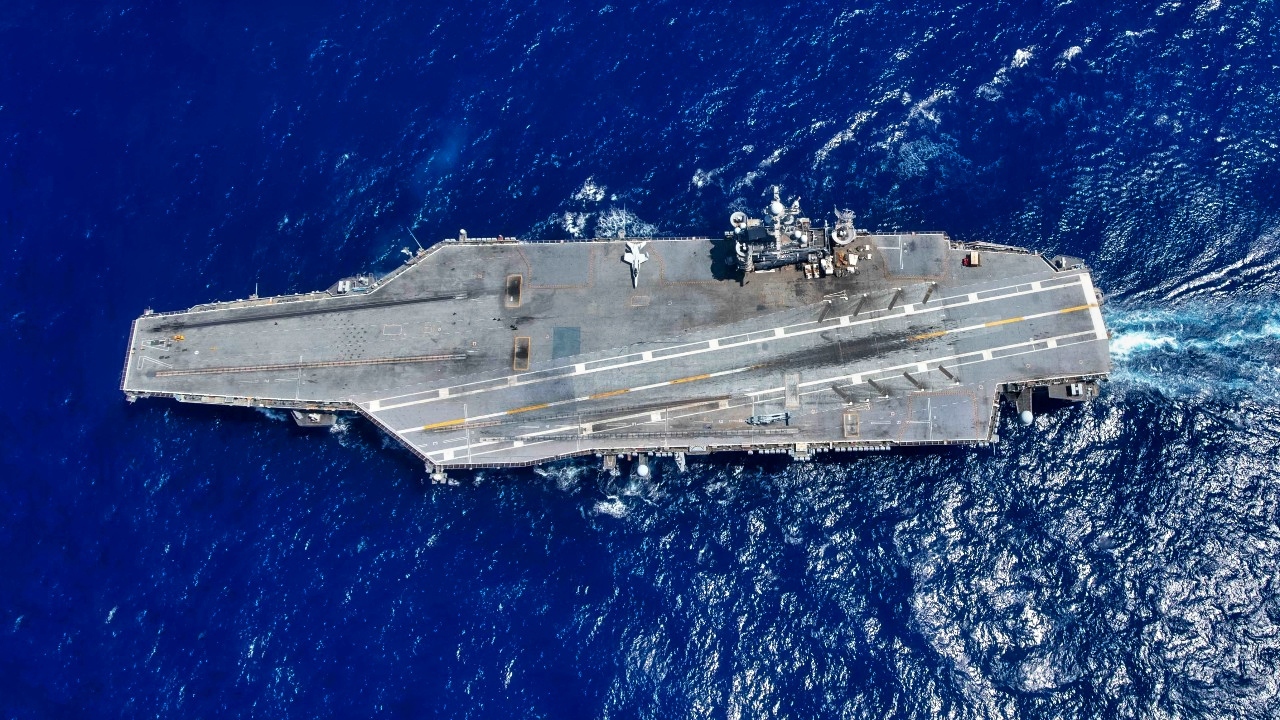
The Strait of Hormuz has always been a strategic geopolitical weapon for the Iranian regime. The waterway has carried 20 percent of the world’s oil, gas, and liquefied natural gas (LNG).
Iran’s closure of the Strait after the beginning of the US/Israeli bombing campaign gave it important leverage in negotiations with the United States to end the current conflict, as it had a profound effect on the world’s economy.
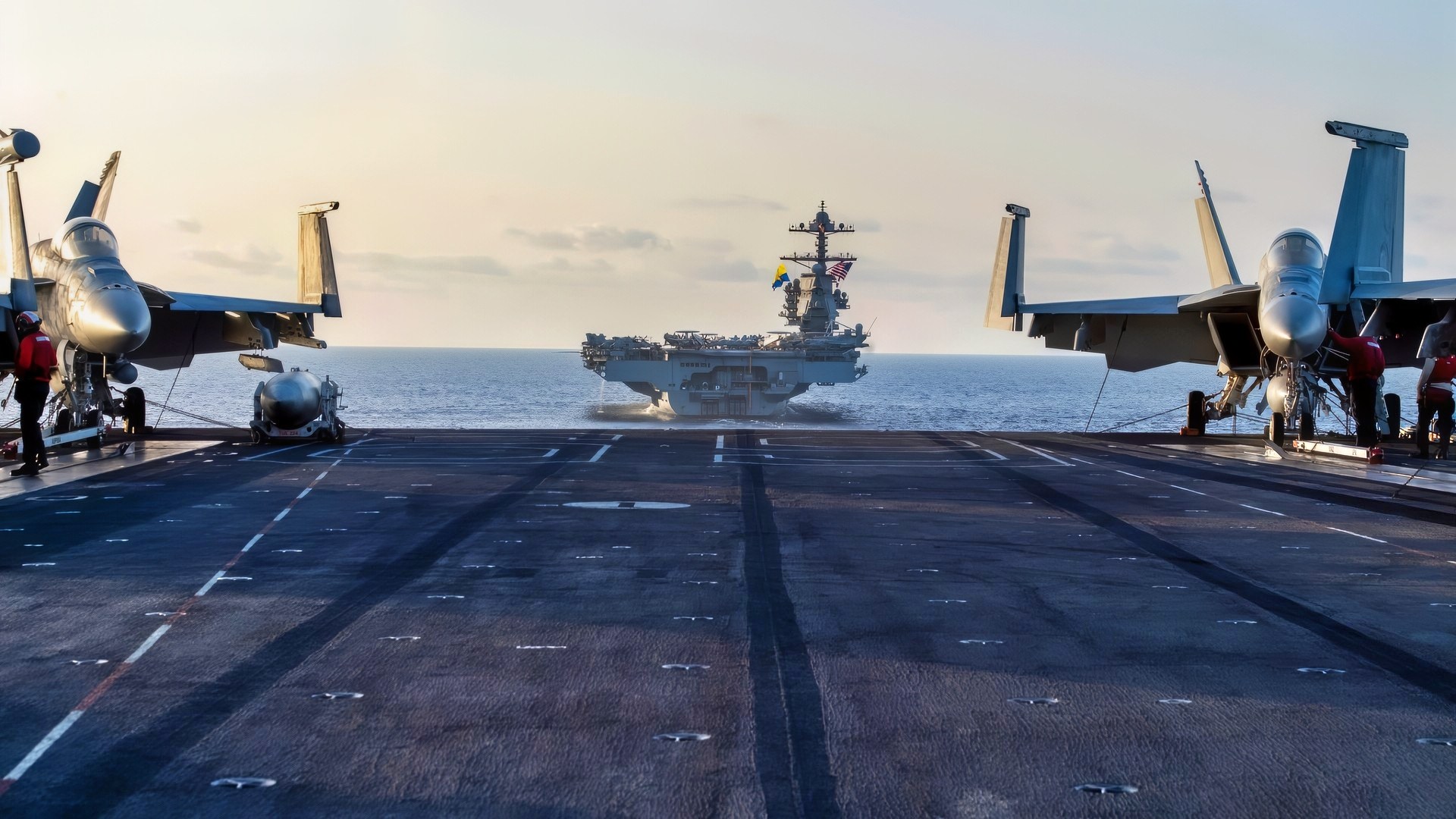
USS Eisenhower Aircraft Carrier. Image Credit: U.S. Navy.

USS Ford Aircraft Carrier U.S. Navy Photo
Especially considering that the US has mid-term elections on November 3. Continued high oil and food prices would be catastrophic for President Trump.
This leverage by Tehran was cited by many analysts as a significant factor in the US’s quick agreement to the Memorandum of Understanding (MoU), whose terms are widely considered to greatly favor Iran.
However, as Simon Watkins recently wrote on OilPrice.com, plans are unfolding to reshape the regional energy map, making Iran’s Hormuz threat increasingly ineffective in the coming years.
Iran’s Actions May Cause Less Dependence On Hormuz Traffic
Iran is attempting to coerce oil producers in the Gulf and the world economy by creating a new Persian Gulf Strait Authority (PGSA) to levy tolls in the Strait, where none existed before. Despite the Strait being open for at least 60 days before further negotiations take place, they fired on three tankers that passed on the Omani side of the Strait.
The Iranians are banking on the world caving to their blackmail, but the fact that they are showing their intent to close it again if they choose to is simply filling the rest of the world with the intent of investing in alternatives to Iran’s blackmail attempts.
The US and Gulf-nation partners supported the ‘Southern Highway’ corridor that hugged Oman’s coast. It proved slightly more effective at reducing market panic than it was at restoring the number of oil tankers in transit.
During peak operations early in the blockade, the corridor allowed roughly a dozen vessels per weekend to transit, rising to around 119 ships by late June — still a long way off the historical 700 weekly transits normal for the waterway.
Iran’s actions, however, will only make the Strait of Hormuz less vital and less valuable in the very near future.
Vidya Mani, an expert on global supply chains at the University of Virginia, told the New York Times that she expects to see countries turn more toward renewable energy and other sources of oil outside the Middle East to reduce risk and increase stockpiles.
The Plan To Eliminate Iran’s Leverage By Bypassing The Strait
The U.S. and its allies and partners are accelerating the construction of pipelines, export terminals, and overland trade corridors to reduce global dependence on the Strait of Hormuz and weaken Iran’s ability to disrupt oil markets.
The United Arab Emirates’ Habshan–Fujairah Pipeline, a 360 km-long pipeline linking Abu Dhabi’s fields directly to the port of Fujairah on the Gulf of Oman, has reached its maximum capacity of 1.8 million bpd.
The UAE is also building a new pipeline to Fujairah, which should double its bypass capacity to over 3 million bpd by 2027.
Abu Dhabi believes that Iran will ultimately threaten to close the Strait to traffic in the future and is ensuring that their oil will flow free from Iranian interference.
Saudi Arabia’s East-West Pipeline expansion, which is 1,200 km long, moves crude oil from its eastern oil fields across the Arabian Peninsula to the Red Sea port of Yanbu, increasing capacity to 7 million bpd.
New Iraqi export routes to Turkish and Syrian ports and the fast-tracked India–Middle East–Europe Economic Corridor (IMEC), designed to bypass the Strait of Hormuz. That would divert 60 percent of the container traffic in the Strait.
Alternative Sources (Nations) Are Ramping Up Production
The weaponization of a narrow but vital waterway will only result in alternative sources being sought, and there are plenty of oil-producing nations; the United States, Brazil, Argentina, Canada, Kazakhstan, and Venezuela are already increasing their oil production to allow Middle East customers to bypass the region altogether, without the risk of further disruptions.
Watkins added that the Americas already produce 32 percent of the global oil production, and that President Trump’s dislike for OPEC has driven his administration to drive the oil industry “From Hormuz To Houston.”
The Trump administration’s plan is to bypass up to 50 percent of the approximately 20-21 million bpd of oil that flows through the Strait in the short term, using existing pipelines, overland routes, and new construction.
But increases in other oil-producing nations will affect the long-term reliance on oil passing through the Strait.
The Gulf Nations To Curb Iran’s Leverage
The Gulf nations are under no illusions about the prospect of a lasting peace with Iran. A look at the history of the Islamic Republic and its insistence on maintaining its grip on power and its bellicose actions toward its neighbors doesn’t bode well for a peaceful coexistence.
Gulf nations are curbing Iranian leverage in the Strait of Hormuz by rejecting Iranian-imposed tolls and bypassing the waterway altogether.
The Gulf Cooperation Council (GCC) is utilizing targeted strategies to counter Tehran’s control and maritime influence.
Bahrain, Kuwait, Qatar, Saudi Arabia, and the UAE formally rejected Tehran’s creation of the “Persian Gulf Strait Authority” and advised international ships to ignore Iran’s designated maritime routes.
Gulf nations have pressed the UN Security Council to demand that Iran halt seizures, disclose mine locations, and cease interference with merchant shipping traffic.
Iraq and Syria are advancing plans to establish pipeline networks to transport crude oil from Iraqi fields to the Mediterranean, bypassing the Strait of Hormuz.
Iraq’s Foreign Minister, Fuad Hussein, met last week with Syrian President Ahmad Al-Sharaa in Damascus to advance plans to expand cooperation on energy infrastructure, including the project to revive the 800-kilometer Kirkuk-Baniyas pipeline, which has a historical design capacity of 300,000 bpd.
The US is working with Iraq on a huge Basra-Haditha Pipeline. This $5 billion, 700-km internal pipeline would run from the southern oil fields of Iraq up to Haditha and would have a capacity of 2.25-2.5 million bpd.
This pipeline would allow Iraq to pump its enormous southern oil reserves directly to the north, into Europe or Syria, completely bypassing the Strait of Hormuz and thereby negating any Iranian leverage.
So, while Tehran can threaten oil flows in the short term through coercive tactics such as attacking ships and imposing fees, its leverage will soon be largely negated. And the flow of the world’s oil will not be eroded again.
About the Author: Steve Balestrieri
Steve Balestrieri is a National Security Columnist. He served as a US Army Special Forces NCO and Warrant Officer. In addition to writing on defense, he covers the NFL for PatsFans.com and is a member of the Pro Football Writers of America (PFWA). His work was regularly featured in many military publications.


high-end faight
July 10, 2026 at 5:44 pm
Tehran’s greatest weapon against America and her sidekicks is NOT oil, but the US bases in the Persian gulf region.
Let’s see how long the gulf Arabs gonna tolerate trump’s on-off off-on war.
Trump’s military has bombed iran’s rail links heading to the Russian border, and this IS the very signal for Moscow to smash trump’s Nazi minions in Ukraine with tactical nukes.
The undescribable sufferings of the gazans, Lebanese, venezuelans and Cubans and now iranians, must be answered by a firm no-nonsense nuke riposte against Kyiv.
Also, Russia must test air-launched burevestnik missiles against lviv. And other areas.
China, under the evil despot xi jinping, has failed to protect the innocent in Iran, or gaza, or Venezuela or Cuba.
It was xi, who opened the very floodgates of hell for all those unfortunate humans, when xi agreed to meet trump in busan, south Korea, on October 30 2025.
Xi deserves to go to hell for his unfettered greed, his lust for friendship and praise from trump, the most dangerous man on the planet today.
The hell, hell, hell with xi, and zelenskyy.
zhduny
July 10, 2026 at 9:40 pm
While the world is today quietly redrawing the map around iran, and trump is doing the same for greenland and the arctic, another man is also doing very similar things for australia.
On thursday, or just over 24 hours ago, modi (the great nobly noble saintly hidutva leader of south asia) told a large crowd in melbourne, “The milk in your house is aussie, but the drink you make is south asian.”
Already, many locals are concerned about the ongoing great Indian invasion.
With India now already having 1.45bil people, and huge numbers born every minute, australia is set to become the receiving bowl for her excess production.
So while iran is getting a new map, and greenland getting a new makeover, australia is set to become the center stage star of tomorrow.
Hail, australia.