

The United States launched a major new round of airstrikes against Iran overnight on July 30 after U.S. President Donald Trump vowed to retaliate for an attempted Iranian ballistic missile attack on U.S. forces stationed in Jordan.
The operation ended a brief diplomatic pause in fighting, which had lasted almost two weeks, and resumed direct U.S. strikes against Iran.

A U.S. Air Force KC-135 Stratotanker offloads fuel to U.S. Air Force F-15 Strike Eagles over the U.S. Central Command area of responsibility, April 11, 2025. The F-15E is deployed to the CENTCOM AOR to reinforce regional stability and deter aggression from violent extremist organizations.. (U.S. Air Force photo by Senior Airman Keegan Putman)
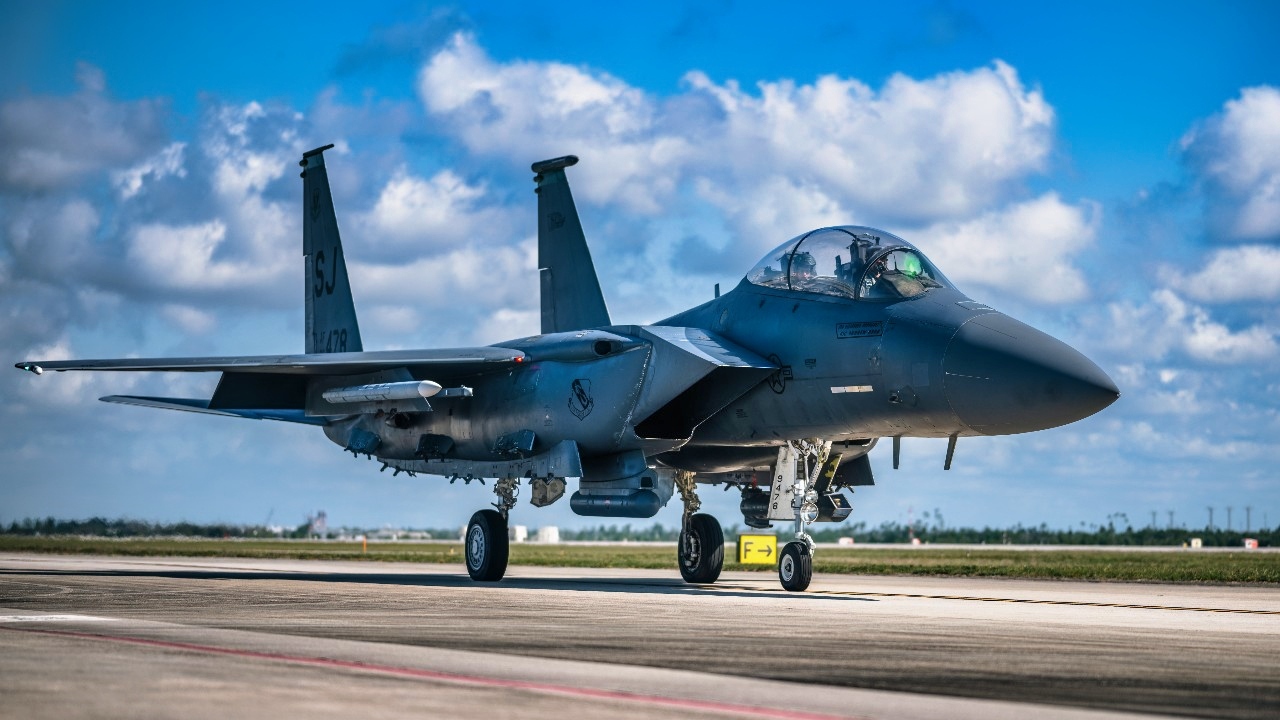
A U.S. Air Force F-15E Strike Eagle assigned to the 335th Fighter Squadron, Seymour Johnson Air Force Base, North Carolina, taxis during Checkered Flag 25-2 at Tyndall AFB, Florida, May 14, 2025. Checkered Flag, one of the Department of Defense’s largest air-to-air exercises, integrates fourth and fifth-generation aircraft to enhance mobility, deployment, and employment capabilities. (U.S. Air Force photo by Airman 1st Class Zeeshan Naeem).
U.S. Central Command (CENTCOM) described the operation as a “powerful response” to Iran’s attempted surprise attack one day earlier, saying that American forces successfully struck dozens of military targets associated with the Islamic Revolutionary Guard Corps (IRGC).
Trump Promised Iran A “Beating”
Trump had spent much of Wednesday, July 29, publicly signaling that a military response to Iran’s attempted strikes was imminent.
CENTCOM said that every missile targeted at a U.S. base in Jordan was intercepted, preventing casualties but ending hopes that the temporary pause could continue while regional powers attempted to save diplomatic talks.
Speaking at the White House, President Trump left little doubt about his plans.
“We’re going to be hitting them very hard because it’s our turn to hit them. They know it’s coming,” the president told reporters.
The comments came after the president used more extreme language during a Fox News interview that morning. The president said U.S. forces were “going to beat the f***ing sh** out of them” in response to a “surprise attack” by IRGC forces.
Iran Launched Ballistic Missiles at U.S. Forces
Per a statement from CENTCOM, Iran attempted to strike U.S. forces stationed at Muwaffaq Salti Air Base in Jordan overnight into July 29.
The strike involved five ballistic missiles that were aimed at the installation, but CENTCOM said every projectile was intercepted by U.S. Patriot air-defense systems before impact, preventing casualties or damage to the base.
Speaking in the Oval Office on Wednesday, the president said that diplomatic talks are still possible, but noted that U.S. forces would need to “smack them a little bit” in response to the attacks.
“In the meantime, we’re going to be hitting them very hard because it’s our turn to hit them. They know it’s coming. They’re asking us not to do it, but you know they tried shooting it last night,” Trump said.
President Trump later described watching footage of the interception and praised U.S. crews operating the Patriot batteries.
“So we had five rockets shot going 8,500 miles an hour, and all five rockets were knocked down to the ground, but they nevertheless took a shot,” Trump said. “So, it’s our turn, and we’ll see if we get there with an agreement at some point. But we’re going to hit them very hard.”
Trump also told a reporter that the U.S. position is “pretty much” that every attempted Iranian strike will be met with a U.S. military response.
CENTCOM Strikes Broad Targets In Iran
Less than twelve hours after Trump’s warning that the U.S. would respond, CENTCOM announced that American forces had begun a new wave of strikes at approximately 8 pm Eastern Time on July 29.
“U.S. forces began launching strikes against Iran at 8 p.m. ET today. The strikes are a powerful response to yesterday’s attempted Iranian attacks on U.S. forces based in the Middle East,” a statement published on X explains.
Speaking to Fox News, an unnamed U.S. official described how the latest round of strikes hit a “very broad target set.”
Although the Pentagon did not release a complete assessment of the damage caused by the strikes by Thursday morning, the targets are understood to have consisted of IRGC military infrastructure used to support ballistic missile operations and drone attacks.
The strikes were the first direct U.S. attacks on Iranian territory since Trump paused the bombing campaign several days earlier amid reports that Washington was concerned about its dwindling supply of Patriot missiles.
Diplomatic Talks Continue
Despite the resumption of strikes, Washington insists that diplomacy remains possible and that its negotiators remain in frequent contact with Tehran.
The Islamic regime, however, continues to deny that negotiations are taking place. During his weekly press conference on July 27, Iranian Foreign Ministry spokesman Esmaeil Baghaei said that there are no negotiations with the United States and that Iran had not requested any meetings with U.S. officials.
“At present, we are not engaged in any negotiations with the United States,” Baghaei said.
“Mediators may convey messages to us from the American side regarding ongoing developments in the region. But at present, we have no negotiations with the American side,” he continued.
Meanwhile, regional powers continue to push for a diplomatic end to both the conflict between the U.S. and Iran and the Houthis and Saudi Arabia. Egypt has intensified consultations with Qatar, Oman, Iran, and Saudi Arabia, with Egyptian Foreign Minister Badr Abdelatty holding a series of calls and meetings focused on restoring diplomacy.
About the Author: Jack Buckby
Jack Buckby is a British researcher and analyst specializing in defense and national security, based in New York. His work focuses on military capability, procurement, and strategic competition, producing and editing analysis for policy and defense audiences. He brings extensive editorial experience, with a career output spanning over 1,000 articles at 19FortyFive and National Security Journal, and has previously authored books and papers on extremism and deradicalization.


