

In an analytical essay this week for the Jamestown Foundation, the author, Ukrainian-British political analyst Taras Kuzio, details how Russia continues to sustain defense production despite an increasingly stringent sanctions regime imposed by the US, the UK, the EU, and other allied nations.
Moscow’s defense industrial base nonetheless continues to thrive and even expand since the 2022 invasion of Ukraine, he writes. Moscow has skilfully navigated various loopholes in the sanctions regime and embargoes. One key evasive measure, as he describes it, is that “many defense-linked companies” in Russia, “particularly those working in chemicals and dual-use technologies, have managed to “stay outside of the existing restrictions.”
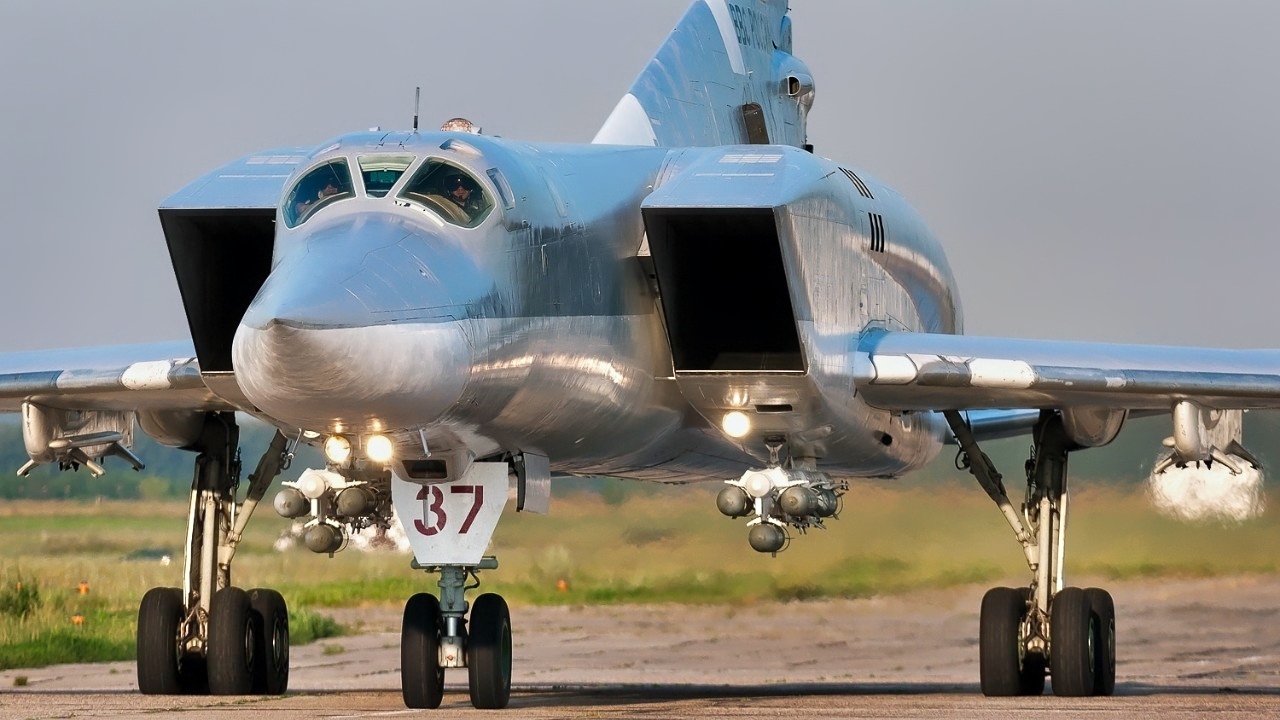
Russia Tu-22M Bomber. Image Credit: Creative Commons.

Tu-22M Bomber from Russian Air Force. Image Credit: Creative Commons.
“Another is that Russia continues acquiring critical military components through intermediary states, parallel imports, and weak export controls, while thousands of companies—particularly in the People’s Republic of China (PRC) and Hong Kong—facilitate sanctions evasion and sustain Russian weapons production.”
According to his interactions with the relevant departments within both the Ukraine Security Service (SBU) and the Defense Intelligence Service (HUR), there is voluminous evidence that proves “extensive Western-made components in Russian missiles, drones, aircraft, and air defense systems, demonstrating that US, European, and Asian [produced] technologies remain integral to Russia’s precision-strike capabilities despite sanctions.”
Inadequate Sanctions Regimes
Ukrainian analysis of the sanctions regime reveals several methods used by the Russians to evade the restrictions imposed by Western nations. One Ukrainian publication explains that paradoxically “Western sanctions have expanded significantly since 2022.”
“The European Union alone has introduced nineteen packages (now 21 as of today), some targeting Russian defense industry and others focusing upon financial networks that facilitate evasion. Yet sanctions lists tend to be reactive.”
“By the time a particular component or part number is prohibited [for export to Moscow], Russia has often shifted to another near-equivalent design. Divergence between the United States, European Union and United Kingdom systems also creates opportunities for evaders to identify and exploit the least restrictive jurisdiction.”
Western sanctions, however, as he and others have explained, “have not successfully completely inhibited Russia’s military-industrial complex. The paradox of Russia’s military-industrial complex is that, as the Stockholm International Peace Research Institute found, it grew after the imposition of Western sanctions and the decline in arms exports following the 2022 full-scale invasion of Ukraine (Stockholm International Peace Research Institute, 2026).”
Sanctions in a Swiss Cheese World
One expert on the issue who spoke to National Security Journal explained that the basic dilemma with sanctions is that “no matter how many new packages are voted in, no matter how nations try to turn the screws on enforcement, you are still talking about a sanctions regime that is kind of like slices of Swiss Cheese. No matter how many layers there are and how many you add on over time, there are always holes that allow items to slip through.”
At the 2025 Group of Seven (G7) meeting, the US Secretary of State, Marco Rubio, stated, “There’s not a lot left to sanction from our part,” as if there were nothing more Washington could do in this regard. But the end of the road is still a long way off when it comes to keeping US tech out of Russian hands.
According to Kuzio and others, at least half of the Russian companies that supply critical items to the military-industrial complex remain unsanctioned. An example is Rosatom, Russia’s state nuclear corporation, which is responsible for nuclear weapons development and has 21 companies under its corporate umbrella.
These include Innovation Hub, Mayak Production Association, and others – but they are not sanctioned, and they have direct links to Moscow’s military-industrial complex. Rosatom’s former CEO is Sergei Kiriyenko, First Deputy Head of the Presidential Administration, one of the most powerful men in the country, and he still sits on the Rosatom Supervisory Board. With the many corporate lines across different companies under his control, there are more ways to evade sanctions than to enforce them.
There are a multitude of complications in the Russian sanctions regime, which is one reason it remains so porous. To be effective, it would require an army of specialists to ensure it is properly applied and enforced.
“If there is one main problem to deal with in sanctions on Russia – on any other nation for that matter – it is that those who are responsible for seeing them become law do not recognize that having a sanctions package voted in is only the beginning of the process – the hard work is just beginning,” said one EU official who spoke to National Security Journal.
“Some people think that once you have a sanctions regime put in place, it’s time to celebrate – that you have done a great deed. But a set of sanctions are just a piece of paper. You have to get out there and make sure that its regulatory power is recognized in every part of government and industry and institutionalized. And the nation being sanctioned just does not sit there passively and take this punishment. They try every way possible to outsmart the enforcers.”
“Overall, sanctions are a cat-and-mouse game,” the official said. “You cannot just react to the country being embargoed – you have to get out in front of it. And that is what many in the halls of ministries and regulatory agencies do not understand.”
About the Author: Reuben F. Johnson
Reuben F. Johnson has thirty-six years of experience analyzing and reporting on foreign weapons systems, defense technologies, and international arms export policy. Johnson is the Director of Research at the Casimir Pulaski Foundation. He is also a survivor of the Russian invasion of Ukraine in February 2022. He worked for years in the American defense industry as a foreign technology analyst and later as a consultant for the U.S. Department of Defense, the Departments of the Navy and Air Force, and the governments of the United Kingdom and Australia. In 2022-2023, he won two awards in a row for his defense reporting. He holds a bachelor’s degree from DePauw University and a master’s degree from Miami University in Ohio, specializing in Soviet and Russian studies. He lives in Warsaw.


