

While the front line in Ukraine has remained relatively static, one of the war’s more interesting developments this year has been the escalation in the Black Sea.
In 2026, Russia has massively ramped up its strikes against tankers and civilian vessels near Ukraine’s coastal regions as it tightens its blockade against Kyiv. More recently, however, the Russians have grown bolder.

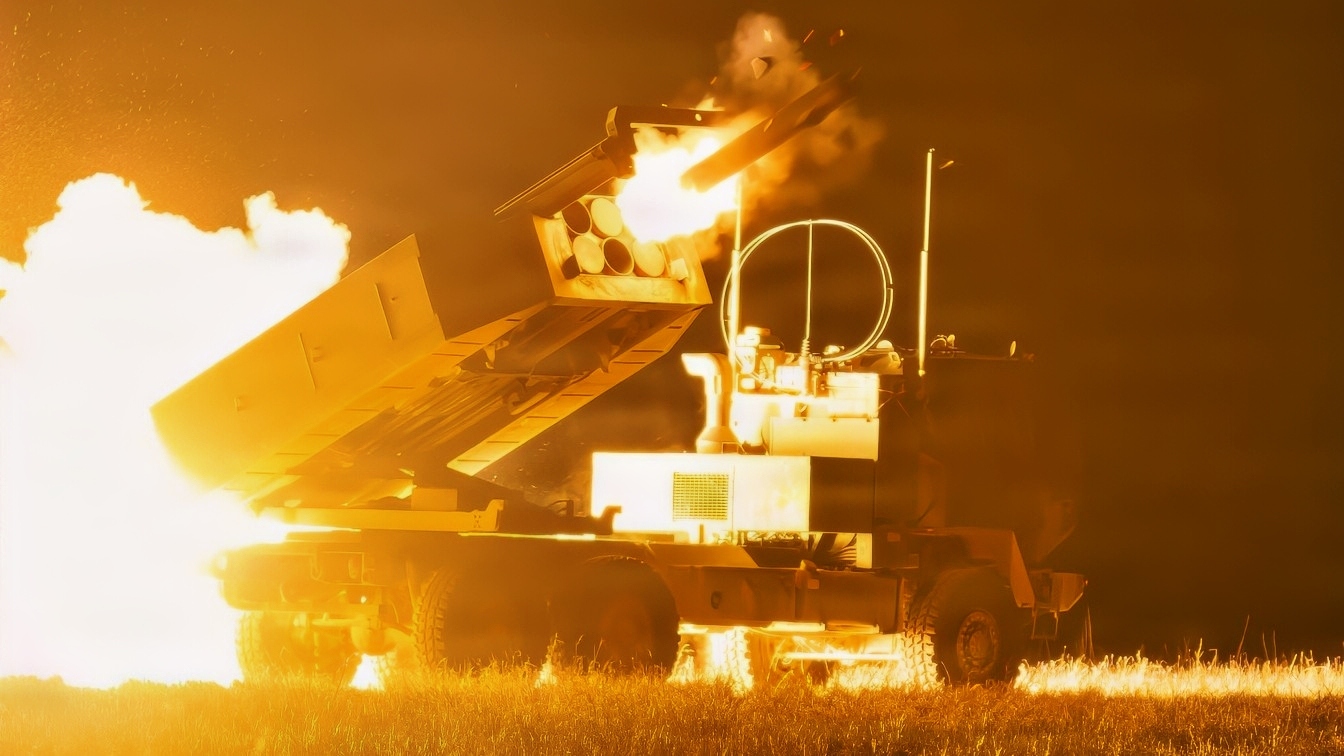
Tennessee Army National Guard Soldiers with Alpha Battery, 1-181st Field Artillery Regiment conduct a training exercise using the M142 High Mobility Artillery Rocket System (HIMARS) at Camp Shelby, Mississippi, June 9. The unit’s annual training enhances battalion readiness, focuses on mission-essential tasks and ensures Soldiers are proficient in critical skills. (U.S. Army National Guard photo by Sgt. Grayson Cavaliere)

HIMARS Rocket. Image Credit: Creative Commons.
In October, several vessels in the Black Sea were struck in NATO’s territorial waters.
Just a few weeks ago, a Greek container ship was struck in Bulgarian waters, almost certainly by a Russian drone.
While Moscow has not claimed responsibility for the attacks, the incidents are widely understood as a massive escalation on Russia’s part and are likely a test of NATO’s red lines.
Attacks in the Black Sea
In October, seven strikes against cargo ships were recorded near Bulgarian and Romanian territory. Afterward, NATO said it would deploy maritime patrol aircraft, radars, and drones to deter future attacks.
However, three days later, another container ship was struck.
On October 28, yet another ship was struck, bringing the total up to nine ships in October.
The ship, a Greek-built container ship sailing under the Liberian flag, was struck while sailing in Bulgaria’s exclusive economic zone (EEZ).
The ship’s owner, Contships Management, confirmed that all the crew members, 14 Filipinos and four Ukrainians, made it to shore safely.
The ship, along with its 421 cargo containers, sank after being struck by three naval drones.
Some estimate that around two dozen international seafarers have been killed in October by Russian strikes.
While the Russians have not claimed responsibility for the attacks, almost everyone, even pro-Russian channels, unanimously agrees that Moscow is likely the culprit.
According to Ambrey, a global maritime risk management firm, footage from the attack appears to confirm that the Greek container ship was struck by a Russian unmanned surface vessel (USV).
The attack, Ambrey told Reuters, was likely carried out by a Russian Navy Murena-300S USV.
According to the Bulgarian Navy, defense authorities were alerted to the attack by a French patrol aircraft, but were unable to prevent it before it was too late.
The attacks are interpreted as a major escalation on Moscow’s part, which has been increasing its long-range attacks against Ukraine in 2026.
The Russians, for their part, claimed Europe was escalating the war because of its support for Kyiv.
Testing NATO’s Resolve
Due to constant attacks on Ukraine’s ports in the Odesa and Mykolaiv regions, Ukraine routes its maritime trade through the Sulina Canal in Romania.
Many of the cargo ships hit in October were either anchored near the Sulina Canal or sailing to or from it. One ship was struck in Romania’s territorial waters, while the other was struck in Romania’s or Bulgaria’s EEZ.
Experts in the West suspect Moscow is probing NATO’s red lines, given the alliance’s hesitancy to escalate. “This is about testing these red lines, with full awareness that we will do everything possible to take the most minimal measure,” said Iulia Joja, director for the Black Sea program at the U.S.-based Middle East Institute think tank.
NATO officials claimed Russia was trying to undermine support for Kyiv, saying Moscow’s actions were a national security threat and that the alliance’s support for all its members, especially those along the Black Sea, was unshakable.
The Black Sea is a critical trade route for both NATO and Ukraine. Romania relies on its ports for a large share of its exports and is home to the offshore Neptun Deep project, which aims to make Romania the EU’s largest gas exporter next year.
According to Bucharest, Neptun Deep was approached by a naval drone, likely Russian, in August amidst fears of Russian sabotage operations.
Ukraine is likewise heavily dependent on the Black Sea to export its large grain reserves. Since 2022, most of Ukraine’s ports have been rendered inoperable.
Despite efforts to find alternative routes, its grain exports have shrunk from 2.1 million tons last year to only 0.81 million tons this year.
Russian exports through the Black Sea have similarly suffered, falling from 4.47 million tons of grain last year to only 0.3 million tons this year.
Moscow has since considered exporting grain through its northern Arctic ports.
Food Crisis on the Horizon
Both Russia and Ukraine are major grain exporters.
However, Black Sea attacks have significantly reduced grain exports from both nations. Several nations, including Turkey, India, and Egypt, have pushed for a maritime ceasefire to allow grain exports to recover.
The proposal is supported by the U.S., which is seeking to minimize economic fallout amid high oil and fuel prices.
Russia, however, has rejected the proposal, stating that such a ceasefire would only provide respite for Kyiv and allow it to continue stocking up on weapons and ammo.
Russia has targeted vessels in the Black Sea since 2022.
However, its strikes in the region have ramped up substantially this year following Ukrainian attacks against commercial ships in the Sea of Azov.
In the summer, Ukraine caught Russia off guard after launching 137 attacks against civilian ships in the Black Sea and the Sea of Azov.
Russia retaliated by launching near-daily attacks against port infrastructure in Odesa and striking any ship sailing to or from Ukraine.
As a result, Ukraine’s maritime imports/exports have fallen dramatically.
Now, however, Russia is widening its attacks, targeting vessels supplying Kyiv through NATO ports.
About the Author: Isaac Seitz
Isaac Seitz, a Defense Columnist, graduated from Patrick Henry College’s Strategic Intelligence and National Security program. He has also studied Russian at Middlebury Language Schools and has worked as an intelligence Analyst in the private sector.


