

Iran’s commanders believe round two (three?) against the US is coming. They want everyone to know they’re ready. According to a recent article on CNN, Tehran has spent the past month broadcasting that it is preparing for another round of war with the United States.
Revolutionary Guards spokesman Hossein Mohebbi set the tone in late September, saying, “The world will be amazed.” He added that the war isn’t over, that the IRGC has prepared itself for a long fight, and that Iran has new targets it hasn’t hit yet.
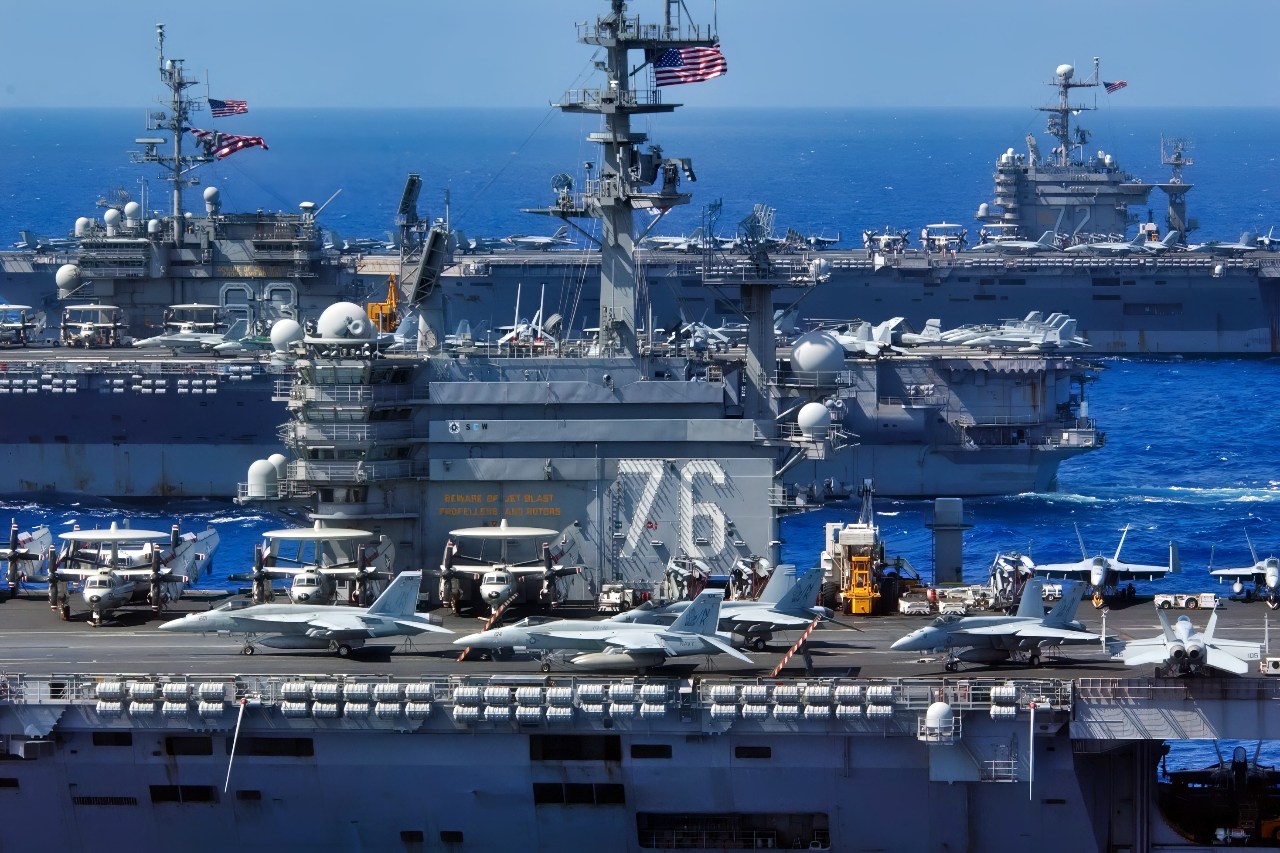
USS Ronald Reagan (CVN 76), USS Kitty Hawk (CV 63), and USS Abraham Lincoln (CVN 72) cruise side-by-side in the Philippine Sea June 18, 2006, during exercise Valiant Shield 2006. The joint exercise consists of 28 naval vessels, more than 300 aircraft, and approximately 20,000 service members from the Navy, Army, Air Force, Marine Corps and Coast Guard. (U.S. Navy photo by Chief Photographer’s Mate Spike Call) (Released)
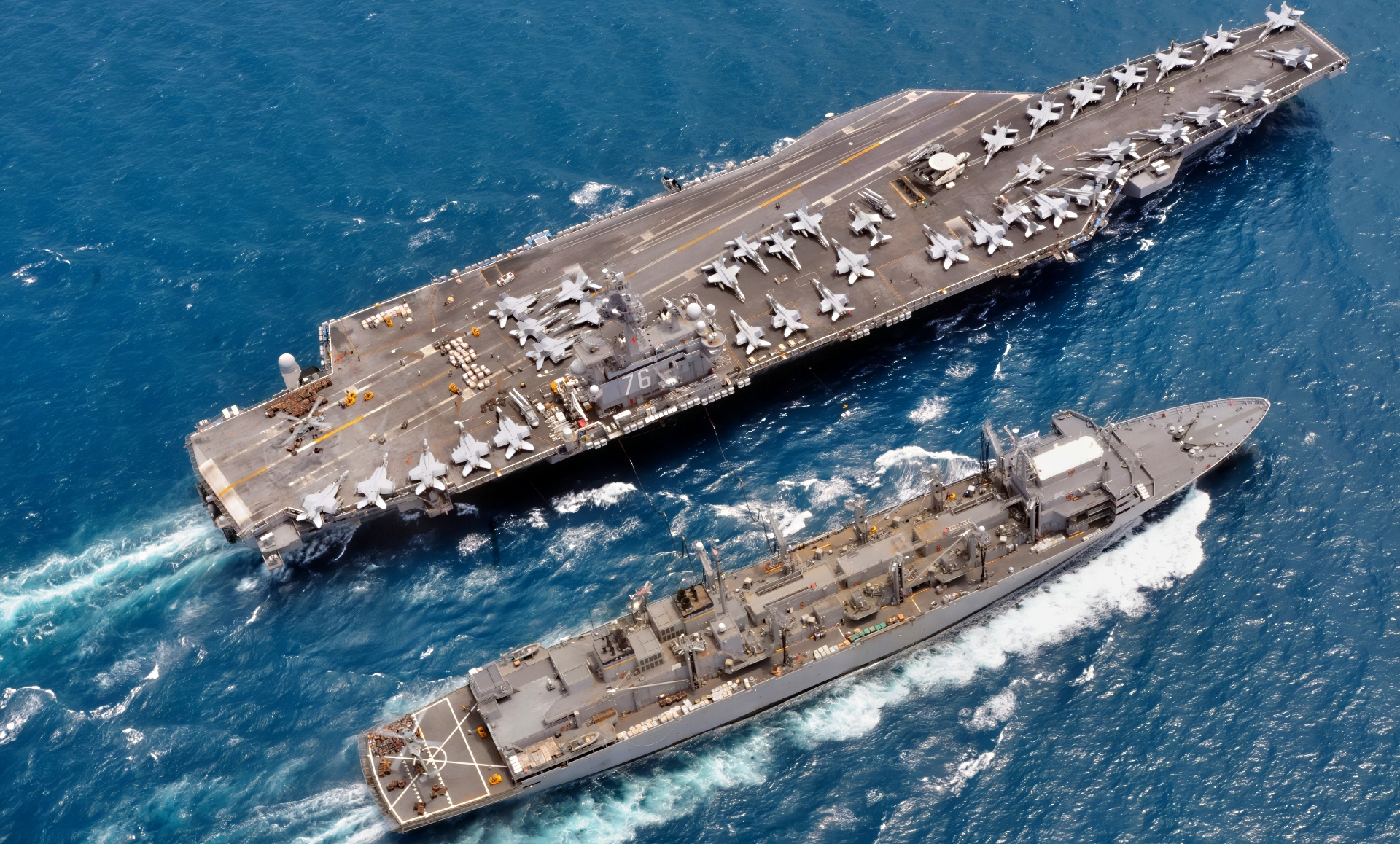
(August 15, 2008) With SH-60 helicopters moving pallets of supplies both USS Ronald Reagan (CVN 76) and USNS Bridge (T-AOE 10) work together during a replenishment at sea or RAS. With Reagan’s six galleys and approximately 4,100 Sailors it takes a lot of produce to feed that many folks and the Nimitz-class aircraft carrier got what it needed from USNS Bridge to do so.
The Ronald Reagan Carrier Strike Group is on a routine deployment in the 7th Fleet area of responsibility. Operating in the Western Pacific and Indian Ocean, the U.S. 7th Fleet is the largest of the forward-deployed U.S. fleets covering 52 million square miles, with approximately 50 ships, 120 aircraft and 20,000 Sailors and Marines assigned at any given time.
U.S. Navy photo by Senior Chief Mass Communication Specialist (SW/NAC) Spike Call
That’s a lot of typical chest-thumping from a country whose economy is in free fall and close to collapse.
But dismissing it as mere Iranian bluster would be a mistake.
The Threats Are Getting Specific
CNN reports that Iranian commanders have stepped up public claims of large stockpiles of new weapons, ready to be used against targets beyond the region if the U.S. resumes the conflict that began in February.
Last week, Mohsen Rezaei, head of Iran’s Supreme National Security Council, warned that Iran would hit U.S. assets in the region, including inside the UAE, in response to any new strikes.
That isn’t an empty threat aimed at the Emiratis.
During the first round, Iran fired more than 2,500 missiles and drones at the UAE alone, more than it launched at any other country, Israel included.
Iran has also signaled a more offensive doctrine, suggesting it won’t wait to absorb the first blow and could strike pre-emptively.
Last week, IRGC social media accounts showed nationwide exercises that included launching 30 ballistic missiles in a single salvo.
Thirty at once.
That’s a saturation number.
It’s designed to overwhelm interceptor batteries, and it’s the kind of math that keeps air defense planners awake.
Ramstein and RAF Bases on the Target List?
The most eye-opening part of the CNN piece involves Europe.
Farzin Nadimi of The Washington Institute said that if Tehran chose to use its newer long-range missiles against Europe, likely targets include U.S. forces at airbases in England and the logistics hub at Ramstein in Germany, the largest U.S. military installation outside the United States.
He added that Iran would probably save that option for the very top of the escalation ladder.
Nadimi also raised the possibility of coordinated drone swarms that use cameras, datalinks and AI to talk to each other and adjust speed and flight paths to beat jamming and air defenses.
However, he noted Iran hasn’t demonstrated those capabilities yet.
Here’s what makes the England angle more than theoretical.
Last week, British Prime Minister Andy Burnham told Parliament that an attempted attack on an air force base in England was “almost certainly directed” by the IRGC.
Iran doesn’t need a ballistic missile to reach a base in Britain if it can send operatives.
The Strait of Hormuz Is Already Hot
While the commanders talk, the IRGC Navy is acting.
Iran International reported that 12 vessels were attacked between October 5 and 11 in and around the Strait of Hormuz, six of them on a single day.
Rear Admiral Ali Azmaei warned that Iranian forces would sink U.S. warships approaching the strait and said they were “counting down” to a confrontation. CENTCOM fired back that American and partner forces clearly control the waterway.
Analysts believe that the timing is deliberate.
President Trump has said the U.S. won’t strike Iran before the Nov. 3 midterms, and Tehran has been pushing the envelope, testing how far it can push in that window, with Brent crude hovering just under $108 a barrel.
Meanwhile, Trump told Newsmax he may have to go after Pickaxe Mountain, the fortified underground site near Natanz, amid reports that planners were weighing the GBU-43/B MOAB.
That particular bomb would not be particularly useful, however, in targeting the deep recesses of the mountain, where Iran’s nuclear program was located.
The MOAB was used against targets in Afghanistan, back in 2017.
Iranian army commander Alireza Sheikh brushed that off, telling CNN that such talk was propaganda and that the Iranian people themselves are the “father of all bombs.”
Deterrence or Provocation?
Say what you want about Iran’s capability claims.
That’s beside the point.
The real danger is how they’re received.
Ali Vaez of the International Crisis Group told CNN that Tehran wants to show the next round will be fought on a wider battlefield with fewer restraints, but that what Iran intends as deterrence could look like provocation in Washington.
That is entirely their aim.
Deterrence only works if the other side believes you and decides the cost is too high.
It fails when the other side believes you and decides to hit you first.
Iran’s leadership continually misreads American politics.
Pausing strikes before an election isn’t the same as being unwilling to strike.
Iran International quoted analysts warning that Tehran may be mistaking temporary restraint for a lack of resolve.
Iran Can’t Afford This Economically
None of this changes the economics, where Tehran is reeling.
Iran loaded no crude oil onto tankers in September, the first full month without loadings since 1979, and the IMF projects its economy will shrink 7.6 percent this year.
Ordinary Iranians are bracing for the bombing to resume.
One 70-year-old Tehran resident told CNN they had charged their power banks and stocked up on water.
The regime is betting it can threaten its way out of a war it can’t pay for.
That’s a gamble with other people’s money and other people’s lives.
Many analysts, cited by the International Crisis Group, suggest these aggressive statements are a primary tool of deterrence.
By projecting extreme costs and threatening “crushing blows” beyond the region, Tehran aims to discourage Washington and its allies from launching further military operations.
Concurrently, the Trump administration has downplayed Iran’s threats, with U.S. officials asserting that Iran’s military infrastructure, drone capabilities, and economy have already been severely degraded by U.S. campaigns.
Iran says the world will be amazed.
The world has been amazed before. It usually doesn’t end the way Tehran predicts.
About the Author: Steve Balestrieri
Steve Balestrieri is a National Security Columnist. He served as a US Army Special Forces NCO and Warrant Officer. In addition to writing on defense, he covers the NFL for PatsFans.com and is a member of the Pro Football Writers of America (PFWA). His work was regularly featured in many military publications


