

On Sunday night/Monday morning, Russia launched yet another large-scale drone/missile attack against Kyiv and other regions in Ukraine.
According to reports, the Russians utilized roughly 16 ballistic missiles, none of which were shot down, that struck energy facilities and power substations in the capital city.
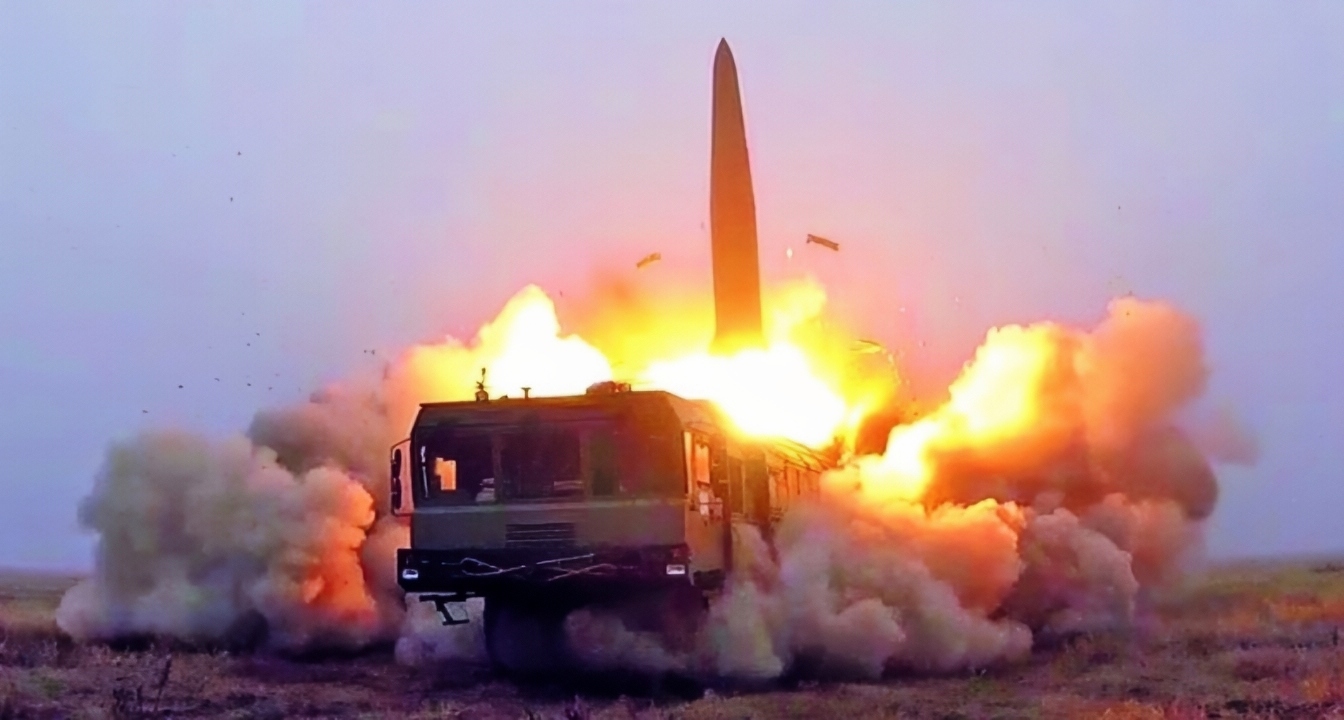
Iskander Missile Attack Creative Commons Image

Iskander-M. Image Credit: Creative Commons.
The attacks caused widespread power outages across the city, leaving about 550,000 people without power.
After the attack, President Zelenskyy claimed that Ukraine received no early warning from its Western partners.
Recently, Zelenskyy has clashed with his American counterpart over Trump’s controversial decision to import diesel fuel from Russia.
Trump previously threatened to end intelligence-sharing operations, and now Zelenskyy claims the American President has followed through.
Has the U.S. Stopped Providing Intelligence to Ukraine?
After last night’s barrage, President Zelenskyy took to social media, saying Ukraine received no prior warning about the attack. “Another Russian ballistic missile attack came in several waves overnight, and once again, there was no early warning from our partners,” he wrote on social media.
The attack used around 21 missiles, about 16 of which were ballistic missiles, while the rest were reportedly Iskander-K missiles launched from the Kursk Oblast.
Kyiv was the primary target of last night’s attack. Russian missiles hit the CHP-4 power plant along with a 330 kV substation and other facilities.
Because Kyiv still lacks ballistic missile interceptors, it intercepted none of the ballistic missiles.
However, according to the Ukrainian Air Force, three of the six Iskander-K cruise missiles were shot down by air defenses.
According to Zelenskyy, this is not the first time that the U.S. has failed to inform Ukraine of an impending missile attack.
Last week, on October 13, after a previous missile attack, the Ukrainian President claimed that the West had not warned Kyiv of the impending attack. “There was also a particularly vile ballistic missile strike on Kyiv – five missiles that hit civilian infrastructure,” Zelenskyy wrote. “Unfortunately, we received no early warning from our partners about this strike.” Previously, the Ukrainian President told NPR that the White House threatened to cut off intelligence-sharing operations if Kyiv continued its attacks against Russia’s oil infrastructure.
The Trump administration denied that it made such threats, claiming that it was still providing Ukraine with information on upcoming ballistic missile attacks. “We are helping them, and we are sharing intel; we want the war to end. So, we’re working with them and with Russia on getting the war to end,” Trump told reporters on October 13.
Contradictory Claims: What’s Going On Behind the Scenes?
The U.S. has since denied any claims that Washington has ceased sharing intelligence with its Ukrainian partners.
On Monday, Secretary of State Marco Rubio was asked whether the U.S. had stopped sharing information on Russian ballistic missile launches, as Zelenskyy claimed, and he denied it. “I don’t know where he’s getting these things from or why he’s saying these things to the press. You should go back and ask him. There’s been no pause.”
Likewise, some Ukrainian sources claimed Kyiv received prior warning of last night’s strike, or at least it could be interpreted that way. On October 18, before last night’s attack, the Ukrainian monitoring channel Nikolaivskii Vanyok, associated with Ukraine’s SBU, wrote, “The threat of ballistic missiles remains relevant. As you can see, the ‘experts’ have stopped playing around with the data, and for now, the warnings are coming in time.”
Contradictory claims from U.S. officials, Zelenskyy, and various monitoring channels have created significant ambiguity, making it difficult to determine what is actually happening.
Has the U.S. actually stopped sharing intelligence, or is Zelenskyy lying?
Adding to the confusion, many Telegram channels and some journalists don’t know how intelligence-sharing operations between Washington and Kyiv actually work.
Satellites heavily monitor Russian ballistic missile launches. Western, particularly American, satellites track movements of Russia’s missiles and inform Kyiv of signs of impending missile attacks, usually within 24 hours.
Furthermore, Western satellites detect ballistic missile launches and inform Ukraine’s SBU, which then activates air alarms across the country.
Satellite Intelligence: an Advantage Only America Can Provide
This method works fine most of the time, but it isn’t perfect, which is probably the main source of confusion.
For one reason or another, Western satellites occasionally fail to pick up launch data.
For example, on October 2, a single Iskander-M ballistic missile was fired from the Rostov Oblast in Russia, which the West did not detect.
Other types of missiles, such as the RM-48U launched from an S-400 air defense platform, are also harder for Western satellites to detect for one reason or another.
When Kyiv receives no warning of these attacks, it is often framed as Trump refusing to provide intelligence, rather than the simpler answer: Western satellites simply failed to detect the attack.
Regardless of what’s happening behind the scenes, Kyiv needs U.S. intelligence.
The U.S. maintains the most military/intel satellites of any NATO member.
France, which also provides intelligence to Kyiv, operates around 17 military satellites, while Germany operates around 10.
In contrast, the U.S. operates around 605 military and intelligence satellites.
The U.S. has unique ISR capabilities that Europe cannot match anytime soon.
These capabilities have been instrumental to Ukraine’s defense efforts.
Without them, the Ukrainian military wouldn’t collapse, but it would be at a major disadvantage in an already uphill battle.
About the Author: Isaac Seitz
Isaac Seitz, a Defense Columnist, graduated from Patrick Henry College’s Strategic Intelligence and National Security program. He has also studied Russian at Middlebury Language Schools and has worked as an intelligence Analyst in the private sector.


