


Russia has been issuing threats to Europe in recent weeks, like never before since the end of the Cold War. A new report from NBC News says Baltic nations bordering Russia are on alert.
In Lithuania, NBC reports that a volunteer paramilitary organization called the Lithuanian Riflemen’s Union is making its presence felt to prepare civilians for a potential national emergency — namely, a full-on invasion by Russia.
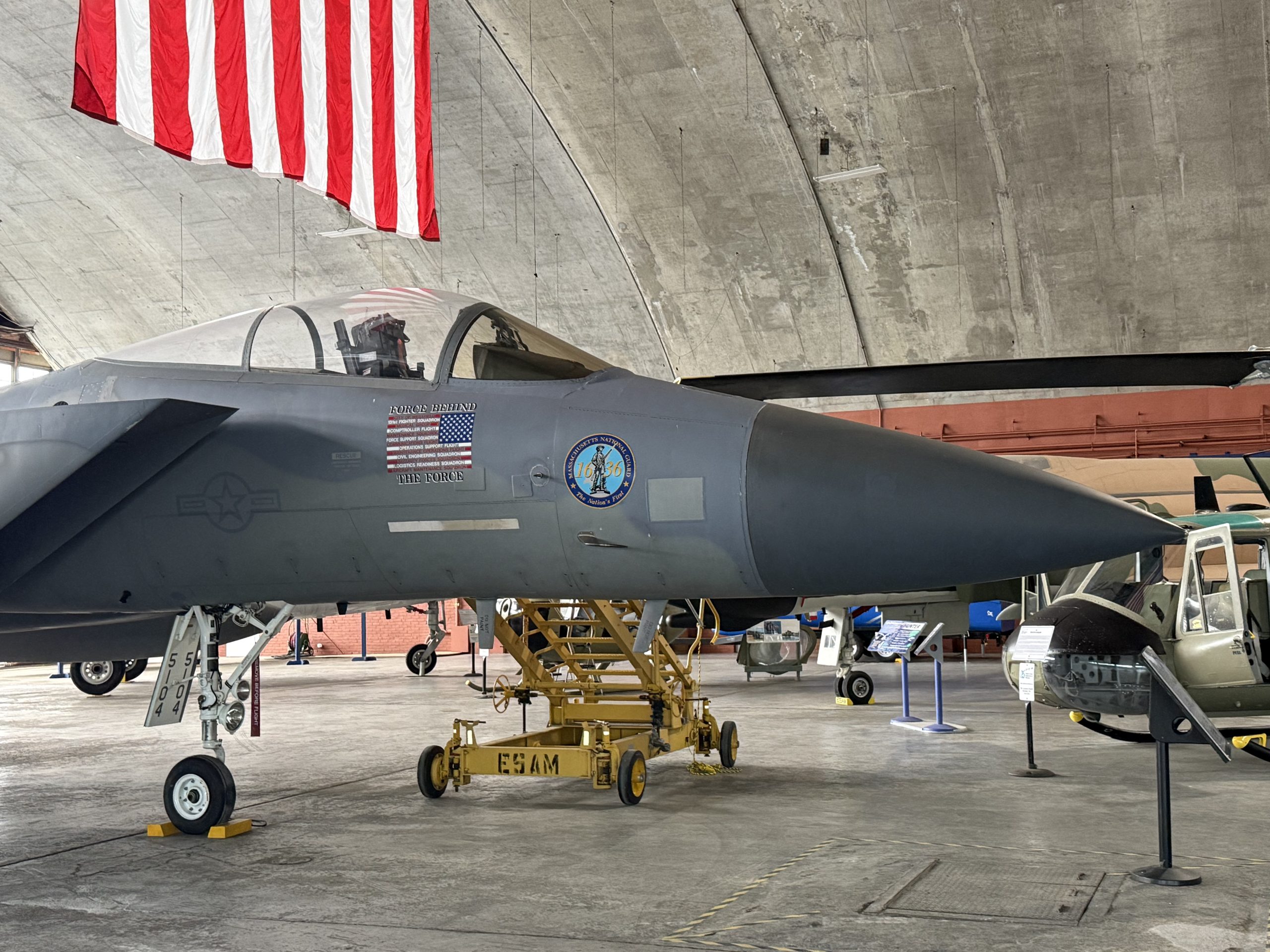
F-15 in museum. National Security Journal Photo.
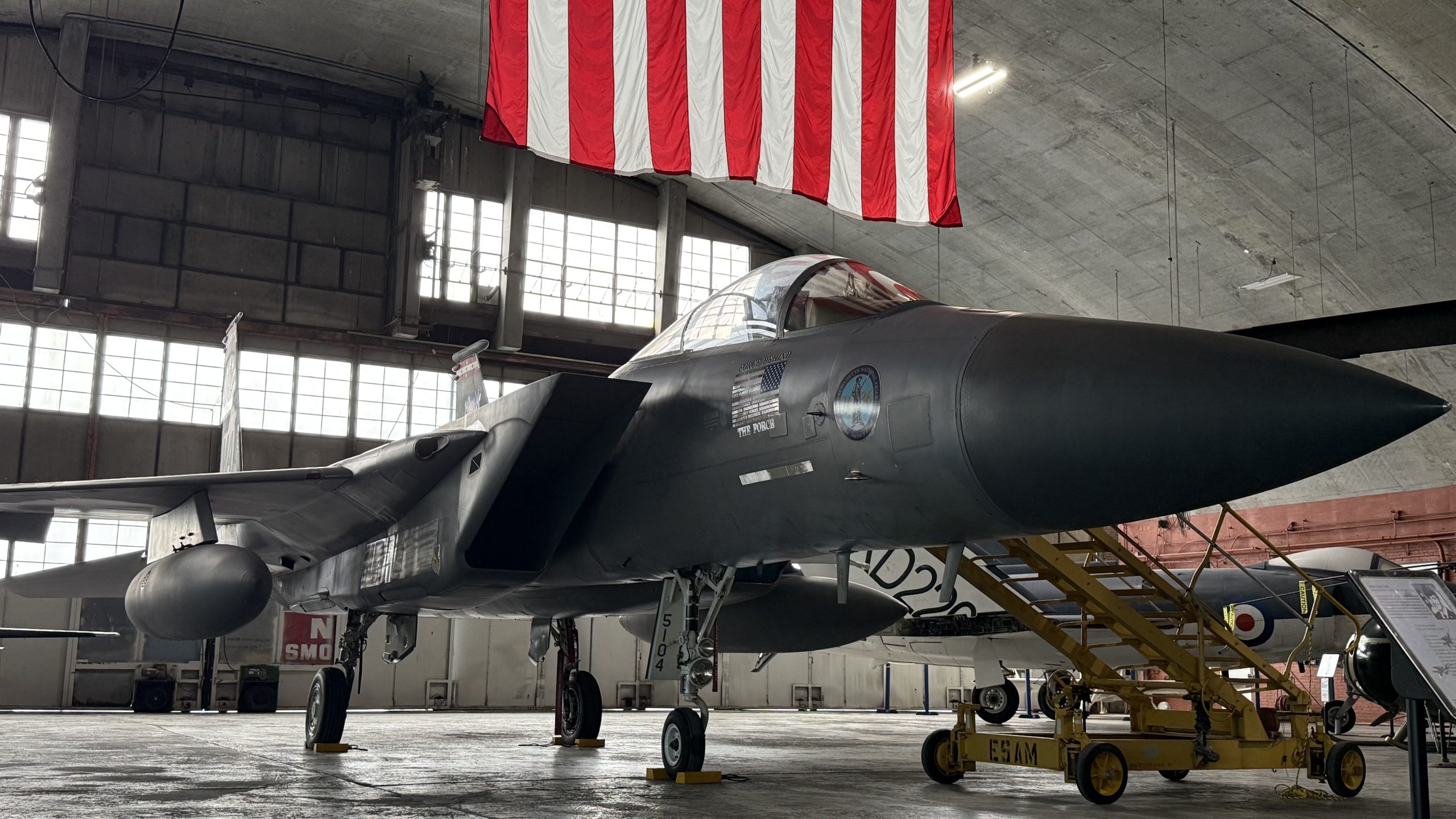
F-15 fighter at Museum. National Security Journal Photo.
The report said that 18,000 new volunteers have joined the Riflemen’s Union since 2025.
That is a growing worry throughout Europe, even in NATO countries, as Russia has been seen as engaging in “hybrid warfare,” with drones and other Russian weapons making incursions into NATO airspace.
A Near-Miss
In September, a Russian drone struck a passenger train near Ukraine’s border with Poland. Former British Prime Minister Boris Johnson, along with other foreign dignitaries, was on a train that had just left the station.
In contrast, former CIA Director and General David Petraeus was at the station at the time, although neither man was hurt.
In another recent incident, a drone containing explosives was found in August at Leipzig/Halle airport in Germany.
Russia, however, has denied and maintained deniability for such attacks.
Lithuania is located between Russia-allied Belarus and Kaliningrad, a Russian “exclave” that Russia has been claiming, over the last two weeks, that NATO is planning to attack.
This appears to stem from a Sky News miniseries broadcast in the U.K. in which analysts war-gamed a fictional attack on that location, as well as an op-ed published in a British newspaper.
This led Russian embassies in Europe, and later President Vladimir Putin himself, to threaten NATO countries with a nuclear response, should they threaten Kaliningrad.
In a note to NATO, the Kremlin said Russia threatened to use its “entire arsenal of forces and capabilities at its disposal, including nuclear weapons,” should the exclave come under NATO threat.
However, NATO made clear that it is a defensive alliance and has no plans to engage in such an attack.
Russia’s recent belligerence toward Europe has prompted a rebuke on the op-ed page of The New York Times.
A Dangerous Game
Lawrence Freedman, an emeritus professor of war studies at King’s College London, writes that while some wonder whether Putin would really launch a war in Europe, they asked before February 2022 whether he would launch a war in Ukraine.
Freedman himself had doubted that Russia would invade Ukraine but did predict that Ukraine would fight back, that the United States and Europe would provide backing for the Ukrainian side, and that Putin’s Russia would find itself “bogged down in a long conflict from which he would struggle to extricate himself and his army.”
Freedman writes that he is reminded of those days today, as Russia engages in hybrid warfare, and rumors once again indicate that they could launch a more conventional attack on Europe.
Russia’s recent attacks, despite the deniability, are “getting close to the edge,” the op-ed author writes, leading to a situation that threatens to “take us to a new and more dangerous place.”
Why Russia is Doing It
Russia’s goal, the op-ed argues, is to bring about a positive end to its war effort, while also punishing the NATO allies that have been backing Ukraine since the war began.
One silver lining for Europe is that Russia’s military and manpower are exhausted after four and a half years of war, and launching another military adventure so quickly would likely stretch the Russians even further. However, Freedman notes that Ukraine’s rearmament is in its “early stages.”\
Freedman also cited recent analysis by the Institute for the Study of War, which stated that Russia is “operating within a war framework against Europe while Europe continues to function within a peace framework.”
Perhaps justifying Lithuania’s preparations and its Riflemen’s Union, Freedman argues that a Russian attack wouldn’t necessarily mean a full war in Europe, but possibly “a limited move against one of the Baltic States, for which Russia could have sufficient forces.”
But of course, an attack on a NATO country would be considered an Article 5 violation, and risk a wider war.
About the Author: Stephen Silver
Stephen Silver is an award-winning journalist, essayist, and film critic, and contributor to the Philadelphia Inquirer, the Jewish Telegraphic Agency, Broad Street Review, and Splice Today. The co-founder of the Philadelphia Film Critics Circle, Stephen lives in suburban Philadelphia with his wife and two sons. For over a decade, Stephen has written thousands of articles on politics, national security, technology, and the economy. Follow him on X (formerly Twitter) at @StephenSilver, and subscribe to his Substack newsletter.


