

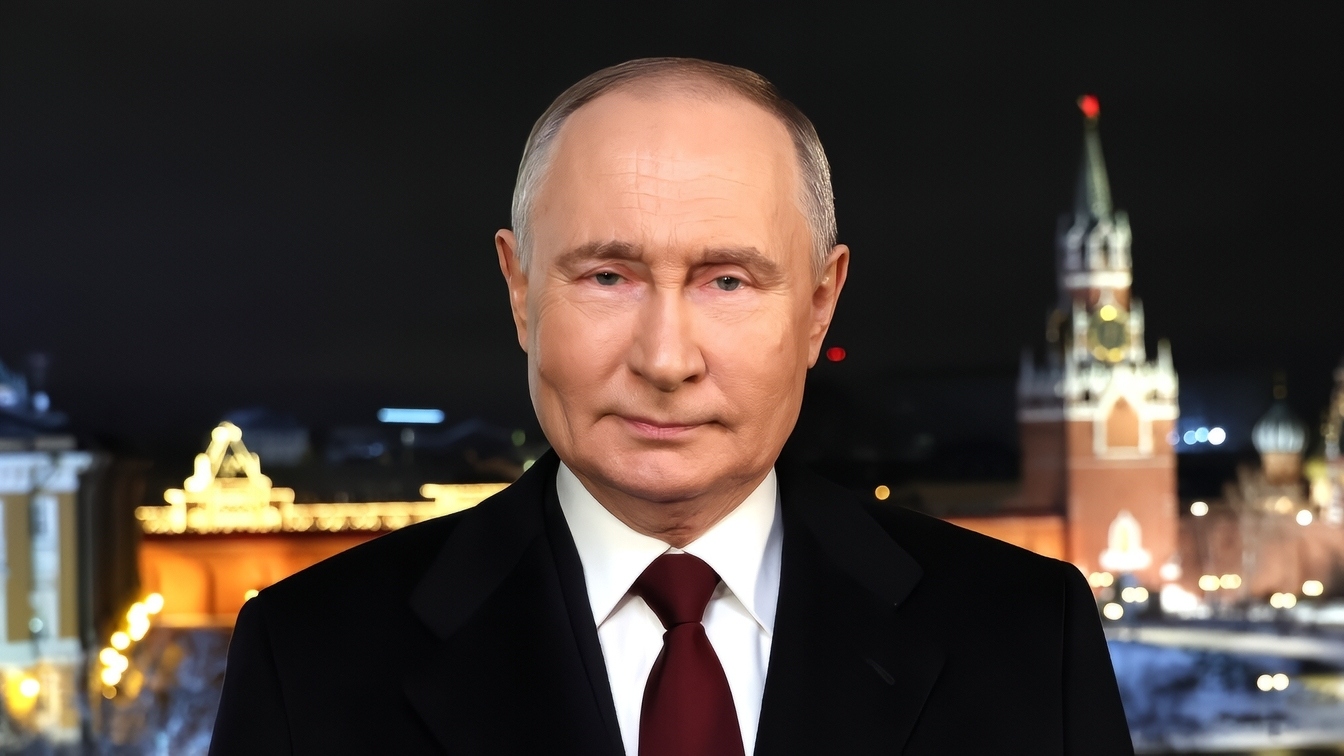
Russia is once again proving just how little transparency there is in determining the ownership of major money-making entities.
The daily attacks by Ukrainian drones on the warehouses in city after city that belong to the Russian e-commerce giant Wildberries have led to several inquiries about the company.
Putin State Media Photo
Putin in 2025 Russian State Media Photo
At the top of the list was the issue of who really owns the company and benefits from the enormous profits it used to generate.
That story has some surprising findings. But first, the question is why the company is so powerful and has such economic heft that the senior people around Putin would be ready to kill one another to become the top owners, at least according to some reporting and experts.
The revelations have all the internecine warfare of a Prohibition-era crime novel.
Ukraine has stated that the reason it hit the company’s different warehouse locations with a vengeance is that Wildberries was selling numerous items that directly supported Russia prosecuting its war against Ukraine.
Soldiers were buying helmets, boots, body armor, tactical backpacks, camouflage uniforms, two-way radios, tactical medical kits and field rations from the company.
Then there were the major components and other items that are largely shipped in from the People’s Republic of China (PRC) and are used in the production of drones.
In addition to fully assembled commercial and FPV drones, the company sold electric motors, navigation systems, drone components, signal boosters, thermal-imaging cameras, and specialized payload delivery of grenade-drop rigs.
Wildberries was so actively engaged in supporting the war effort that there was a special page on the company’s website showing combat equipment – the “Everything for the SVO [Special Military Operation]” section.
Certain products were listed with specific endorsements based on their proven use in the war with Ukraine – like “tested in the SVO” or “SVO fighters’ choice.”
But by attacking this company’s facilities, Ukraine is not just undermining Russia’s ability to wage war. Attacking this company is also an act of undermining the ability of Russia’s day-to-day economy to function.
Wildberries is not just Russia’s largest online marketplace; it has been called “a cultural force reshaping consumer behavior across 11 time zones.” With 4.5 million daily orders and a user base of 48 million or more monthly shoppers, it has also provided foreign sellers with a direct pipeline to the Russian market, which is desperate to acquire global brands.
Forming The Common Fund
But from the view of the Russian Government’s leadership, the most important aspect of the company is that it has become a “common slush fund” for high-ranking Russian government officials, according to reporting and expert analysis.
Through these officials’ involvement and the power of their positions, Wildberries was quickly transformed from a marketplace into a multi-industry holding company, with the legal head being Aleksei Gromov, the First Deputy Chief of Staff of the Presidential Administration.
Several media outlets had also previously reported that the other co-owner of the company is Anton Vaino, who is himself the Chief of the Russian Presidential Administration.
The executives of the parent holding company RWB are corporate officers Robert and Levan Mirzoyan.
They also reportedly visit Gromov two to three times per week, indicating that he is in charge of the operation, and they refer to him as “boss” or “senior.”
This arrangement was all originally formed up in the summer of 2024, writes exiled Putin opponent Mikhail Khodorkovskiy.
Everything began when Wildberries announced the planned merger with Russ Group, an advertising company that was owned by the Mirzoyans, who have ties to billionaire Senator Suleiman Kerimov.
Kerimov, together with the two brothers, had earlier decided to invest in the purchase of Russ Outdoor, which was one of Russia’s largest outdoor advertising operators.
They essentially pooled their funds for the purchase, which then led to their acquisition of Wildberries.
As a result, Gromov, through his acquaintances Kerimov and the Mirzoyans, also decided to invest in the purchase of Russ Outdoor. His son, Danila, then became deputy director of the Russ Outdoor group of companies.
Kerimov and the Mirzoyan brothers are the key figures behind the corporate takeover and merger. The latter also act as managers and junior partners representing Kerimov’s broader financial and political interests.
The “Family” Business
These family ties in the ownership and their links to Vaino and Gromov are why the merged entity has received what looks like unlimited support from the Kremlin.
Gromov was even originally attempting to establish Wildberries as a monopoly—a single operator for all digital outdoor advertising—by having a bill to this effect passed in the Russian parliament.
According to one source who was quoted for a long profile last month of the company, “during the fight over this bill, the Mirzoyans never left Gromov’s office.” The rest of the saga of how Wildberries’ current corporate ownership came to be reads like the history of an organized crime family.
This family business now includes Konstantin Mayor, who is the husband of Putin’s niece.
It is also due to Vaino’s support for this ownership bid that Kerimov was able to defeat the efforts by Chechen leader Ramzan Kadyrov in the “war” for control of Wildberries. At one point, the Chechen strongman even declared a mafia-style “blood feud” against Kerimov.
Which translates into a simple equation, said Konstantin Sonin, an exiled Russian economist and professor at the University of Chicago. “It is pretty obvious that large stakes in the company are now owned by people in Putin’s administration,” he said.
When Ukraine strikes these warehouses, it is indeed more than just an attack on a supplier of the Russian military or the Russian consumer economy as a whole.
It is an attack on the pocketbooks of the Kremlin’s ruling order. Every burning warehouse means more of their personal fortunes are going up in smoke.
About the Author: Reuben F. Johnson
Reuben F. Johnson has thirty-six years of experience analyzing and reporting on foreign weapons systems, defense technologies, and international arms export policy. Johnson is the Director of Research at the Casimir Pulaski Foundation. He is also a survivor of the Russian invasion of Ukraine in February 2022. He worked for years in the American defense industry as a foreign technology analyst and later as a consultant for the U.S. Department of Defense, the Departments of the Navy and Air Force, and the governments of the United Kingdom and Australia. In 2022-2023, he won two awards in a row for his defense reporting. He holds a bachelor’s degree from DePauw University and a master’s degree from Miami University in Ohio, specializing in Soviet and Russian studies. He lives in Warsaw. The opinions expressed in this op-ed are the author’s own.


