

The World Is Upside Down: Ukraine Is Defeating Russia in War of Attrition – Spend enough time covering former KGB Lt. Col. Vladimir Putin’s increasingly disastrous war, and eventually you will witness a knowledgeable person in a position to deliver learned opinions make a statement that you are sure must be an April Fool’s trick come early. Just such a statement has come in a commentary from the infamous RAND Corporation, the US Air Force’s captive Federally Funded Research and Development Center (FFRDC).
“Ukraine is winning the war against Russia through a strategy of attrition,” is the eye-popping phrase from the two RAND authors, Gian Gentile and Andrew Radin. It will certainly make people read twice—if not three times—and then reach for a tissue to clean their eyeglasses to make sure they are not seeing things.
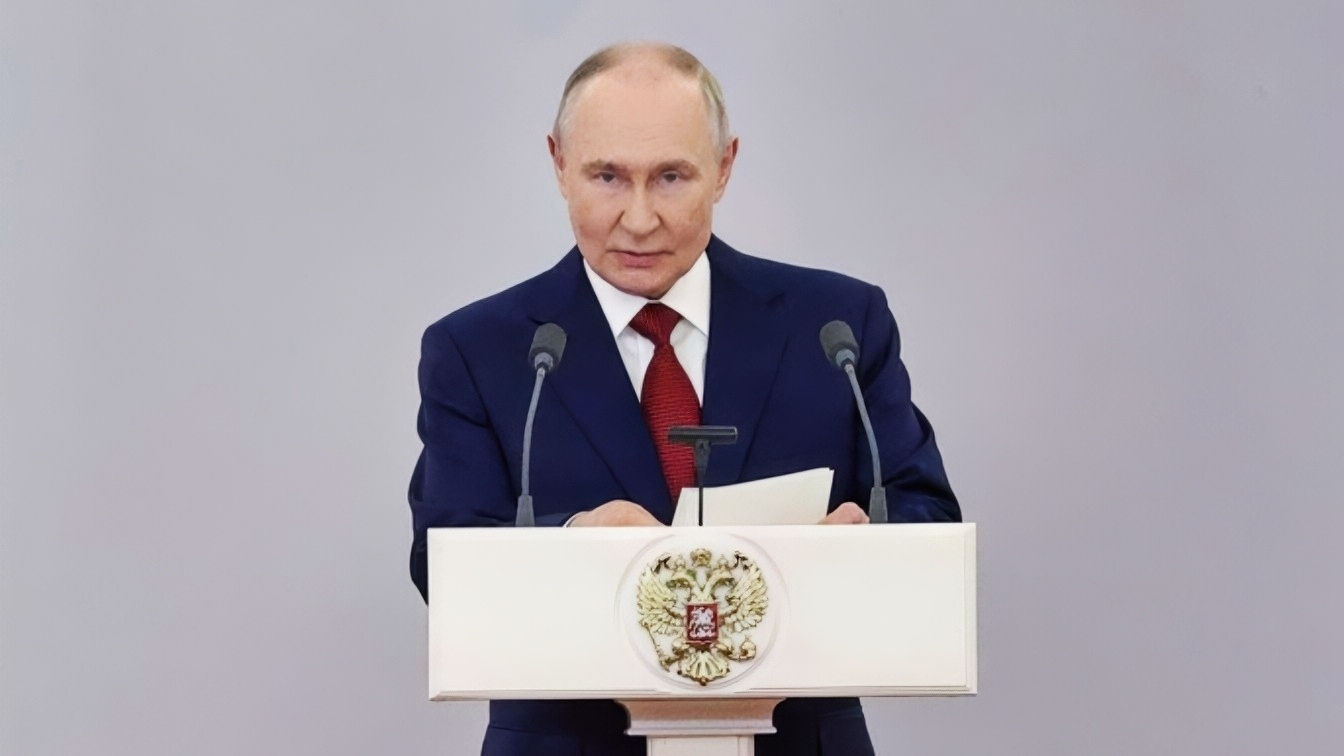
Putin Speaking in July 2026 Creative Commons Photo
That this assessment is somewhat of a shock is an understatement.
Since the day that Russia invaded Ukraine in February 2022, most of those in the world of military analysis have always declared that, should the conflict come down to being one of attrition warfare, Ukraine was doomed.
Any effort by the two sides to grind each other down in the conflict would have to favor Russia, was the constant drumbeat I and others have been hearing for years. “They [the Ukrainians] do not have enough people,” was the most popular observation you heard about the war, which was based on the reality that its population is three times the size of Ukraine’s.
Then you have the madness of President Vladimir Putin. He seems to have no hesitation about throwing his soldiers into suicidal attacks in which units can suffer 80 percent losses or greater – in just one assault – to gain small parcels of land. The Russian population as a whole does not seem to be bothered either.
This is possibly due to these horrendous losses being visited on those from the impoverished hinterlands of Russia, or they are North Koreans sent by the Great Kin Jong Un to die for Russia, or groups of Africans, Indians, or Nepalese hoodwinked into being drafted into Putin’s military. The sons of bankers, businessmen, and billionaire party hacks back in St. Petersburg and Moscow – the people who “really matter” to Putin – are not the ones coming back home in body bags.
Why Ukraine is Winning
But despite these disparities in who is bigger in the Russia v. Ukraine fight, there are indications that the trend of the war is today moving in Ukraine’s direction.
More than one European intelligence service’s report assesses that, among a host of problems, Russia’s economy is tanking.
Its financial lifeline for years has been its massive oil industry, an export business that is such a major revenue generator that the late US Senator John McCain once stated that Russia “was a gas station masquerading as a country.” And that revenue source is under constant attack as Ukraine hits oil industry sites deep inside Russia on a daily basis. Fuel shortages are becoming so acute that the occupied region of Crimea has resorted to petrol rationing.
And this is only the beginning; Ukraine’s long-range drones are becoming increasingly long-range. Ukraine’s President Volodymyr Zelenskyy has recently announced that the country has successfully tested drones with a range of 3,000 kilometers and that new models with a range of 10,000 kilometers will be ready by next year.
Russia is in an increasingly dire situation with its major industries under daily attack. And the senior leadership is now beginning to get nervous. As the RAND assessment reads, “there are very real signs of unrest within parts of the population and the Russian oligarchy.”
Reversing the Equation
But this still does not explain how Ukraine could win over Russia if the name of the game really is attrition. Ukraine’s smaller size, smaller population, and fewer resources should condemn it to eventually being overwhelmed.
But Ukraine, taking a decidedly high-technology, business-world approach to the war, has out-finessed the opposition, reversing the equation. Kyiv has found a way to neutralize the advantage of Russia’s larger population and landmass.
“Over the last two years,” write the RAND analysts, “Ukraine has developed an effective, if not necessarily novel, strategy of attrition: kill more Russian soldiers, faster. Ukraine leaders use business principles to maximize both Russian casualties and economic costs.”
The commentary focuses on how the former Minister of Defense, Mykhailo Fedorov, developed a war plan based on brutal quotas. His plan “for Ukraine has been to make Russia suffer 200 killed for each square kilometer of territory seized and eliminate at least 50,000 Russian soldiers each month.”
In the end, Ukraine could very well grind down Russia, but not just in the number of soldiers killed. It could break Russia’s will to keep on fighting by more than just inflicting such incomprehensible losses week after week.
The final point of the RAND assessment is that all of this will depend on Ukraine continuing its current strategy, expanding the range of its long-range strikes into Russia, and its partner nations continuing to support it.
About the Author: Reuben F. Johnson
Reuben F. Johnson has thirty-six years of experience analyzing and reporting on foreign weapons systems, defense technologies, and international arms export policy. Johnson is the Director of Research at the Casimir Pulaski Foundation. He is also a survivor of the Russian invasion of Ukraine in February 2022. He worked for years in the American defense industry as a foreign technology analyst and later as a consultant for the U.S. Department of Defense, the Departments of the Navy and Air Force, and the governments of the United Kingdom and Australia. In 2022-2023, he won two awards in a row for his defense reporting. He holds a bachelor’s degree from DePauw University and a master’s degree from Miami University in Ohio, specializing in Soviet and Russian studies. He lives in Warsaw.


