
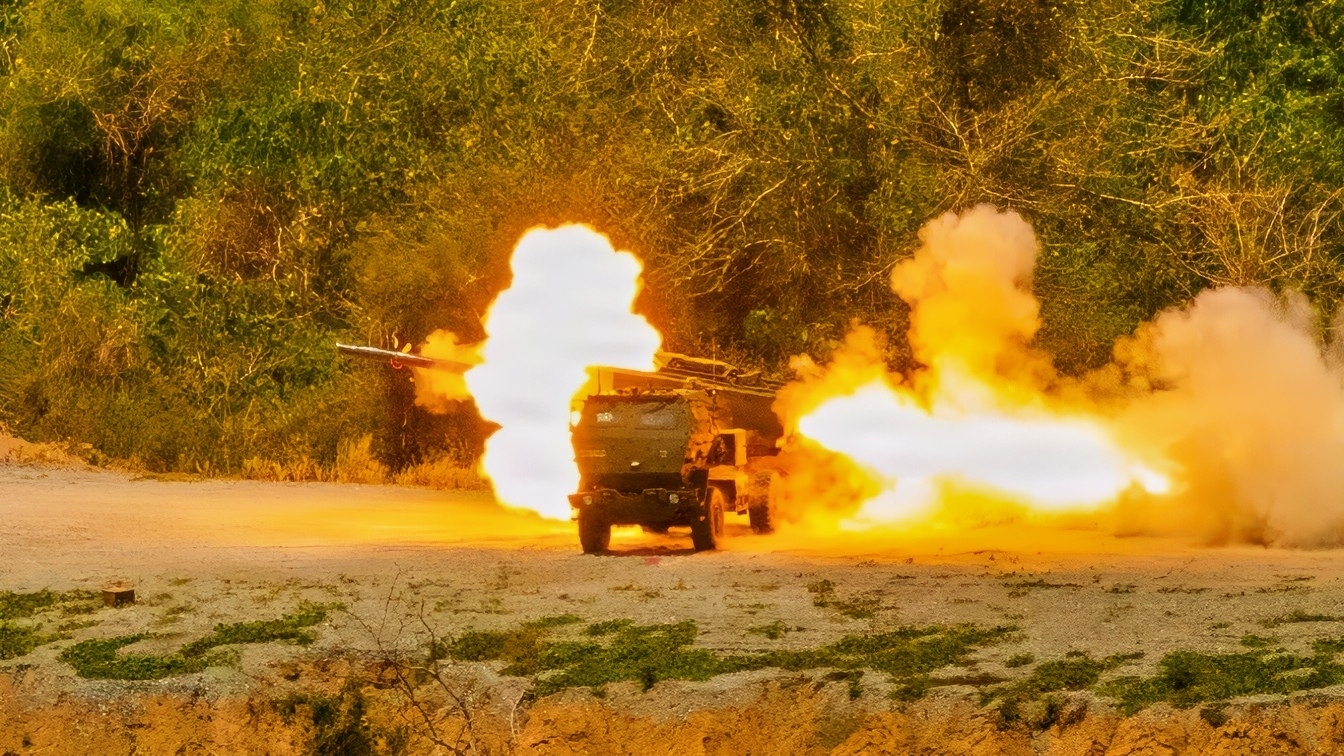
Russia continues to push back against ongoing Ukrainian long-range strikes by escalating its ballistic missile campaign, overnight launching one of its largest ballistic missile attacks of the entire war. The strikes, which carried into the morning of Sunday, July 19, saw Russian forces target sites across Ukraine’s capital city with more than 100 drones. The attack poses a great challenge for Kyiv as it seeks the rapid delivery of new Patriot interceptor missiles – the only weapon proven to be capable of reliably intercepting Russian ballistic missiles.
The overnight barrage also came less than 24 hours after Ukraine carried out yet another major long-range strike campaign inside Russia, striking logistics hubs and oil infrastructure – and even targeting logistics sites, military supply chains, warehouses, and vessels.
Putin Back in April of 2022 Creative Commons Photo
Russia Fires 41 Missiles and 125 Drones
According to the Ukrainian Air Force, Russia launched a strike that consisted of 41 missiles and 125 attack drones. Ukrainian forces also identified Kyiv as the primary target for the strikes.
According to the Ukrainian military, the missile attack included 25 Iskander-M and S-400 ballistic missiles, 10 Zircon hypersonic missiles, three Onyx anti-ship missiles, and three Kh-59/69 guided missiles. The drones included Shahed attack drones alongside Gerbera, Italmas, Banderol, and other decoy unmanned aircraft launched from multiple locations inside Russia and occupied Crimea.
Ukraine also said its air defenses intercepted 18 missiles and 108 drones, including 17 ballistic missiles. Authorities did, however, acknowledge that 23 missiles and 10 drones still struck targets across roughly 20 locations, with falling debris also causing additional damage elsewhere.
It was described by President Volodymyr Zelenskyy as one of the largest attacks on Kyiv so far.

Iskander-M. Image Credit: Creative Commons.
What Zelenskyy Said
“Last night’s attack was one of the largest Russian ballistic missile attacks to date. Kyiv and the Kyiv region were the Russians’ primary target. They had been preparing this attack for several days, stockpiling missiles. The threat, of course, remains even now, and this must be taken into account,” Zelenskyy said in a statement on X.
The Ukrainian president also used the statement as an opportunity to remind allies that Patriot interceptors are still urgently needed and that every day that new interceptors are not delivered presents new opportunities for Russia to hit back as Kyiv continues its long-range strike campaign.
“Russia is placing its wagers on ballistic missiles, and it is because of them that Putin still believes in his war. It is very important that our partners understand what is happening and that air defense missiles are needed to protect lives literally every single day. It is important to accelerate everything – both with our European partners and with the United States,” he said.
Kyiv Suffers Widespread Damage
The strikes began at approximately 1:30 am local time and continued for several hours, with explosions reported throughout the capital city. Ukraine’s State Emergency Service said that fires had broken out across multiple districts of the city, including Sviatoshynskyi, Shevchenkivskyi, Solomyanskyi, Desnianskyi, and Dnipro.
Local officials also reported that residential buildings, industrial facilities, warehouses, office blocks, a supermarket, vehicles, and a student dormitory were damaged during the strikes. Emergency crews also rescued residents trapped inside burning buildings, and firefighters spent hours bringing the fire under control.
As of Sunday morning, Ukraine said that one person had been killed in Kyiv and 16 others injured, although additional reports have indicated further casualties elsewhere in the country following separate Russian strikes that occurred near Kherson, Sumy, and Kharkiv.
Russia Uses More Ballistic Missiles
The overnight barrage was certainly large, but it was also interesting because of the composition of the weapons used. Unlike many of Russia’s largest attacks over the past year, the strike relied overwhelmingly on ballistic missiles rather than long-range cruise missiles. Of the 41 missiles launched, Ukraine said 35 were either Iskander-M, S-400-derived ballistic missiles, or Zircon hypersonic missiles, while only three were Kh-59/69 guided missiles.
It seems to reflect a shift in Russia’s strike strategy – one that appears to be taking advantage of Ukraine’s shortage of Patriot interceptors. Ballistic missiles travel at several times the speed of sound, dramatically reducing the time available for air-defense crews to respond and making Patriot systems the only reliable means of interception. By contrast, slower cruise missiles can often be engaged by a much wider range of Western and Soviet-era air-defense systems.
Ukrainian Foreign Minister Andrii Sybiha described the overnight attack as one of the largest ballistic assaults of the entire war, and suggested that Moscow is now deliberately exploiting Ukraine’s limited supply of interceptors.
Russia, it seems, is now prioritizing expending ballistic missiles at the best possible time, before Ukraine can better defend itself and make launching ballistic missiles a more costly endeavor with limited returns. Until Ukraine receives those interceptors, this may be exactly how Russia continues to respond to the ongoing long-range strike campaign ahead of a possible new assault from the north.
About the Author: Jack Buckby
Jack Buckby is a British researcher and analyst specializing in defense and national security, based in New York. His work focuses on military capability, procurement, and strategic competition, producing and editing analysis for policy and defense audiences. He brings extensive editorial experience, with a career output spanning over 1,000 articles at 19FortyFive and National Security Journal, and has previously authored books and papers on extremism and deradicalization.


