


Key Points and Summary – Retired Col. Gen. Vladimir Chirkin, former commander of Russia’s ground forces, has publicly blasted his country’s intelligence community for fatally misreading Ukraine before the 2022 invasion.
-In a remarkably blunt interview with RBC Radio, Chirkin said Moscow went to war “once again unprepared,” relying on assessments that claimed 70 percent of Ukrainians would welcome a pro-Russian regime—when the opposite proved true.
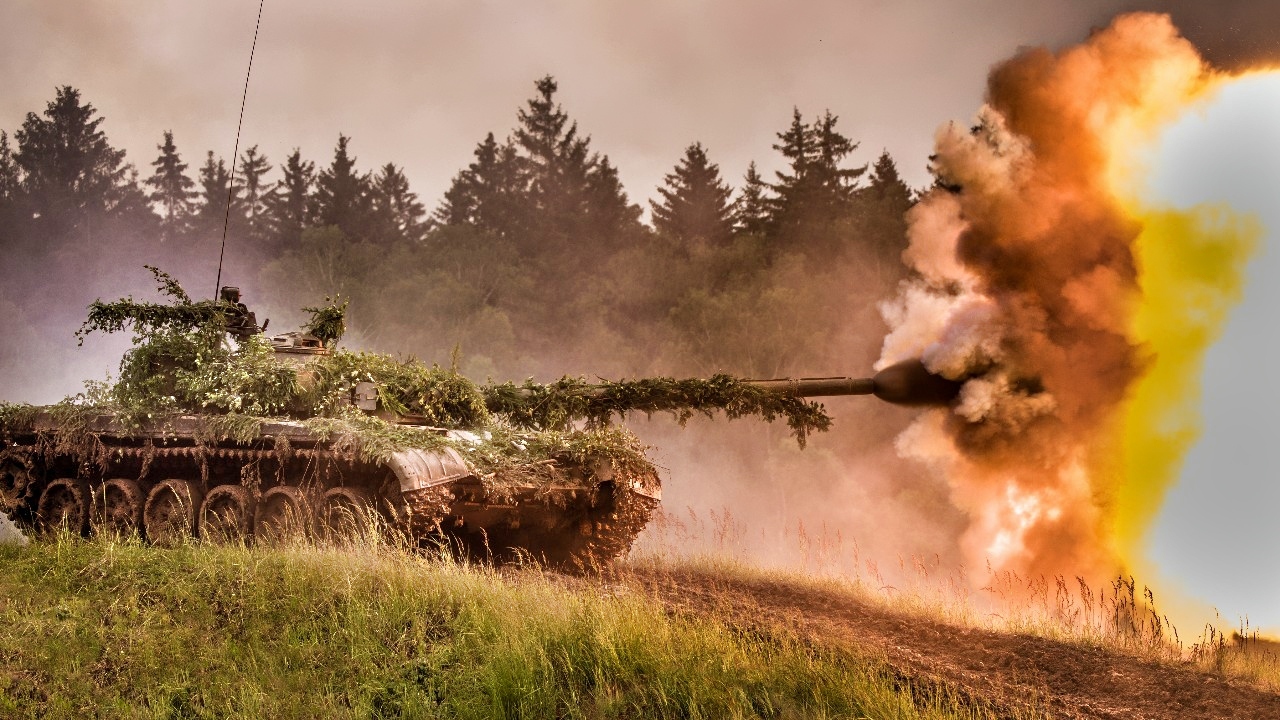
T-72 Like Those Fighting in Ukraine.
-He gave Russia’s entire intelligence apparatus a “failing grade” and linked early battlefield paralysis to a “Tbilisi syndrome” culture of fear and over-centralized command.
-His comments suggest that fear of criticizing Vladimir Putin’s war may finally be eroding inside Russia.
The Message From Gen. Chirkin: Russia’s War in Ukraine Was Built on Lies
In a sign that the taboo over speaking out against Russian President Vladimir Putin’s war in Ukraine is cracking wide open, one of Russia’s former senior military commanders has stated that the intelligence assessments given to the Kremlin prior to the February 2022 invasion were next to worthless. Therefore, when the former KGB Lt. Col., who is now Russia’s commander-in-chief, launched his “Special Military Operation”, or SVO in its Russian acronym, Moscow was “once again unprepared” for war.
The comments came from Col. Gen. Vladimir Chirkin, a former chief commander of Russian ground forces, and are highly critical of the intelligence advisors to the Kremlin leadership. His observations are some of the most outspoken to date. Both the RBC Radio host, Yuri Tamanstev, and the broader military analyst community are shocked by the tone of his narrative.
“Russia has become, after all, a place where anyone who denounces the war, or challenged the ‘all-knowing’ Putin regime that launched it, can easily receive some visitors the next day. These people will be wearing white and will take you off to some place you would not want to visit,” said a Russian military analyst in Moscow.
Strangely, there are no reports that anyone has come to drag Chirkin out of his flat and into a “special services” van. This indicates that the fear imposed on Russians who dare criticize the military operation in Ukraine is evaporating.
Chirkin’s outspokenness also appeared to surprise his interviewer, radio host Yuri Tamantsev from RBC, one of Russia’s few remaining semi-independent news sites. “To be honest, I didn’t expect such frankness at the very beginning of our conversation,” Tamantsev said afterwards.
Misleading From The Start
The Russian intelligence community had completely misled the Kremlin about the political sentiment in Ukraine, he told Tamantsev. Chirkin blasted the Kremlin’s intelligence services in this November 27 interview, which is often regarded as infallible in the West, giving them failing marks for their performance in the early days before the Ukraine war.
In his opinion, their assessments were so flawed that they prompted an unprepared Moscow to launch its full-scale invasion under completely erroneous and false assumptions.
“Everyone, if you recall, started saying in February 2022 that the war would be over in three days,” and were boasting “we’ll beat them all now,” recalled Chirkin in the RBC interview.
Reality, as he recalled, turned out to be, as they say, “not as advertised.”
Chirkin was last in command of the ground forces from 2012 to 2013, when he was forced to step down. Even though he had been in retirement for almost a decade before the invasion, his comments are unusually critical for a top Russian military official, even among those no longer on active duty.
“But unfortunately, it didn’t work out that way. I would give our entire Russian intelligence community a failing grade,” he added. The general’s criticism of his own country’s military and intelligence services has crossed the border. This week, Ukrainian news circles highlighted Denis Kazanskyi, a Ukrainian political journalist who repeated many of Chirkin’s talking points.
Not As Advertised
These flawed predictions of how an enemy might react are more the rule than the exception, said Chirkin. Moscow, he said, has “traditionally” miscalculated the balance of power. This has historically meant that Russia underestimates the enemy’s forces, predicts a victory with great bravado, and simultaneously overestimates the performance of its own troops.
“To be fair, I don’t intend to criticize anyone, but in my opinion, Russia was once again unprepared for war, as it had been in previous years and centuries,” he said.
One of the most unforgivable failures, in his opinion, was the reports given to the Russian leadership stating that 70 per cent of Ukraine’s population would support a pro-Russian government installed by Moscow.
“It turned out to be exactly the opposite,” he explained. The Ukrainians were 30 per cent for us and 70 per cent against,” he said. “During the first few weeks [of the invasion], we were taught a ruthless lesson.”
Chirkin also described Russian forces as being paralyzed in the early stages of the invasion and falling victim to what is known as the “Tbilisi syndrome.” This term dates back to the lacklustre performance of Russia’s military in the 2008 invasion of Georgia.
It is now commonly used as shorthand for a dysfunctional command system in which troops are afraid to make tactical decisions without their superiors’ orders. In a conflict run this way, by the time a decision has received approval from above, it is usually too late.
This diagnosis has been echoed by both Western and Ukrainian assessments of the invasion’s initial failures. Russia’s military not only completely misunderstood what was required to take the Ukrainian capital, Kyiv, but also dispatched an under-equipped force of poorly maintained equipment that was almost guaranteed to fail.
The result was weeks of confusion among Moscow’s troops, hobbled by a nonexistent logistics system and a lack of air superiority, compounded by the Russian military’s complete inability to suppress Ukraine’s air defenses.
Weeks of a stalled offensive and columns of vehicles stuck on the road being hit with constant attacks from Ukraine’s territorial defense forces resulted in the Russian military being forced to withdraw from the assault. The failure of the invasion was now complete, and Moscow has not threatened the Ukrainian capital since.
So much for “victory will be ours in three days,” said the Russian military analyst.
About the Author: Reuben F. Johnson
Reuben F. Johnson has thirty-six years of experience analyzing and reporting on foreign weapons systems, defense technologies, and international arms export policy. Johnson is the Director of Research at the Casimir Pulaski Foundation. He is also a survivor of the Russian invasion of Ukraine in February 2022. He worked for years in the American defense industry as a foreign technology analyst and later as a consultant for the U.S. Department of Defense, the Departments of the Navy and Air Force, and the governments of the United Kingdom and Australia. In 2022-2023, he won two awards in a row for his defense reporting. He holds a bachelor’s degree from DePauw University and a master’s degree from Miami University in Ohio, specializing in Soviet and Russian studies. He lives in Warsaw.


