


The MiG-31 Foxhound first entered service in 1981 as a successor to the MiG-25 Foxbat.
Originally designed around one mission—defending the vast Soviet airspace from intruding US bombers and cruise missiles—the end of the Cold War could have ended the MiG-31’s career.

MiG-31 Flying High Russian Air Force. Image Credit: Creative Commons.
Instead, Russia kept the jet in service, repeatedly modernizing the platform rather than replacing it.
Today, the MiG-31 has evolved into something far different from the platform originally imagined: one of the world’s only operational hypersonic missile carriers.
Deviating from the Original Mission
The Soviet Union is massive. With 11 time zones and thousands of miles of Arctic coastline—yet only a few airfields—the Soviets had unique geographical problems and a pressing need for a unique interceptor, something that could launch quickly, fly extremely fast, patrol huge distances, and engage multiple bombers simultaneously.
The MiG-31 was not a dogfighter at all but a jet built specifically for long-range interception over Soviet airspace.
Though developed from the MiG-25, the MiG-31 was largely redesigned.
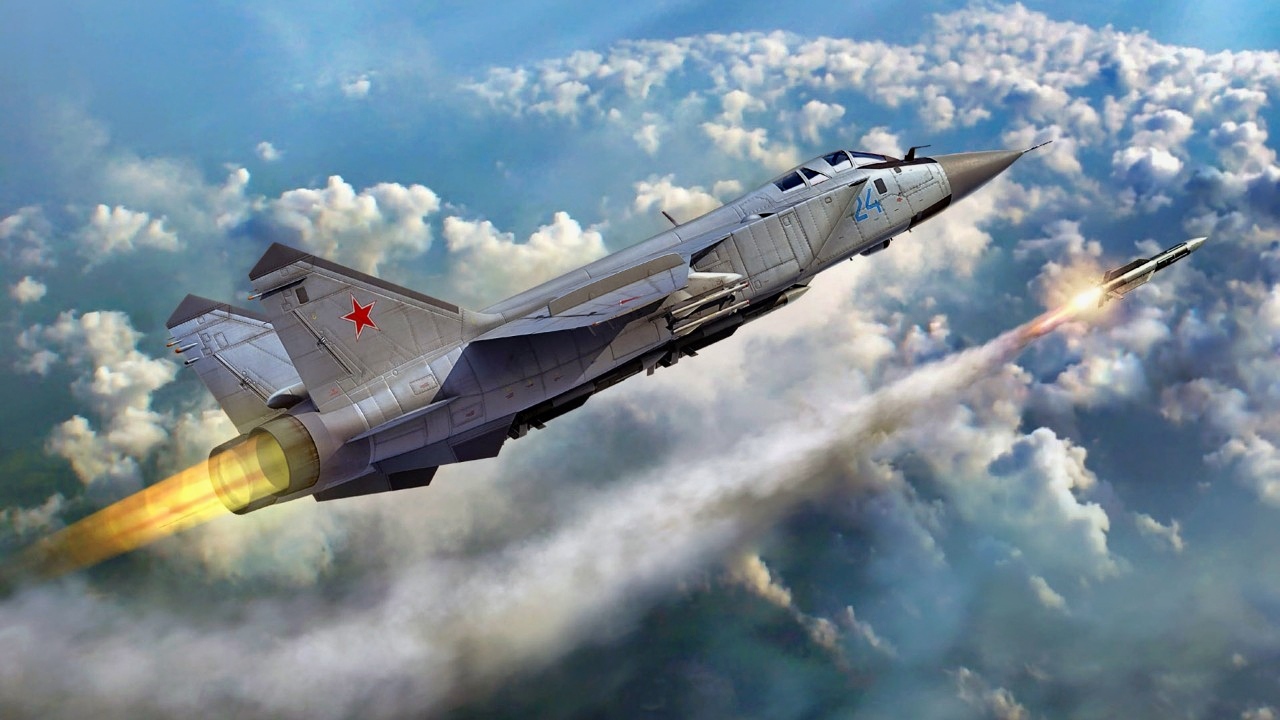
MiG-31 from Russian Air Force. Image Credit: Creative Commons.
With a new, stronger airframe, more powerful avionics, and a two-person crew (featuring a pilot and a weapons systems officer), the MiG-31 was well suited for its interception role.
Outfitted with a massive Zaslon phased-array radar, the MiG-31 served as the first operational fighter with a passive electronically scanned array (PESA) radar.
It could detect bombers hundreds of kilometers away, track multiple targets simultaneously, and guide several missiles at once.
The MiG-31 could also share targeting information with other MiG-31s, meaning four-aircraft formations could monitor enormous sectors of Soviet airspace.
Built for Speed
With a maximum speed around Mach 2.8, the MiG-31 was quite fast. Actually, the jet could briefly exceed Mach 3 (though doing so would damage the engines).
The service ceiling was a generous 65,000 feet, and with a large internal fuel capacity, the MiG-31 enjoyed a long combat radius. The high dash speeds allowed for rapid interception.
But of course, effective interception requires not just reaching intruding bombers, but killing those intruding bombers.
Accordingly, the MiG-31 was well armed. Originally, the jet was outfitted primarily with the R-33 long-range missiles, designed to destroy B-52s, B-1s, cruise missiles, and various reconnaissance aircraft.
Later, the R-33 was upgraded to the R-37M, one of the world’s longest-range air-to-air missiles with a range of roughly 200–250-plus miles depending on the profile.
Indeed, the MiG-31 excelled at beyond-visual-range engagements, with the ability to attack targets long before seeing those targets.
Rebooting the Original
The Soviets and Russians have been upgrading the MiG-31 for decades. The MiG-31B offered improved electronics, better navigation, and better radar processing, while the MiG-31BS offered a more incremental upgrade.
The MiG-31BM featured the largest modernization leap, with new mission computers, a digital cockpit, better radar processing, greater tracking capacity, the ability to employ modern precision weapons, new datalinks, and improved electronic warfare capability.
But the most significant evolution, arguably, was the MiG-31K, which removed or simplified the radar and optimized the aircraft to carry the Kh-47M2 Kinzhal hypersonic missile.
This move shifted the MiG-31 from interceptor to strategic strike platform.
Hypersonic Transformation
The Kinzhal, which weighs over 4,000 kilograms, is prohibitively heavy for most fighters. But the MiG-31, with its unique combination of speed, altitude, and payload, makes it an ideal launch platform.
The aircraft accelerates to high speeds and climbs, then the missile is launched while the jet is already moving fast and high.
This gives the Kinzhal additional launch energy, which translates to additional range and energy.
The claimed strike range is over 1,200 miles, depending on the launch profile. In effect, the MiG-31 acts as the first stage of the missile.
Strategically, the MiG-31K allows Russia to threaten command centers, logistics hubs, air bases, and ships—all from standoff distances.
This is particularly useful against NATO infrastructure, forcing adversaries to defend against a larger geographic area.
The MiG-31K has been employed during the war in Ukraine.
Kinzhal missiles have been used against infrastructure and hardened facilities, and according to Russian claims, Patriot batteries.
Operational experience has been mixed, however, with Ukraine reporting that it has intercepted some Kinzhals with the Patriot system, suggesting that hypersonic missiles are not actually invulnerable.
About the Author: Harrison Kass
Harrison Kass is a writer and attorney focused on national security, technology, and political culture. His work has appeared in Tablet, City Journal, The Hill, The Spectator, and The Cipher Brief. He holds a JD from the University of Oregon and a master’s in Global & Joint Program Studies from NYU. More at harrisonkass.com.


