

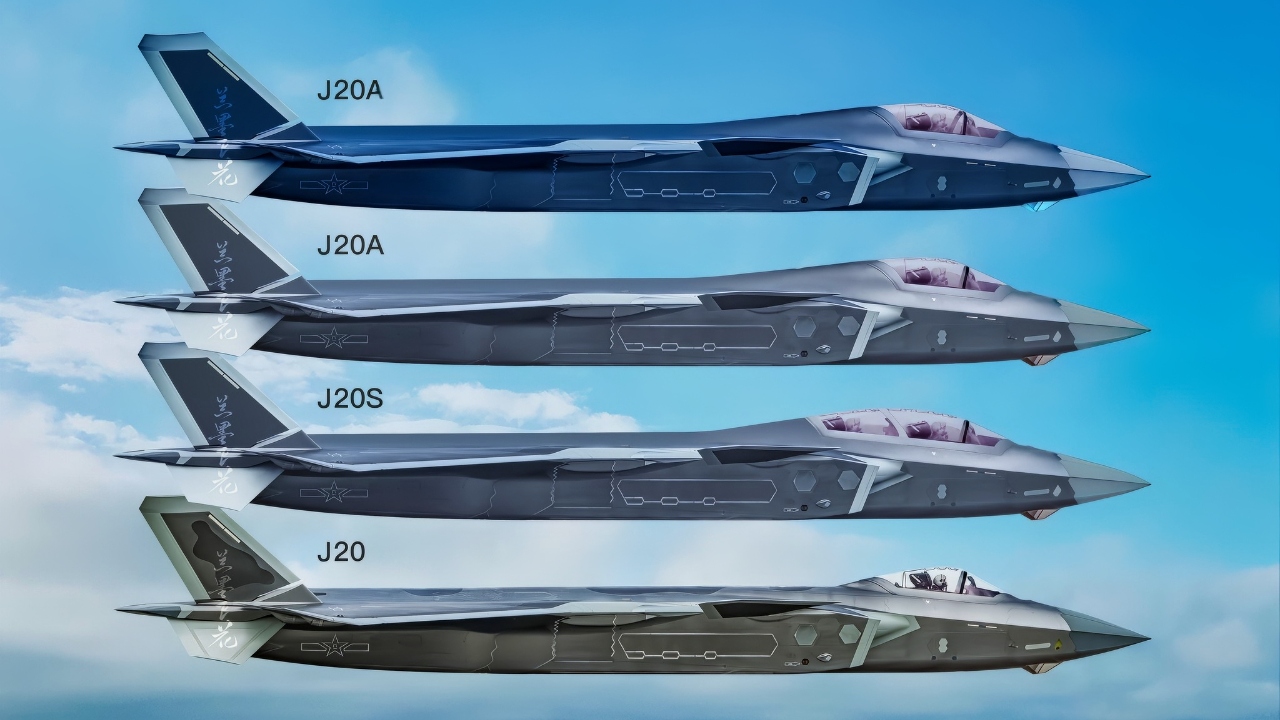
PUBLISHED on August 7, 2025, 02:58 PM EST – Key Points and Summary – Despite being a formidable fifth-generation aircraft, China’s J-20 “Mighty Dragon” has four significant weaknesses.
-The jet’s complete lack of an internal cannon for close-range combat as its “most glaring” flaw.
-Other significant issues include a history of engine reliability problems that have plagued its development, compromised stealth characteristics due to its forward canards, which increase its radar signature, and inferior maneuverability compared to its American counterparts like the F-22 and F-35.
-These flaws could put the J-20 at a distinct disadvantage in a real-world combat scenario.
The J-20 Mighty Dragon Isn’t Perfect
China’s Chengdu J-20 Weilong (“Mighty Dragon;” NATO reporting name “Fagin”) is, chronologically speaking, the third of the 5th-generation stealth fighters to achieve operational status, behind America’s F-22 Raptor and F-35 Lightning II (both of which are produced by Lockheed Martin’s famed Skunk Works division).
The “Mighty Dragon” is indeed a mighty impressive warbird in many ways, and indeed has multiple advantages over the F-22 and the F-35 alike. Among these advantages are maximum airspeed, a heavier weapons payload capacity, lower production costs, and reduced maintenance requirements.
But like any manufactured object—especially one made in a Communist country—the “Fagin” has its flaws. With that in mind, National Security Journal now examines the J-20’s four biggest weaknesses.
J-20 Weakness #1: What, What, No Gun?!?!
The J-20 is unique amongst the currently operational stealth fighters in terms of the absence of a gun; its US-made and Russian-made counterparts (the Sukhoi Su-57 “Felon” in the case of the latter country) still do, in fact, have a cannon. In this former US Air Force officer’s professional opinion, that lack of a gun is the Weilong warbird’s most glaring weakness.
Mind you, some pundits opine that cannons are outmoded and obsolete for supersonic jet fighters, and granted, history’s last recorded supersonic air-to-air gun kill took place way back on 2 June 1972, during the Vietnam War. (The feat was pulled off by an American McDonnell Douglas F-4E Phantom II against a North Vietnamese MiG-19 “Farmer, and the winning fighter pilot was USAF Col. Phil “Hands” Handley.)
Still, though, there’s something to be said about the philosophy of “Better to have and not need than vice versa,” especially if and when a fighter runs out of air-to-air missiles before the fight is over! Aircraft-mounted guns have continued to prove their usefulness in other combat applications, particularly against adversaries’ unmanned aerial weapons systems. Case in point: on 13 December 2024, a Ukrainian Air Force F-16 pilot became a national hero when he shot down six Russian cruise missiles in a single sortie; two of those kills were in fact obtained with the Fighting Falcon’s General Dynamics M61A1 Vulcan 20mm Gatling gun.
What’s more, a fixed-wing jet fighter could still conceivably use its gun in the air-to-ground role, such as strafing enemy troop formations whilst performing close air support (CAS) duties. The J-20 inherently lacks this sort of versatility. To put it another way, the “Mighty Dragon” may be a fire-breathing beast in the figurative sense, but it doesn’t breathe gunfire in the literal sense.
J-20 Weakness #2: Engine Reliability Issues
As Peter Suciu elaborates, “When it [the J-20] was introduced it relied on the Russian-produced AL-31F engines, though earlier in January [2021], Beijing announced that it would cease using those imported engines in favor of an upgraded and domestically-produced WS-10C engine, a modified version of the WS-10…The decision to go with the WS-10C also came about due to failures with China’s own WS-15 engines, which proved unreliable in its final evaluation in 2019.”
Weakness #3: Compromised Stealth Capabilities
Compared with the Raptor and the Lightning II, the “Fagin” has poorer stealth characteristics. Presumably, this is mainly due to the canards—smaller wings (lift providing horizontal surfaces) mounted forward of the aircraft’s main wings—on the Chinese warbird, which increase its radar cross section (RCS) and therefore make it comparatively easier to detect from beyond visual range (BVR).
J-20 Weakness #4: Less Maneuverable
The Chengdu plane is less maneuverable than either of its Lockheed Martin adversaries, which, combined with the aforementioned lack of a cannon, could be a distinct disadvantage in a tight-turning, rapidly unfolding, short-distance dogfight (there’s no guarantee that all future air-to-air combat will be limited strictly to BVR distances).
As an anonymous author wrote in a 17 October 2021 article for Global Defense Corp, “Analyzing the flights of the J-20 at the air show, experts note that the fighter ‘clearly lacks dynamics.’ In flight, the plane does not demonstrate super-manoeuvrability flight characteristics, especially when performing aerobatics … The aerobatics are selected in such a way that the problems with their implementation are not striking. And these flights were also carried out without a payload.”
The airshow in question was the 13th China International Aviation and Aerospace Exhibition, AKA Airshow China 2021.
About the Author: Christian D. Orr, Defense Expert
Christian D. Orr is a Senior Defense Editor. He is a former Air Force Security Forces officer, Federal law enforcement officer, and private military contractor (with assignments worked in Iraq, the United Arab Emirates, Kosovo, Japan, Germany, and the Pentagon). Chris holds a B.A. in International Relations from the University of Southern California (USC) and an M.A. in Intelligence Studies (concentration in Terrorism Studies) from American Military University (AMU).
Military Problems
No F/A-XX Fighter? Say Goodbye to the Aircraft Carrier


Ehud Gavron
August 8, 2025 at 3:07 pm
Vietnam was half a century ago, and BVR mean guns are of no value. It’s not better to have and not need than need and not have if you don’t give up cubic feet and pounds of carriage.
You can’t turn any supersonic BVR stealth fighter into an A-10 or an AC-130J so let’s leave ground (random) strafing to the aircraft that do it best.
That leaves the engines. I have no trust that we don’t have the full picture. Likely they are NOT as good as the PW F-135 but we won’t know until there’s a dogfight — which is as not likely.
Finally, yes, a Ukranian pilot using a Goodwill Industries F-16 shot down some cruise missiles. Great job. But knowing WHICH missiles operating in what trajectory type (ballistic? straight? arc?) and speed (subsonic, supersonic, hypersonic) would halp turn this anecdote into data.
Statistics are made with data, not grampa’s tales next to the fire.
Decent overview but a better review with respect to BVR expectations (something new on the battlefield) would suggest the “unknown engine deficit” is the only definite issue.
Also can I get chopsticks with that?