

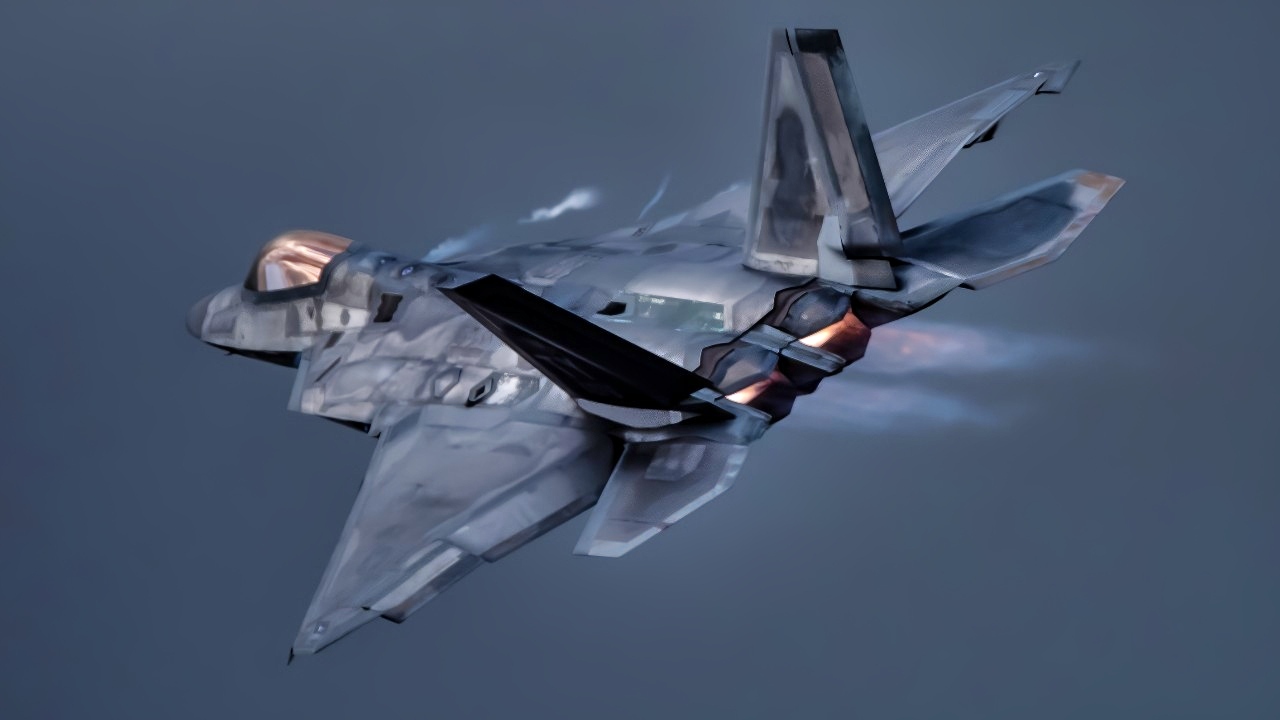
Key Points and Summary – The F-22 Raptor, considered the world’s best dogfighter (and some say best fighter ever, too), is operated exclusively by the U.S. Air Force despite high demand from allies.
-The reason it was never exported is a 1998 congressional law known as the Obey Amendment, which explicitly banned its sale to any foreign government.
-This measure was enacted to protect the F-22’s revolutionary and highly classified technology, particularly its unmatched stealth capabilities.
-Citing fears of reverse engineering by China and potential leaks from allied nations, the U.S. government chose to keep the pinnacle of its aircraft technology an American-only asset.
Why The F-22 Was Never Exported To US Allies
The US Air Force’s F-22 Raptor program was the most expensive and most advanced fighter in the world – some say the best raw fighter ever.
Although some say it was eclipsed only by the USAF’s fifth-generation system, the F-35.
However, even today, the Lockheed Martin F-22 Raptor, a fifth-generation stealth fighter, remains considered the best dogfighter in the world, and its stealth capabilities are still unmatched; the radar signature of a Raptor is approximately the size of a large insect. It was the absolute pinnacle of American aircraft technology.
And naturally, many of our allies wanted a contract allowing them to purchase the Raptor. And many other US-manufactured aircraft are sold to allied foreign governments. The F-16 has been widely sold to US allies and partners, and the F-35 has been sold to a host of nations, giving the US and allies the interoperability that is needed in coalition warfare.
But the F-22 was different; it is solely operated by the United States Air Force (USAF), which has 183 aircraft in its inventory across various air commands. So, why did the US never export the F-22 Raptor to foreign allies?
F-22, “Cannot Be Matched”
The Air Force was looking to replace the F-15 Eagle with a next-generation stealth fighter that would last into the 2040s.
The F-22 Raptor was the first fifth-generation stealth fighter that combined advanced technology, such as stealth, sensor fusion to produce superb situational awareness, and an airframe that is highly maneuverable and can supercruise at more than 1,200 mph without the use of afterburners.
The Raptor’s thrust vectoring technology gave it unmatched maneuverability in a dog-fighting role. The aircraft’s two powerful engines, each with 70,000 pounds of thrust, had specially designed nozzles that could allow the aircraft to make high-G-force turns quickly by vectoring the nozzles.
The Raptor was operational with the Air Force in 2005, and at the time, the service was quite optimistic about the aircraft.
“The F-22, a critical component of the Global Strike Task Force, is designed to project air dominance, rapidly and at great distances, and defeat threats attempting to deny access to our nation’s Air Force, Army, Navy, and Marine Corps. The F-22 cannot be matched by any known or projected fighter aircraft.”
The Raptor Was Full Of Classified Technology
The F-22 Raptor is distinguished by its exceptional stealth, a central asset in modern conflicts. Its radar cross-section (RCS) is estimated at 0.0001 square meters, compared to 0.1 square meters for the F-35.
This capacity relies on advanced composite materials and a geometry designed to deflect radar waves. The United States has invested heavily in these technologies, with an initial development cost exceeding 62 billion dollars at the time.
China Purchased Shot-Down F-117 Debris For Reverse Engineering
No other country had stealth technology at the time; Russia and China were working on stealth properties, and the US feared reverse engineering, which was realized after an F-117 stealth fighter was shot down in Serbia. China purchased debris from the aircraft. The Chinese J-20 was developed in response to this.
The US feared leaking such advanced technology, such as its sensors, such as the AN/APG-77 active electronically scanned array radar, as well as its stealth, to our enemies. Israel was given plans for the F-16, which they used for their Lavi fighter platform, but the project was ultimately canceled. Israel sold related technologies to China. The Chinese-manufactured J-10 is a capable fighter that is essentially a F-16 clone.
The US was wary of allies that later became non-allies. Iran purchased F-14s while the Shah was in power. And until June of this year, it still operated a handful. Venezuela, an ally in the 1980s, was sold F-16s, which still protect its borders.
Congress Bans Sale Of F-22
In 1998, Congress adopted the Obey Amendment, explicitly banning the export of the F-22. This measure was aimed at protecting critical technologies in the face of the growing power of China and Russia.
Congressman Dave Obey worried that the F-22’s stealth technology would end up in the hands of China or Russia if sold to allies, especially Israel.
He was worried the Israelis would leak US tech to China, the way American intelligence believes Israel aided China in the development of its J-10 fighter.
Congress stated, “None of the funds made available in this Act may be used to approve or license the sale of F-22 advanced tactical fighter to any foreign government.”
The US decided at that time to grant complete autonomy to the F-22. And keep the technology to itself. The only issue with that was that they didn’t make enough of them.
About the Author: Steve Balestrieri
Steve Balestrieri is a National Security Columnist. He served as a US Army Special Forces NCO and Warrant Officer. In addition to writing on defense, he covers the NFL for PatsFans.com and is a member of the Pro Football Writers of America (PFWA). His work was regularly featured in many military publications.
Hypersonic Weapons In-Depth
Russia’s Hypersonic Missiles Summed Up in 4 Words


james b
August 1, 2025 at 4:16 pm
” Israel was given plans for the F-16, which they used for their Lavi fighter platform, but the project was ultimately canceled. Israel sold related technologies to China. “…….never to be trusted.
Tindmish
August 1, 2025 at 5:28 pm
There’s ample evidence f-22 never is the amazing fighter so greatly hyped out to be.
Reports arose briefly in 2007, very greatly suppressed by ALL sides, spoke of one f-22 brought down over Zhejiang province by a Chinese fighter.
It was said at the time that the US Pacific forces commanders were so confident of the f-22’s, abilities, they flew an f-22 in BROAD DAYLIGHT over the Chinese coast.
However, the plane was detected and spotted, and eventually brought down.
Hence, the f-22 production was stopped by Robert gates in 2009.
Why else, would he cease production if the plane was so good.
It actually wasn’t anywhere that good as proven by the Chinese. Just two years earlier.
Even today, supposing there’s a actual low level occasional bust-up between the PLAAF and Pacific forces, f-22 wouldn’t figure in it.
Why.
F-22 would be able to fight for the first day or first two days, and then, and then, retire permanently for eternity to the states for major overhaul and maintenance. Heh !
Norman Gregory Koch
August 3, 2025 at 2:27 pm
There needs to be an investigation into the theft of the F-22 production line and tooling from the military base it was warehoused at. The greatest heist in American history and no one seems to care. This is unacceptable.