

Key Points and Summary – Recent U.S. troop and contractor deaths in Syria highlight a mission that no longer matches America’s core strategic interests.
-The regional balance of power is now driven by Turkey, Israel, Iran, Saudi Arabia, and the UAE, whose competing ambitions collectively prevent any single hegemon from dominating the Levant.
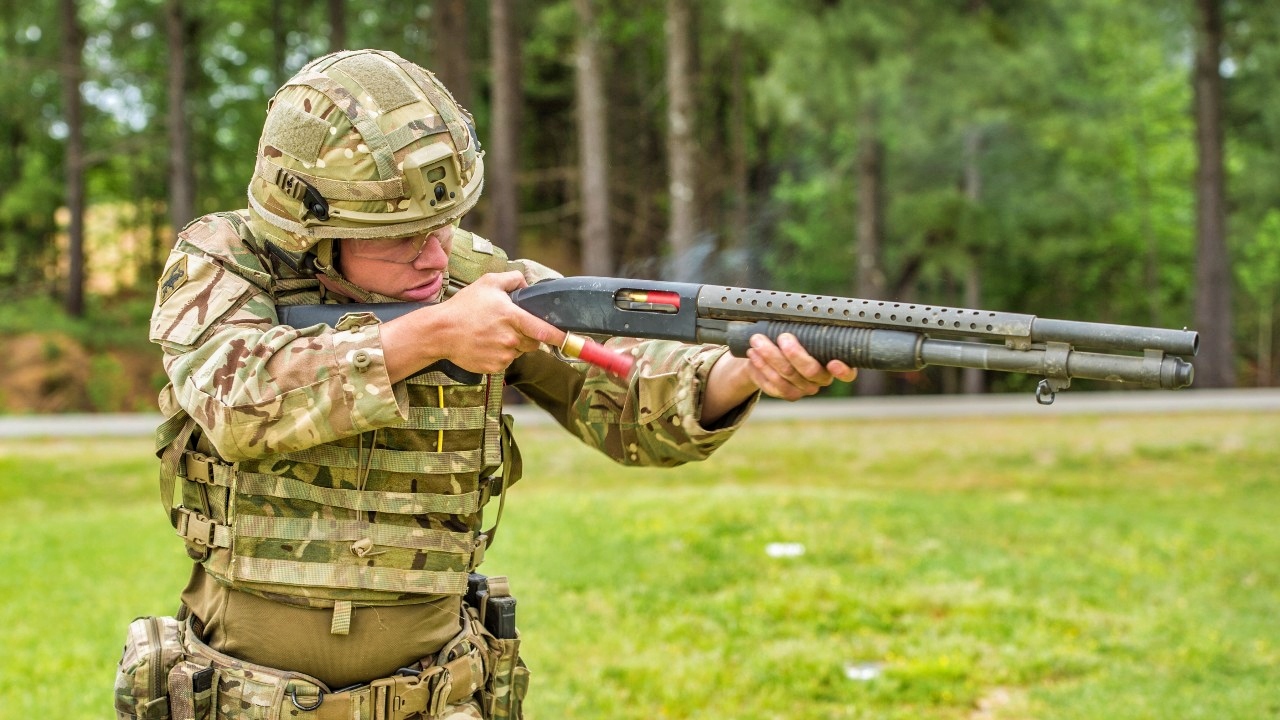
British Royal Air Force Regiment troop cycles M500 Shotgun at the Winston P. Wilson (WPW) and 27th Armed Forces Skill at Arms Meet (AFSAM) at Robinson Maneuver Training Center, Ark, 2018. The annual events, hosted by the National Guard Marksmanship Training Center (NGMTC), offer Servicemembers from the National Guard and international community an opportunity to test marksmanship skills in a battle-focused environment.
-Their friction—Turkish limits on Iran and Russia, Israeli strikes on Iranian assets, and Gulf resistance to Tehran’s influence—creates a self-reinforcing equilibrium that does not depend on a small, exposed U.S. ground presence.
-Washington can protect its interests through diplomacy, intelligence, and partnerships, freeing resources for real great-power contests in Europe and the Indo-Pacific.
What Is American Forces Still Doing in Syria?
The deaths of American troops and contractors in Syria recently reveal the fragility of an operation that has long since lost strategic coherence. What these tragic killings reveal is a gap in the regional balance of power.
From the vantage point of great-power competition, Washington does not need boots on the ground in Syria to secure US-favorable outcomes. The major powers of the region—Turkey, Israel, Iran, Saudi Arabia, and the United Arab Emirates—are already pursuing their own interests in ways that collectively frustrate any single actor’s ability to consolidate hegemony over the Levant.
Taken together, their interactions create an emerging balance of power that, if hardly tidy, reinforces the United States’ minimal but enduring strategic interests: keeping the Middle East fragmented rather than consolidated under a hostile power; blocking the emergence of a regional hegemon; and ensuring that the Middle East cannot be weaponized to coerce the global system.
Turkey’s Self-Interested Constraints on Iran and Russia
Turkey is a large part of this equation. Formally, it remains a US ally, but in practice now follows a grand strategy shaped by multialignment and what many describe as “neo-Ottomanism.” Whatever Ankara’s motives, the effect of its intervention in northern Syria has been to hem in both Iran and Russia along a frontier it considers vital to its security. Turkey’s rivalry with Iran in this space is hardly aligned with American preferences, yet it still constrains Tehran’s ability to project power westward.

An AH-64 “Apache” attack helicopter assigned to 1st Battalion, 211th Aviation Regiment, flies overhead during Training Exercise Hydra on Utah Test and Training Range, Utah, May 7, 2025. Exercise Hydra is a Utah National Guard-led, joint, multi-domain combat training exercise designed to simulate real-world operations across air, land, and cyber domains. The exercise brings together the 151st Wing (KC-135), 419th Fighter Wing (F-35), 19th Special Forces Group, 65th Field Artillery Brigade, and multiple Army and Air Force elements to test joint targeting, rapid insertion, battlefield communication, and dynamic problem-solving.
(Utah Army National Guard photo taken by Spc. Dustin B. Smith)
Turkey’s more complicated relationship with Russia—one marked by cooperation in some spheres, conflict in others—produces a similar effect on Moscow’s position in Syria, keeping it conditional rather than absolute. Ankara checks both powers for its own reasons, but in doing so, it contributes to an environment in which no single external actor can easily consolidate control.
Israel’s Unilateral Check on Iran
Israel compounds that trend from a different angle. Its campaign to contain and degrade Iranian military capabilities in Syria has been consistent and unrelenting for more than a decade, and independent of Washington’s tactical position on the ground. Israel does not need US forces in Syria to conduct these operations; it has the intelligence and airpower to do it on its own.
This unilateral capacity has raised the costs and lowered the survivability of Iranian entrenchment in Syria. For US strategy, what matters is not the diplomatic choreography surrounding these strikes but their structural effect: Iran’s attempt to use Syria as dependable strategic depth faces persistent, credible military disruption.
Iran’s Influence—Significant but Contested
Iran itself is not an inconsiderable player in this competition, but its position inside Syria reflects a constant negotiation among other powerful states rather than an unimpeded march eastward. Tehran works through proxies and local partners, but its influence is contested by Israeli operations, Turkish territorial objectives, and Russian interest in remaining the dominant external power in Damascus.
These forces do not coordinate against Iran, but they intersect in ways that impose limits on Tehran’s freedom of action. The result is a pattern of interaction in which Iran is influential but subject to meaningful pushback from multiple directions.
Gulf States as Stabilizers of the Wider Environment
The Gulf states add another layer of complexity to this interaction. Saudi Arabia and the United Arab Emirates have long since backed away from direct attempts to shape the battlefield in Syria. However, their regional posture still restricts Iran’s ability to convert gains in Syria into broader regional influence.
Their intelligence sharing with Western partners, their continued wariness of Iran’s regional intentions, and their capacity to underwrite political and economic alternatives to Iranian influence in places like Iraq and Lebanon ensure that Tehran’s reach is contested on multiple fronts.
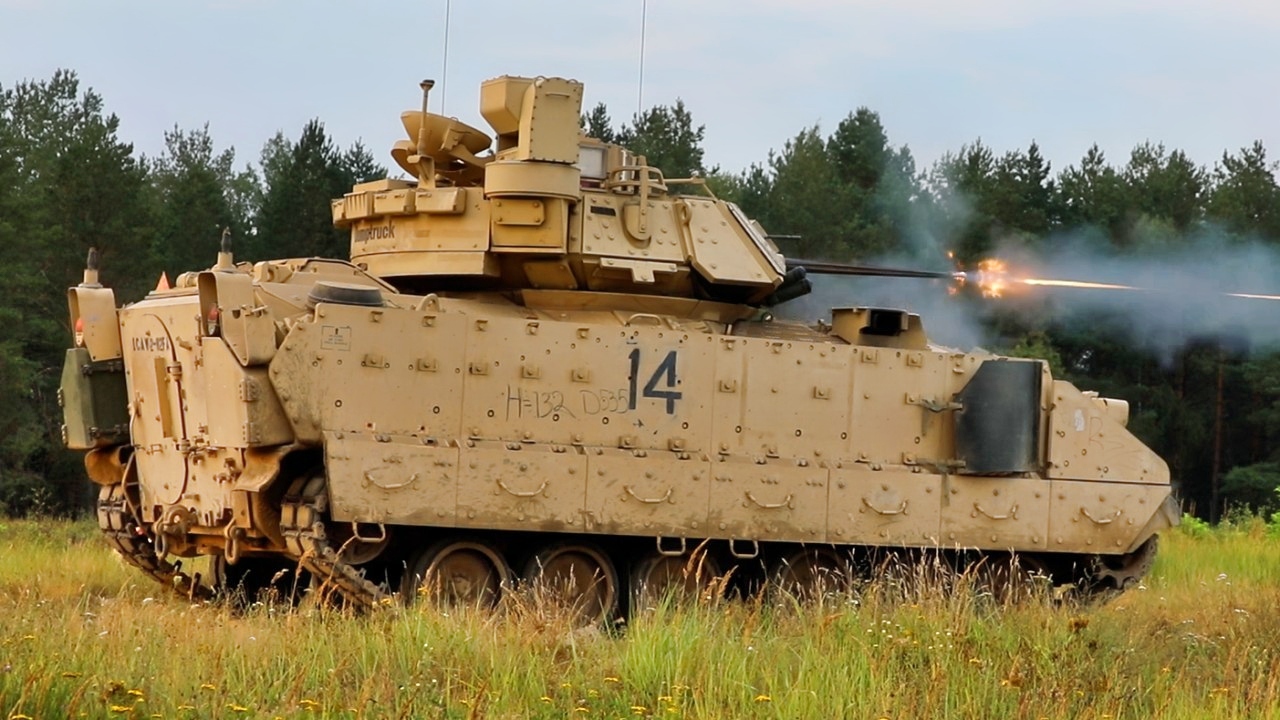
Troopers with 3rd Armored Brigade Combat Team, 1st Cavalry Division firing the 25mm canon on a Bradley fighting vehicle in order to zero the vehicles weapons systems at a range in Poland. Ranges such as these familiarize troopers with the vehicles systems in order to ensure combat readiness. US Army Photo.
Saudi and Emirati policies are a product of their own perceived interests, not American direction. Yet, the states’ strategic incentives often converge with Washington’s objective of preventing Iran from securing a dominant regional position.
A Self-Reinforcing Balance That Does Not Rely on U.S. Troops
Seen in this light, the Syria dynamic is less the consequence of U.S. management than the product of self-interested behavior by regional powers. None of the states involved is individually powerful enough to enforce an order on its own terms. Each is, however, simultaneously strong and sufficiently threatened to push back against the encroachments of others.
The result is a pattern of interaction that is hardly elegant, but stable in the way that multipolar systems often are: equilibrium emerges not from coordination but from friction. In this kind of environment, a small U.S. ground presence in Syria is a marginal part of the underlying balance and a needless exposure of Americans to risks that yield no meaningful strategic return.
What Washington’s Interests Actually Require
Washington’s core interest in the Middle East has always been limited: to prevent the emergence of a hostile hegemon and to ensure that regional conflicts do not distort the global distribution of power. Today, neither outcome depends on U.S. troops patrolling the Euphrates River Valley.
Washington can maintain a diplomatic presence, an intelligence footprint, and a network of partnerships with regional actors without tying its strategic credibility to a set of exposed and vulnerable outposts. Indeed, the ability to shed missions that no longer meaningfully influence great-power alignments is a prerequisite for focusing American resources where they matter most: in the Indo-Pacific and Europe, where peer competitors have the capacity actually to shape the international system.
Why Leaving Would Strengthen U.S. Strategy
The deaths of American service members in Syria will always be tragic, but they should not be reflexively interpreted as evidence that the United States has to stay. From a strategic perspective, the Middle East already exhibits a pattern of interaction among regional powers that collectively frustrates any single actor’s ability to consolidate power.
That balance is rough, and often violent, but it is also self-reinforcing. In such an environment, the continued U.S. military presence in Syria is not what stabilizes the region. It is what keeps the United States mired in a theater that no longer determines the global balance of power.
The more honest conclusion is also the more restrained one: Syria does not need an American garrison to produce outcomes compatible with U.S. interests.
The region, for once, shows signs of doing that on its own.
About the Author: Dr. Andrew Latham
Andrew Latham is a non-resident fellow at Defense Priorities and a professor of international relations and political theory at Macalester College in Saint Paul, MN. You can follow him on X: @aakatham.


David Caiin
December 16, 2025 at 11:47 am
Insightful article describing the self-reinforcing balance of countries of the region. The US would do well to promote this concept in other regions. This would be especially appropriate in Europe, where the US Congress in its infinite wisdom deems a presence of 67,000 American soldiers to be justified and essential. Presumably this force is aimed as a deterrent against Russia. European NATO population is about 850 million versus 144 million Russians. EU GDP is $19 trillion versus $2.5 trillion Russian GDP. If the Europeans cannot fend for themselves now, then when? A regional self-reinforcing balance would be good for both Europe and the US taxpayer.
It is wasteful and nonsensical for the Iowa National Guard to ever be on patrol in dusty streets of other countries. Approximately 99% of America’s problems are swirling inside this country. They are complicated and daunting. The American people are divided and confused, probably more than any time sine the Civil War. We presently have no solution to the disunity corroding our society. The fault, Dear Brutus, lies not in Syria, but in ourselves.