


Landing a fixed-wing aircraft on an aircraft carrier is one of the most demanding procedures in all of aviation. The aircraft is arriving at 130 to 150 knots while the ship is moving at 25 to 30 knots into the wind. A modern supercarrier’s flight deck is about 1,000 feet long but the usable landing area is far shorter, compared to roughly 10,000 feet for a standard Air Force runway. The pilot does not flare — the aircraft is flown directly onto the deck and the tail hook catches an arresting wire. The aircraft decelerates from 140 knots to zero in a few hundred feet, guided in by the Fresnel Lens Optical Landing System — the meatball.
Aircraft Carrier Landings Are Not For the Faint of Heart

A U.S. Sailor, assigned to Airborne Command and Control Squadron 124, signals the launch of a Carrier Air Wing 8 E-2D Hawkeye aircraft on the flight deck of the world’s largest aircraft carrier, Ford-class aircraft carrier USS Gerald R. Ford (CVN 78), while underway in the Caribbean Sea, Nov. 29, 2025. U.S. military forces are deployed to the U.S. Southern Command area of responsibility in support of Operation SOUTHERN SPEAR, Department of War-directed operations, and the president’s priorities to disrupt illicit drug trafficking and protect the homeland. (U.S. Navy photo)

A U.S. Sailor inspects an aircraft catapult launch track on the flight deck of the world’s largest aircraft carrier, Ford-class aircraft carrier USS Gerald R. Ford (CVN 78), while underway in the Caribbean Sea, Nov. 25, 2025. U.S. military forces are deployed to the U.S. Southern Command area of responsibility in support of Operation SOUTHERN SPEAR, Department of War-directed operations, and the president’s priorities to disrupt illicit drug trafficking and protect the homeland. (U.S. Navy photo)
A U.S. Sailor assigned to Strike Fighter Squadron 37 signals to arm ordnance in an F/A-18E Super Hornet aircraft on the flight deck of the world’s largest aircraft carrier, Ford-class aircraft carrier USS Gerald R. Ford (CVN 78), while underway in the Caribbean Sea, Nov. 30, 2025. U.S. military forces are deployed to the U.S. Southern Command area of responsibility in support of Operation SOUTHERN SPEAR, Department of War-directed operations, and the president’s priorities to disrupt illicit drug trafficking and protect the homeland. (U.S. Navy photo)
Landing on an aircraft carrier is generally described as a controlled crash onto a moving ship with a short runway and a pitching deck.
While a modern supercarrier features a roughly 1,000-foot-long flight deck, the usable landing area is far shorter.
By comparison, a normal Air Force base runway might measure about 10,000 feet long, or roughly two miles.
Landing on a carrier is compounded by the fact that the aircraft is typically arriving at 130–150 knots, while the ship is moving at 25–30 knots into the wind. The core challenge is to align with the angled deck, maintain a precise glide path, and catch the arresting wire.
The demands of precision flying, ship timing, and controlled violence are unique in the world of aviation.
Entering the Pattern
To return to the carrier, an aircraft joins a marshal stack or recovery pattern.
Not unlike landing at a fixed airbase, the pilot receives relevant airfield information—in this case, the ship’s position, weather, deck status, and expected recovery time.
The aircraft is configured for landing, with gear down, flaps down, and tail hook down.
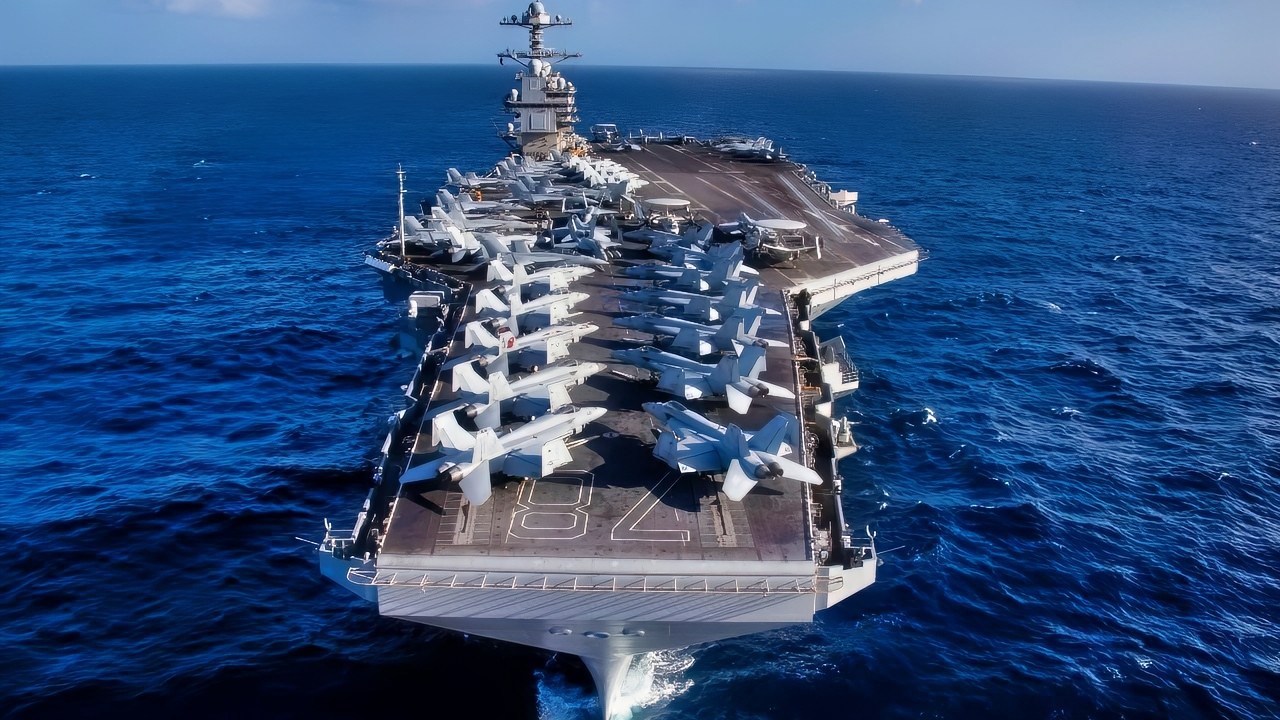
USS Gerald R. Ford Aircraft Carrier At Sea. Image Credit: U.S. Navy.
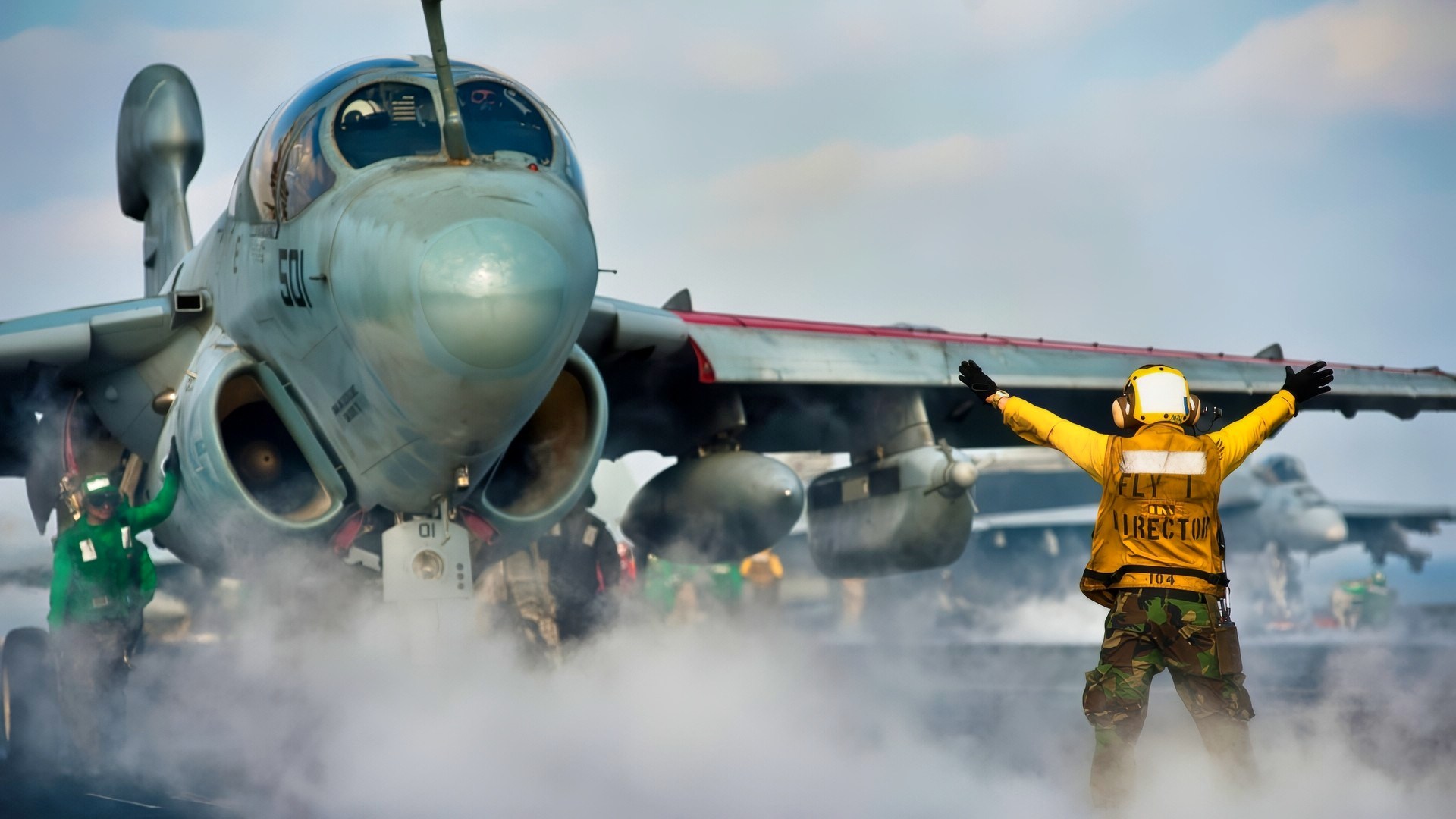
Aircraft Carrier Ops. Image Credit: Creative Commons.

Navy Aircraft Carrier from Above. Image Credit: Creative Commons.
Again, this is standard relative to landing at a fixed base, aside from the tail hook, which is unique to naval aircraft. Before landing, the pilot checks the fuel, confirming enough remains for the approach, bolter, and, if necessary, a divert option.
Then, the pilot enters the carrier landing pattern, usually a left-hand oval around the ship.
The Break and Downwind
The pilot flies overhead of the carrier, then executes a sharp descending turn known as a “break” maneuver.
This slows the aircraft, enters the landing pattern, and builds spacing behind the aircraft ahead.
The landing aircraft then enters the downwind leg, parallel to the ship, opposite to the landing direction—again, very similar to landing at a fixed runway.
The pilot confirms that the aircraft is configured for landing (hook down, gear down, flaps set, angle of attack, etc.). All the while, an LSO is monitoring the aircraft from the carrier.
On Final
The pilot begins the final turn around 180 degrees from the landing heading with the objective of rolling out in alignment with the angled deck.
The deck is angled away from the ship’s centerline; this allows for a missed landing without hitting parked aircraft.
Finally, the pilot manages bank angle, descent rate, airspeed, and angle of attack. If the pilot is too tight, they will overshoot the centerline; if they are too wide, they will undershoot the centerline. This is where margins are unforgiving and small errors compound fast.
Here, the pilot uses the Fresnel Lens Optical Landing System, or “meatball,” which indicates whether the aircraft is too high, too low, or on the glide path. The basic rule is that if the aircraft is high, reduce power; if the ball is low, add power. As usual, when landing an aircraft, power—not nose pitch—is used for glide path corrections.
When landing, pilots are concerned not only with their airspeed but also with their angle of attack.
Flying the correct angle of attack (the angle between the wing chord and the relative wind) is vital because it ensures the aircraft reaches the deck at the proper altitude.
A high AOA creates a stall risk and leads to a hard sink rate; a low AOA could result in missing the arresting wires or in excessive landing energy. So the aircraft must not only arrive at the right place, but also with the right attitude.
Touching Down
Unlike landing on a runway, the pilot does not flare; the aircraft is flown directly onto the deck.
A flare could cause the aircraft to float over the wires, so the aircraft’s descent rate is much higher than a land-based landing.
This is why naval aircraft have massively reinforced landing gear—to manage the vast energy of smashing down onto the flight deck without a flare.
When the aircraft strikes the deck, the tail hook tries to catch one of the arresting wires, which then pulls the aircraft to an abrupt stop (the aircraft decelerates from 140 knots to zero in just a few hundred feet, pushing the pilot hard into their seat straps).
The stopping motion is violent, far unlike landing at a fixed base, where rollouts can last up to 2 miles.
Executing a successful landing requires precision, trust in systems, discipline, and constant readiness for failure.
Pilots must fly an exact AOA, track the meatball, maintain their lineup, hit the deck without a flare, and snag the tail hook on an arresting wire.
Accordingly, landing on an aircraft carrier is one of the most difficult procedures in aviation.
MORE – China Has Thousands of Missiles to Point at Navy Aircraft Carriers
MORE – Canada’s F-35 Purchase Could Get Squashed
About the Author: Harrison Kass
Harrison Kass is a writer and attorney focused on national security, technology, and political culture. His work has appeared in City Journal, The Hill, Quillette, The Spectator, and The Cipher Brief. He holds a JD from the University of Oregon and a master’s in Global & Joint Program Studies from NYU. More at harrisonkass.com.


